
POWER
-
 Legal & Regulatory
Hybrid generation markets endanger competition and innovation
Competition in power generation fosters technical innovation, cleaner power plants, and downward pressure on prices. Before the 1980s, such competition was almost nonexistent: vertically integrated utilities built and operated the vast majority of U.S. plants with oversight by state regulators. The Public Utility Regulatory Policies Act of 1978 and the Energy Policy Act of 1992 […]
-
 Gas
GasDesigning HRSGs for cycling
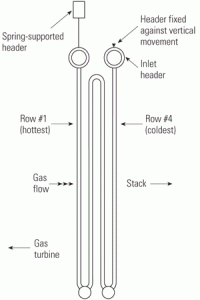
With U.S. combined-cycle plants increasingly being cycled—rather than being run continuously, as they were designed to do—owner/operators worry that units expected to last two or three decades may survive only a few years without an expensive overhaul. Cycling takes as much of a toll on heat-recovery steam generators as it does on gas turbines. Whether you’re procuring a new HRSG or adapting an existing one for cycling service, robust design features should be what you’re looking for.
-
News
Poor Priorities
I couldn’t help but marvel at the synchronicity of two unrelated events over the past few weeks. The first, on January 12, was the rare cancellation of a major military acquisition program with problems called "too expensive to fix." It takes an Act of Congress to kill most military contracts due to the pork flowing […]
-
 Coal
CoalStressed merchant industry hopes for better days
The U.S. power generation industry is changing at warp speed, via regulatory changes, consolidation, mergers, and sales of assets at yard-sale prices. New players have entered the market and become major players overnight, while several mainstays have gone bankrupt. Though many of the latter blamed high gas prices for their woes, well-diversified merchants enjoyed a record year. Whatever changes are in store for the business of combined-cycle generation, you can be sure that innovations in plant design and O&M such as those described in this special section will keep pace with them.
-
 News
NewsEnvironmental quandary shuts Mohave plant
Southern California Edison (SCE, Rosemead, Calif.) closed the 1,580-MW coal-fired Mohave Generating Station in Laughlin, Nev., on December 31. In a filing with the California Public Utilities Commission (CPUC), SCE said it expects the plant to remain off-line for four years—the time it will take for the utility and the plant’s other owners to battle […]
-
 Gas
GasFluid dynamics of the HRSG gas side
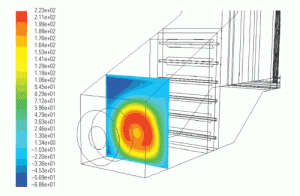
Designers of heat-recovery steam generators are using computational fluid dynamics software as one tool to reveal the invisible forces affecting the flow over, under, around, and through structures such as inlet ducts, distribution grids, and guide vanes.
-
 Coal
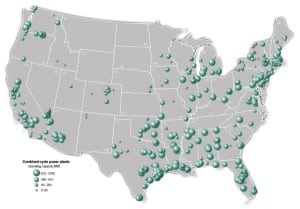
CoalMap: Combined-cycle plants constitute about 20% of U.S. generating capacity
Copyright 2006 Platts, a Division of the McGraw-Hill Companies. All rights reserved. 800-PLATTS-8. Data Source: Platts Energy Advantage www.maps.platts.com
-
 News
NewsFluor completes Texas project
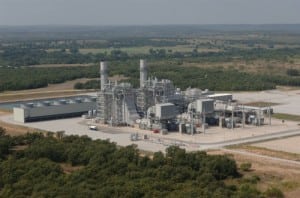
Fluor Corp. (Aliso Viejo, Calif.) has finished building and commissioning the 620-MW Jack County power plant (Figure 2) near Jacksboro, Texas, for Waco-based Brazos Electric Cooperative Inc. The natural gas–fired, combined-cycle plant officially came on-line on February 1. 2. Texas 2 x 1 step. The gas-fired, 620-MW, combined-cycle Jack County Generation Plant was built and […]
-
 Coal
CoalDesigning wet duct/stack systems for coal-fired plants
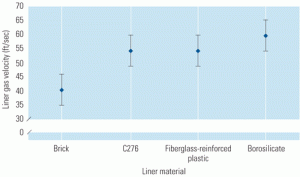
A multitude of variables must be accounted for during the design and development of a wet-stack flue gas desulfurization system. The five-phase process detailed below has proven effective on more than 60 wet-stack system design studies. A basic understanding of these concepts will help inform early design decisions and produce a system amenable to wet operation.
-
 Coal
CoalDesigning HRSG desuperheaters for performance and reliability
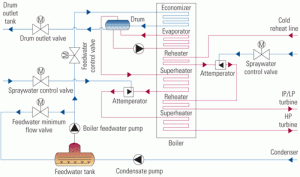
Increased cycling of combined-cycle plants has made precise control of attemperator spray water within heat-recovery steam generators more important if damage to their hardware and piping is to be avoided. Complicating the issue is the industry’s still-limited experience with cycling and the fact that demands on the attemperator and turbine bypass of cycled plants are more stringent than those on baseloaded units.
-
News
Russia says "da" to floating nukes
The Russian Federation plans to start building a floating nuclear power plant this year. According to the country’s atomic energy agency (Rosatom), the first plant will be small (3 MW) but could lead to the development of offshore plants with capacities of several hundred megawatts. The pioneering plant will be sited off the coast of […]
-
-
Poor priorities
I couldn’t help but marvel at the synchronicity of two unrelated events over the past few weeks. The first, on January 12, was the rare cancellation of a major military acquisition program with problems called "too expensive to fix." It takes an Act of Congress to kill most military contracts due to the pork flowing […]
-
 News
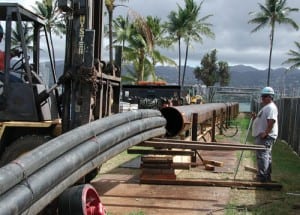
NewsPearl Harbor cable links past, future
A new, mile-long submarine transmission cable in Pearl Harbor (Figure 3, p. 10) will facilitate the U.S. Navy’s plan to renovate and expand historic Ford Island. Honolulu-based Hawaiian Electric Co. Inc. (HECO) recently laid two new 46-kV lines beneath the bridge connecting the island to Oahu. The trickiest part of the installation was avoiding the […]
-
-
 Gas
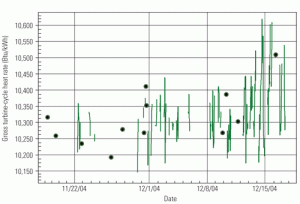
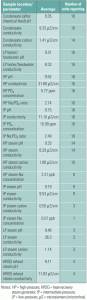
GasFleetwide standardization of steam cycle chemistry
Nearly five years ago, a major IPP began standardizing steam cycle chemistry feed, control, and monitoring across its combined-cycle fleet. This article discusses the steps taken, the costs incurred, and the technical and financial benefits achieved. Although the project focused on non-cogeneration plants, the findings detailed below are broadly applicable to other kinds of plants. However, the specific implementations (especially of the chemistry standards) described may have to be modified slightly for application to cogen plants.
-
 News
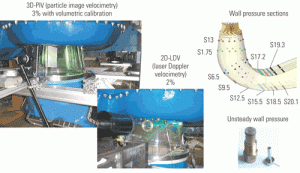
NewsA breakthrough in hydroturbine design
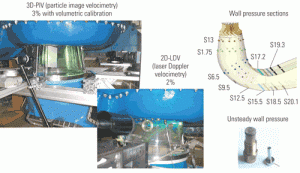
One of the distinguishing characteristics of deregulated power markets is variable demand. The ability to operate efficiently at partial loads can determine whether a plant is profitable or not. This need creates special challenges for hydroelectric turbines, because at partial loads they often exhibit strong swirl in the draft tube at the outlet of the […]
-
 Legal & Regulatory
Gas storage investment stymied
The U.S. needs to add 600 to 800 billion cubic feet (Bcf) of natural gas storage capacity ASAP. Independent storage providers (ISPs) are the entities best equipped to build this needed infrastructure, but they continue to be restrained by anachronistic regulatory policies. The Federal Energy Regulatory Commission’s (FERC’s) December 2005 rule-making to modify its […]
-
O&M
Focus on O&M (February 2006)
CFB refractory repair; Upgrading conductivity monitoring; Low-cost maintenance of spinning reserve
-
 Coal
CoalConstant and sliding-pressure options for new supercritical plants
Sliding-pressure, supercritical plants are all the rage. They generally include certain design features developed for markets and operating environments outside the U.S., where new coal-fired plants have been built in recent decades. U.S. market conditions are different, and considerable capital cost savings—with negligible operating cost differences—are possible if technology options are considered for the next wave of supercritical and ultra-supercritical steam plants.
-
 Coal
CoalCCPI bears first fruit
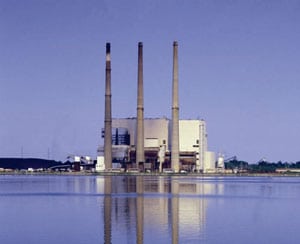
In 2002, the Bush administration launched the Clean Coal Power Initiative in the hope that it would develop the missing technology piece of the cleaner energy puzzle. Four years and two rounds later, the U.S. electric power industry is seeing the first usable clean coal technologies emerge before its eyes.
-
 Instrumentation & Controls
Understanding refractory failures
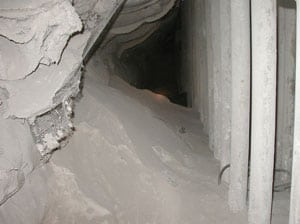
Compared to most pieces of a power plant, refractory costs very little to install. Yet, if improperly manufactured, specified, stored, mixed, installed, cured, or dried, refractory may cause problems that can significantly decrease a plant’s operating efficiency and flexibility. Like Rodney Dangerfield, refractory design and installation deserve more respect.
-
Environmental
The power of one
The 35th birthday of the Environmental Protection Agency (EPA) passed last December 2 with little fanfare. EPA Administrator Stephen L. Johnson noted at the time that, "Over the last three and a half decades, through the use of innovative and collaborative approaches to environmental protection and a commitment to responsible stewardship, we have made remarkable […]
-
 Gas
GasFrame 6C debuts in Turkey
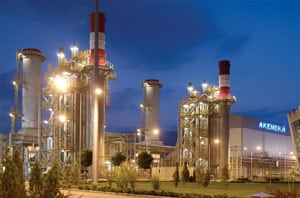
GE Energy’s latest "first" is in Turkey, where the Frame 6C gas turbine-generator—a younger cousin of the popular Frame 6B—has made its commercial debut. The turnkey 130-MW combined-cycle plant, called the GE206C, comprises two 40-MW Frame 6Cs, one GE steam turbine-generator, two heat-recovery steam generators, and a distributed control system. The gas-fired plant (Figure 1), […]
-
 Wind
WindAtlantic City bets on renewables
New Jersey’s gaming mecca is hosting one of the largest hybrid (solar-wind) power plants in the world (Figure 3). The Jersey-Atlantic Wind Farm, with 7.5 MW of wind capacity and 0.5 MW from photovoltaic (PV) cells, is expected to generate 20,000 MWh annually. That should be enough to power an adjacent wastewater treatment plant operated […]
-
 Hydro
HydroPeru commissions hydro plant
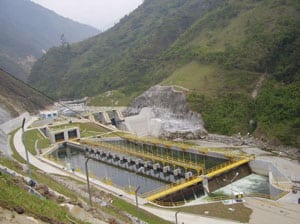
The 130-MW Yuncán hydroelectric plant (Figure 4) has come online in Peru about 210 miles northeast of Lima. To show his support for the project, Peruvian President Alejandro Toledo Manrique attended the inauguration ceremony. Yuncán was commissioned just 21 months after the Peruvian government awarded a 30-year contract to operate the plant to EnerSur, the […]
-
 Business
New edition of steam plant bible
The long-awaited 41st edition of Babcock & Wilcox Co.’s (B&W’s) Steam: Its Generation and Use (Figure 5) is now available for ordering on the company’s web site, www.babcock.com. The release of the book is worth noting by power plant engineers for two reasons: The tome is the world’s longest continually published (since 1875) engineering text, […]
-
Business
Correction
In "U.S. utilities driving for a license" (November/December 2005), we wrote that Bechtel Corp. is part of the UniStar consortium. Bechtel Corp. is not a member but is working for UniStar as a contractor.
-
 Instrumentation & Controls
Long-term catalyst health care
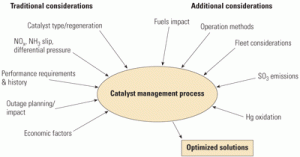
Now that many U.S. selective catalytic reduction (SCR) systems are in their fifth or sixth year of operation, a number of utilities are shifting their attention from implementing the technology to operating and maintaining it. Catalyst management and performance are key to the successful operation of any SCR system.
-
 Business
Catalyst regeneration: The business case
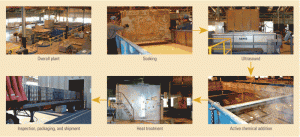
As an alternative to purchasing new catalyst, technological and economic advantages make a compelling case for regenerating rather than replacing the metal or ceramic that enables selective catalytic reduction systems to capture NOx.