
I was talking with a utility executive the other day about his recent vacation in India. It’s certainly not your usual holiday destination, but he’s the adventurous type, eager to mingle with different cultures and sample their cuisine. The exec did a lot more than tour the Taj Mahal and get a glimpse of endangered tigers; he went where real people live and work.
Some years ago, I also had the opportunity to visit India during construction of a power plant by my employer at the time. My experiences were somewhat different; they included a near-fatal collision with an overloaded gravel truck that is nearly as memorable as the six months it took me to recover from “Mahatma’s revenge.” The executive’s visit and mine to the same country were unforgettable, but for different reasons.
Foreign-flavored renaissance
The international adoption of nuclear power can be likened to those widely different experiences—it has either left countries forever changed or has been an experience best forgotten. If Americans look beyond their insular society, they’ll see that most of the adopters now rely heavily on fission to power their economies. But a few remain hostage to the past and refuse to recognize the advances in technology and safety that make the next generation of nuclear plants so attractive. Focusing only on the past is shortsighted—we must expand our views of the industry and of the world around us. As with visiting a foreign country, perspective comes from both experience and attitude.
The latest International Atomic Energy Agency report—Energy, Electricity and Nuclear Power Estimates for the Period up to 2030—reveals the degree to which the world beyond the U.S. is newly embracing nuclear power. The report projects firm growth of 77 GW between now and 2030 for plants that are under construction or firmly committed. “Promising” projects push the prediction up to 300 GW.
The report notes that since 1986, worldwide nuclear generation capacity has remained essentially constant at around 371 GW, or about 15% of total global electricity production. For comparison purposes, the U.S. figure is about 20% of capacity, provided by 104 nuclear plants with a cumulative rating of 100 GW. The top five list is rounded out by France’s 59 plants (63 GW), Japan’s 55 (48 GW), Russia’s 31 (22 GW), and Korea’s 20 (17 GW). Today, 30 different countries have nuclear power plants.
Here’s where the data get interesting. At the end of November 2007, there were 435 operating nuclear plants worldwide, with 27 units in the works (ignoring two Russian floating nuclear plants of 30-MW capacity). The locations of those plants are enlightening:
- Russia, with three plants under construction, plans to significantly increase its nuclear power output.
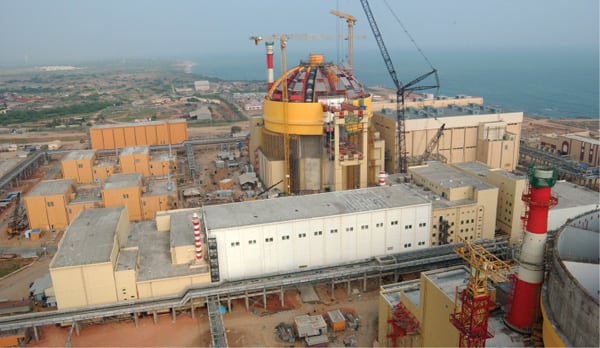
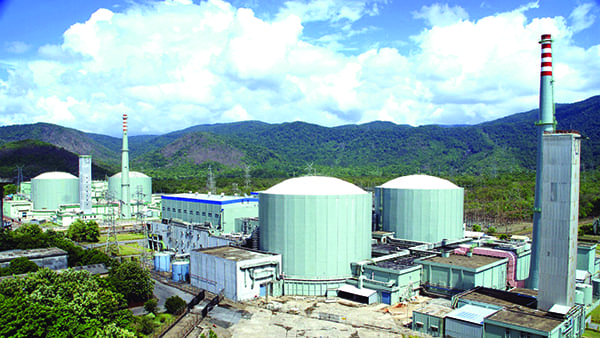
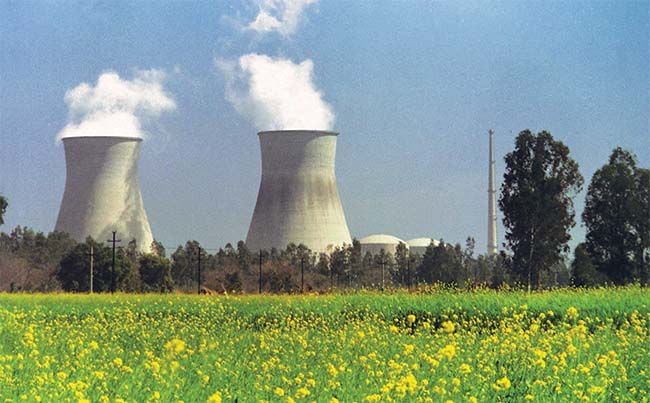
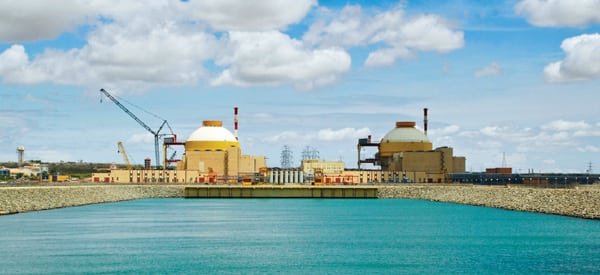
- India has seven plants under construction and hopes to increase its fleet capacity eight-fold by 2022.
- China is installing four reactors and has announced plans to quintuple its nuclear power production by 2020.
- Japan, with just one reactor under construction, still wants to increase nuclear’s share of its capacity mix from 30% to 40% over the next decade.
- Korea completed one reactor in 2006 and has three more under way.
- Europe’s schizophrenic approach to nuclear hasn’t stopped the construction of six new reactors. Nuclear power is now banned in Austria, Italy, Denmark, and Ireland; Germany and Belgium say they intend to phase out their programs.
- The remainder of the new units include one in France, one in Pakistan, and the resumption of construction of Watts Bar 2 in Tennessee.
Behind the power curve
The trend should be abundantly clear: Most of the growth in the nuclear power industry is already under way in India, Asia, and Russia, and those countries have made firm commitments for more in the future. The G8 countries represent 65% of the world’s economy but are home to only six of the 27 units currently under construction, including Watts Bar 2.
There’s no denying that the drumbeat for nuclear power in the U.S. is louder today than it has been in a quarter-century. In the past month alone, Duke Energy and PPL have announced their interest in building new plants, joining a half-dozen other utilities, while Areva and Mitsubishi submitted their reactor designs to the Nuclear Regulatory Commission for certification. Those two new designs join the Westinghouse/Toshiba AP-1000 and GE’s advanced boiling water reactor and economic simplified boiling water reactor designs, which are already approved and being marketed.
The UK also wants to refresh its nuclear capability, given that most of the country’s 19 reactors are due for retirement within the next 15 years. Prime Minister John Hutton said in a January address to Parliament, “I invite energy companies to bring forward plans to build and operate new nuclear power stations.” If the Brits complete their first plant by 2020, the UK’s program will then be several years behind America’s.
Attitude matters
I recognize that little can be done today to accelerate U.S. nuclear plant expansion plans. However, what I suggest is that Americans, as a nation, recognize that development of a robust nuclear power infrastructure is vital to the country’s future economic well-being. Understanding that need will require a change in attitude.
Russia, China, and India have made nuclear power a national priority and are pouring concrete and fabricating steel this very minute. Meanwhile, the U.S. is generating only mountains of paper. Unlike those Bengal tigers my executive buddy recently saw in India, we can offer only paper tigers.