Ongoing investigations into cancellation of the Yucca Mountain project have revealed an astonishing number of irregularities by agencies responsible for the project. Those investigations have exposed a broken system that failed to properly manage the project and that surrendered to political pressure. Worse still, the draft report of President Obama’s Blue Ribbon Commission on America’s Nuclear Future gave the industry little reason to hope that there would ever be a long-term nuclear waste fuel repository.
Eighteen months ago, we examined the history and status of the U.S. spent nuclear fuel policy. In that report we observed that the U.S. Department of Energy’s (DOE’s) legal deadlines required by the Nuclear Waste Policy Act (NWPA) and Amendments (NWPAA) for establishing a permanent repository for spent nuclear fuel (SNF) have come and gone. (See “The U.S. Spent Nuclear Fuel Policy: Road to Nowhere,” May 2010, in our online archives at https://www.powermag.com.) After cancelling the Yucca Mountain repository project, President Barack Obama appointed another commission to “conduct a comprehensive review and to make recommendations about policies for managing the back end of the nuclear fuel cycle and for a new plan” within two years.
A Review of Earlier Conclusions
We presented four important conclusions in our earlier report. They were that:
- The monetary damages to date, and the future federal liability costs for failing to construct a repository, are enormous and continue to grow each year.
- Nuclear utilities continue to pay a mil per kilowatt-hour produced for the Yucca Mountain facility that was cancelled.
- On-site storage will become the new normal because a Yucca Mountain replacement is politically impossible.
- The new Blue Ribbon Commission (BRC) will have no more success finding a new site than its predecessor commissions.
Let’s quickly walk through the rationale we used when coming to those conclusions.
The NWPAA, signed by President H.W. Bush on December 22, 1987, codified the Yucca Mountain site as the nation’s permanent repository for SNF and other high-level nuclear wastes. That location decision was made when both houses of Congress overrode the Nevada governor’s veto, as allowed by law. In our opinion, this decision has so poisoned any future, necessarily public site selection process that no governor would dare vote for a repository site within his or her state—unless the benefits to the state were enormous. Nor will Congress ever again muster enough votes to override a governor’s veto, given the polarizing nature of the project.
We also observed that nuclear utilities had paid $31 billion into the Nuclear Waste Fund (NWF) from 1983 through the end of FY2009, less the $7.3 billion that was spent on developing Yucca Mountain, leaving a $23.6 billion (virtual) balance (updated from our previous article). That money went into the general fund and has been spent—it’s not in a “lock box.”
This financial data was taken from a report released by the Congressional Budget Office (CBO) titled “The Federal Government’s Responsibilities and Liabilities Under the Nuclear Waste Policy Act” that was released on July 27, 2010, a few months after our earlier report.
A strong case can also be made that the money collected to date will have to be refunded to the nuclear payors should the DOE abandon the search for a long-term storage facility. Today, about $2 billion is added to the NWF each year, so the fund balance today, on paper, is pushing $28 billion. From a strictly economic point of view, the formation of the BRC effectively delayed that day of reckoning until at least early in 2012, when the committee’s final report is due.
In the meantime, individual utilities are suing the federal government at a record pace for failing its legal duty to provide the storage facility on time. As of June 2010, electric utilities had filed 72 lawsuits “seeking compensation for costs they incurred because the federal government could not begin to accept nuclear waste for disposal in 1998,” according to the CBO report. As of that same date, 11 of the lawsuits had been settled for about $725 million, 10 lawsuits had been dismissed, and one payment of $35 million was made to Tennessee Valley Authority, another government entity. Of the 50 pending cases, 20 had been decided by June 2010 but had pending post-trial motions.
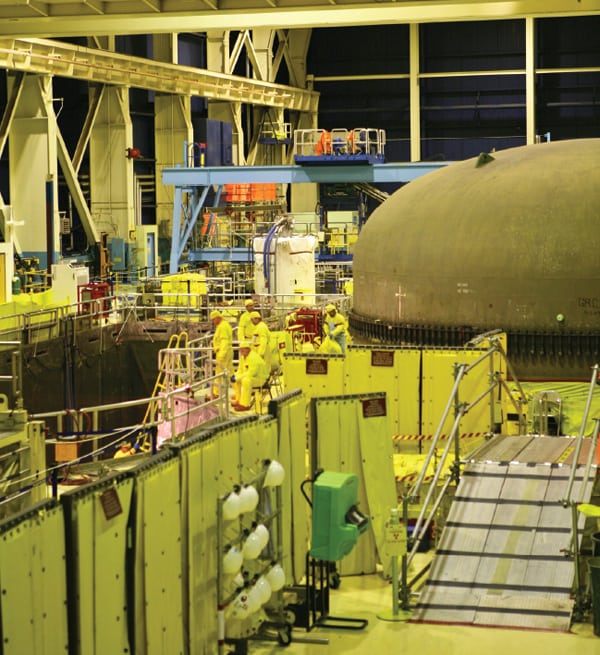 |
| 1. Reactor recharging. Tennessee Valley Authority (TVA) workers carry out refueling operations on the Browns Ferry Unit 2 reactor. Courtesy: TVA |
The CBO observed that, “Because judicial claims for damages are made retrospectively, many more cases can be expected in the coming decades as utilities seek to recover their ongoing costs for storing nuclear waste long after they expected it to be removed and sent to a permanent disposal site.” The CBO also calculated the “taxpayers’ liabilities to electric utilities” will total about $13 billion if a permanent facility is opened by 2021, an unlikely scenario. The CBO also observed that “it is not clear how the Administration’s decision to terminate the Yucca Mountain repository will affect the federal government’s liabilities to electric utilities. If DOE is found at some point to have fully breached its contractual commitments, the federal government’s liabilities could increase considerably.”
Note that should Congress and the president decide to change the NWPA to permit a repository at a new location other than Yucca Mountain, and the federal government comes to terms with a particular state and its stakeholders over siting that repository (two big ifs), the federal government’s financial liability for past transgressions remains and will continue to grow, at least until a central repository enters service. In the words of the CBO, “Even if such legislation is enacted, federal liabilities will remain substantial, and payments from the Judgment Fund to compensate utilities for storing waste will continue for many years.”
Blue Ribbon Disorder
We also concluded in our earlier report that the BRC was in the unenviable position of spending two years preparing a report that will present truly predictable conclusions: either politically untenable options or a rehash of the Yucca Mountain debate. The BRC’s draft report, released on July 29, 2011, confirmed that assessment. Comments on the draft report are due no later than October 31, 2011; the final report is due to be released by January 29, 2012.
The 192-page draft report’s predictable suggestions include forming a new government organization responsible for the project (not the DOE) and placing the NWF annual deposits in a “lock box.” The report is correct when it concludes that “The overall record of the U.S. nuclear waste program has been one of broken promises and unmet commitments” and that “decades of failed efforts to develop a repository for spent fuel and high-level waste have produced frustration and a deep erosion of trust in the federal government.” The report does not make any suggestions for how to restore that lost trust but rather focuses on programmatic and political solutions for licensing a new repository. By announcing early in its report that the BRC was making no comments on the efficacy of the Yucca Mountain project, this BRC showed that it had failed to learn from past mistakes.
The draft report properly recognized that “a new strategy is needed” to address the problem of locating a long-term repository for SNF, and we agree with that assessment. However, the report suggests a “new, consent-based approach for siting future nuclear waste management facilities.” The report describes this as an “inclusive process” in which “communities become engaged in the process.” In essence, the report assumes that when the opportunity is properly presented to and vetted by stakeholders, there will be communities that will embrace construction of a facility in their state—that is, all states but Nevada, according to Senator Harry Reid (D-Nev.). The BRC then explains how it would bring all the disparate stakeholders to the table for negotiations: with a “flexible and substantial incentive program” that will get everyone’s attention. The magnitude of the bribe was not discussed in the report.
Hardball Politics
Since President Obama pulled the plug on Yucca Mountain last February, a number of congressional committees have been picking over the remains. A number of investigations are under way with the purpose of determining if actions taken by various federal agencies were legally sufficient justification for cancelling the project. So far, the results from those investigations are mixed. In no particular order, the following is a partial list of ongoing investigations and a summary of the findings of completed investigations.
The Committee on Energy and Commerce. This committee of the U.S. House of Representatives is vested with the broadest jurisdiction of any congressional authorizing committee. It oversees multiple cabinet-level departments and independent agencies, including the DOE. In spring 2011, its subcommittee on Environment and the Economy notified Energy Secretary Steven Chu and Nuclear Regulatory Commission (NRC) Chairman Gregory Jaczko that it was launching an investigation into the decision-making process that led to the termination of the Yucca Mountain project. Chairman Fred Upton (R-Mich.) and subcommittee Chairman John Shimkus (R-Ill.) launched the inquiry after reviewing available evidence indicating that there was no scientific or technical basis for the DOE to withdraw the application required by the NWPA.
Committee on Science, Space, and Technology. This House committee has jurisdiction over civilian radioactive waste management, including Yucca Mountain. In June 2011, it issued a 203-page staff report, “Yucca Mountain: The Administration’s Impact on U.S. Nuclear Waste Management Policy,” which concluded that there wasn’t a single document presented to the committee by the DOE or the NRC that supported closing Yucca Mountain.
The 695-page Volume III of the NRC’s Safety Evaluation Report (SER)—the NRC’s review of the DOE’s application for construction—was the most noteworthy document presented during this investigation. The report is a comprehensive evaluation and analysis of the technical feasibility of Yucca Mountain with respect to the project’s ability to meet the regulatory thresholds for approval. A copy was obtained by committee investigators only after repeated demands and over the objections of the NRC chairman. As of June 2011, the NRC has still refused to release unredacted versions of the SER on Yucca Mountain to the public, leaving the final NRC conclusions about Yucca Mountain an open question.
Committee reviews of the SER found that the NRC made more than 1,500 findings related to the DOE’s scientific and technical research efforts, and agreed 98.5% of the time with the DOE conclusions regarding the site’s suitability to meet regulatory requirements. The remaining 1.5% of the findings did not affect the NRC staff’s overall conclusions, which found that the DOE’s Yucca Mountain license application complies with applicable NRC safety requirements, including those related to human health and groundwater protection, and specific performance objectives in the NRC regulations. In addition, the SER determined that there was no significant impact on the long-term safety of the facility.
In sum, this committee found agreement among the scientific and technical experts responsible for reviewing the suitability of “the most studied piece of land on Earth” and concluded that nuclear waste can be safely stored at the Yucca Mountain site for tens of thousands of years in accordance with NRC requirements.
NRC Inspector General Report. In June 2011, the NRC Inspector General (IG) released a 46-page report, “NRC Chairman’s Unilateral Decision to Terminate NRC’s Review of DOE Yucca Mountain Repository License Application (OIG Case No. 11-05).” By July 2010, the NRC professional staff was on track to complete the SER Volume III review, well before the scheduled November 2010 publication date. However, the IG investigators found that NRC Chairman Jaczko ordered the staff to slow down or delay their work. In October 2010, Jazcko ordered the staff to stop its work and close down its review—after a decade of work and a month before completion.
Jaczko said that his reason for killing the SER so close to completion was not political but rather purely budgetary. However, release of the purely technical NRC report (which was expected to confirm the science and technology behind the DOE license application, showing that there was no technical reason not to proceed with Yucca Mountain) would have been politically embarrassing for President Obama and Senator Reid, given their promises to cancel to the project.
The IG report concluded that NRC Chairman Jaczko abused his legal authority by deliberately withholding information and not informing other commissioners of his decision to stop work on the SER and that the decision to cease work was a policy decision that should have received full NRC consideration. In fact, a majority of commissioners told the IG that they did not believe that work on the SER should have been stopped at that late date.
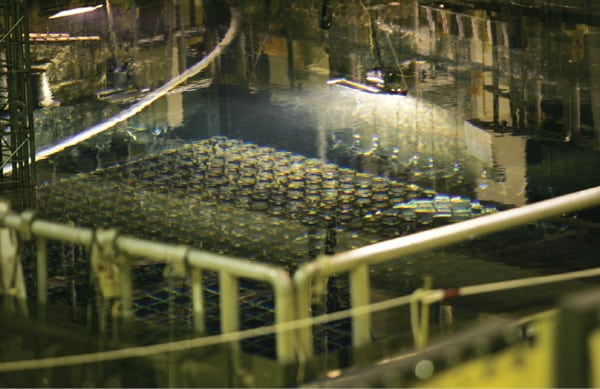 |
| 2. Pool storage. Underneath 27 feet of water sit 12-foot-tall stainless steel racks of spent nuclear fuel at the top of TVA’s Browns Ferry Unit 1. Courtesy: TVA |
The report concluded that Jaczko had not acted illegally but that his conduct was questionable, especially with regard to his highly selective sharing of information with fellow NRC commissioners. However, the IG concluded that Jaczko’s strategic control of information raised questions about his leadership capabilities and political independence. Before President Obama nominated Jaczko to chair the NRC in 2009, Jaczko worked for Congressman Edward Markey (D-Mass.), an ardent opponent of nuclear power, before becoming science advisor to Senator Reid. Jaczko also served as an NRC commissioner from 2005 to 2009.
Consequential Damages
The BRC draft report suggested that many of the technical lessons learned from the work completed to support the DOE license application and the NRC SER will be helpful in developing a future repository. We’re not convinced that will be true. By pulling the plug on Yucca Mountain so quickly, much valuable information was lost.
FY2011 budget guidance received from the president in February 2010 was said to assume no funding for Yucca Mountain. In response, the DOE undertook an ambitious schedule to redirect its remaining FY2010 budget to terminate the repository program and abolish the Office of Civilian Radioactive Waste Management (OCRWM) by September 30, 2010, when funding would have ended under the president’s budget proposal.
A Government Accountability Office (GAO) report, “Commercial Nuclear Waste, Effects of a Termination of the Yucca Mountain Repository Program and Lessons Learned,” released in April 2011, reported that in implementing its ambitious shutdown schedule, the DOE did not consistently follow federal policy and formally approve the shutdown plan, nor did the DOE perform a proper risk assessment. Although the DOE had drafted a shutdown plan by February 2010, department officials told the GAO that it was never approved. Thus, the DOE had no formal implementation goals or milestones to guide progress. The DOE’s IG also expressed concern about the lack of such a plan, given the scope and complexity of the shutdown and impacts to the preservation of intellectual, scientific, and technological information and the disposition of property.
Several DOE officials told the GAO that they had never seen such a large program under so much pressure to close so quickly. The DOE’s primary contractor at Yucca Mountain also expressed concern, as noted in a June 2010 letter to the DOE, that contracts of this scale generally take two years or more to close out; nevertheless, the contractor agreed to meet the DOE’s September 30 date, less than four months away. The process required using “creative and unusual approaches,” such as the transfer of residual work to other parties and saving interim technical work products, without making additional effort to document objectives, plans, status, or path forward. According to a DOE contractor responsible for archiving the records, the files consist of 1.8 million electronic documents and 11,000 boxes of hard-copy documents. In other words, the project files were collected, put in file boxes, sealed, and stored.
In May 2010, OCRWM’s prime contractor was asked for a shutdown plan. The contractor produced a $2.8 million proposal for “knowledge retention packages” that would mitigate the threat of the irrecoverable loss of expert knowledge as staff members depart the program. The contractor said these packages would give the DOE the ability to resume the license application review proceedings, if required. In a written response to this proposal, the DOE stated that the knowledge retention packages were “both costly and unnecessary,” extended beyond the September 30, 2010, closure date, and would require a large expenditure of government funds for work that DOE managers found wasteful, such as videotaping scientists. As a result, the knowledge retention packages were not approved by the department and were not prepared by the contractor.
Although the project is technically still in licensing mode at the NRC and the center of a variety of lawsuits, the NRC closed access to the Licensing Support Network (LSN) in August 2011. The LSN allowed access to information and historical documents. By now, the network’s contractor will have completed the process of clearing any filing backlog and disassembling hardware. The NRC said the timing of the shutdown was necessary to meet the September 30, 2011, deadline for decommissioning the network. To put the network back online after September 30 was estimated by the contractor to take two or three years.
Let’s Make a Deal
Eighteen months later, the destination of the U.S. nuclear waste storage policy remains unchanged: nowhere. Technically, the Yucca Mountain permitting process continues, because the DOE had the legal obligation to submit the application for construction and the NRC has a legal responsibility to complete its analysis of the suitability of the Yucca Mountain site. Those who worked on those reports have revealed that there were few, if any, unresolved technical problems, although the final reports will probably never be formally released.
In fact, as of September 30, 2011, the staff and contractors on the project were gone, the work products were boxed and stored, and further work remained unfunded in FY2012. For us, that constitutes a good definition of a project that is dead and gone.
Setting aside the questionable tactics used to kill the Yucca Mountain project, the question that remains unanswered is this: If not Yucca Mountain, then where?
We stand by our earlier conclusions that there is no site in the U.S. where the full range of stakeholders will agree on siting a Yucca Mountain–like facility. The BRC’s draft report also fails to answer that question but rather suggests a “framework” for “building consensus”—wishful thinking at best.
Until a new site is firmly identified, Congress will be loath to address any changes to the NWPA (in which Yucca Mountain is named). If a new site cannot be identified, then the collection of mil per kilowatt-hour fees will continue indefinitely, and the economic damage to nuclear utilities will continue to spur more lawsuits, further driving up costs. It is a vicious traffic circle with no obvious exit.
The BRC has proposed one audacious approach that has a chance of success, however slim, of escaping the vicious circle: provide sufficient “incentives” to enough stakeholders to cobble together a deal. The $7 billion spent on Yucca Mountain, mostly in Nevada, was obviously insufficient, so the deal will have to be sweetened. Left undetermined is who gets to pay for the incentives, who will benefit from them, and the number of zeros after the dollar sign required to make a deal.
A large portion of the direct benefits from such a deal will surely go to individual state residents, to gain majority support. Any governor willing to take the politically dangerous position of supporting a nuclear waste storage facility will likely demand significant upfront payments. This approach would allow a governor to deliver benefits early and often, keeping state residents appeased.
A model for this approach might be Alaska’s Permanent Fund Dividend Program, through which a share of oil revenues from that state is reinvested for future residents and an individual annual payout is made. Another benefit of the oil revenues: The State of Alaska does not currently have a state income tax. We believe the incentives for a state to consider hosting an SNF repository must be on par with the benefits received by the government and residents of Alaska, at a minimum.
The political downside for any governor would be to begin negotiations yet fail to gain consensus. That governor would forever be branded as an enemy of the environment who was willing to put a price on the health and welfare of the state’s residents—whether true or not.
So, we end where we began: On-site storage is the only option for storing SNF. Many utilities are already upgrading their storage facilities to reflect that reality, the money coming from successful lawsuits brought against the DOE for failing to meet its responsibilities under the NWPA.
Someday (maybe) the U.S. will close the nuclear fuel cycle and on-site SNF will have significant market value. Perhaps, in the end, utilities will be economically advantaged by continuing to own their SNF, rather than turning it over to the federal government for centralized storage.
In the meantime, utilities will continue to pay for a storage facility that doesn’t exist and will be forced to litigate in order to obtain reimbursement for onsite storage costs from the federal government. This non-policy is now the new normal for the nuclear industry.
— Dr. Robert Peltier, PE is editor-in-chief of POWER, and James M. Hylko is a contributing editor.