Our August 2009 issue reprinted a Marmaduke Surfaceblow adventure in which the fictional power engineer visits Camp Century, a “city under the ice” located in northern Greenland, about 900 miles from the North Pole. Under construction was a U.S. Army 2-MW prepackaged nuclear plant designed to provide heat and electricity for the 100 inhabitants. (It operated for less than three years before removal in 1963.) During Marmaduke’s visit, the diesel generators failed. As temperatures in the camp plummeted, Marmaduke once again solved a life-and-death dilemma using only his practical power plant know-how, the tools at hand, and a few puffs on his Ringelmann No. 5 cigar.
Camp Century no longer exists, but near its former location is Thule Air Base, which is experiencing similar energy supply challenges. Thule (“Two Lee”) Air Base is a 254–square mile base located in a coastal valley in the northwestern corner of Greenland, within the Arctic Circle. The base, the U.S.’s northernmost military installation, is nestled between mountains and surrounded by icebergs and glaciers as far as the eye can see (Figure 1).
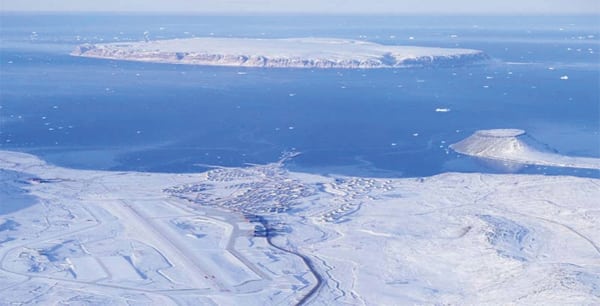 |
| 1. Cold storage. Thule Air Base is located inside the Arctic Circle in northwest Greenland. The base must import all the fuel used to produce electricity and heat. Source: U.S. Air Force Observer. |
Inside Thule Air Base, U.S. Air Force men and women have their eyes locked on computer radar screens. They have the immense responsibility of tracking foreign military rockets and missiles using large, powerful radars. The moment a threat is detected, they’re able to communicate directly with the White House.
This is one of several critical missions they are performing for America’s national security, supported by the U.S. Army Corps of Engineers, New York District. The base is home to hundreds of active-duty U.S. Air Force personnel as well as American, Danish, and Greenlandic civilian contractors.
For decades, under extreme Arctic conditions, the Army Corps has constructed facilities for the base in support of the Air Force’s mission. These facilities include aircraft runways, dormitories, and medical centers.
Most recently, the Army Corps improved the base’s heating system by replacing outdated and inefficient boilers with energy-efficient exhaust gas boilers that will save the U.S. Air Force and taxpayers millions of dollars.
New Energy-Efficient Heating System
The base’s heating system boilers were in need of replacement because they were either no longer operational or operating very inefficiently. Recoverable heat from the system was being lost to the atmosphere, and a considerable amount of fuel was being consumed to make up for this loss. The U.S. Air Force explained to the Army Corps that it needed to replace and upgrade the boilers and make the heating system more energy efficient.
At the request of the Air Force, the Army Corps has designed the system upgrade and is performing this work with Denmark-based contractor GC/MTHøjgaard.
According to Stella Marco, project manager with the Army Corps’ New York District, the new system is expected to save the Air Force and U.S. taxpayers $3 million annually in energy and fuel costs.
Before this project began, the base’s heating system consisted of three structures: a building called the M-Plant, which provided the base’s electricity and some steam, and two steam plant facilities that provided the base’s steam for heating and hot water. All of these buildings used considerable fuel to run engines and boilers.
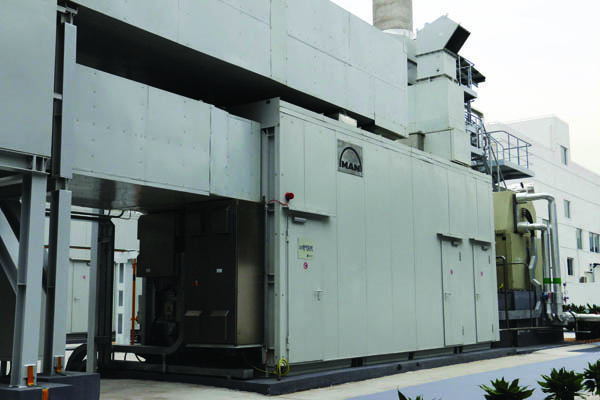
The Army Corps is removing the old boilers and installing four new exhaust gas heat recovery boilers in the M-Plant, which will effectively consolidate all steam production under the M-Plant’s roof. To make room for these boilers, an extension was built onto the M-Plant. The two steam plants will serve as an emergency backup heating source. This consolidation will save the base approximately 1.6 million gallons of fuel annually.
Two boilers were installed this past summer, and two more will be installed next summer, when warmer weather again enables construction.
The new heat recovery boilers are connected to the M-Plant’s existing five 12-cylinder Cooper-Bessemer diesel engines that drive five large generators, each rated at 3 MW. Each diesel engine runs on jet fuel (JP-8). These large engines have an exhaust temperature of 700F–840F (Figure 2).
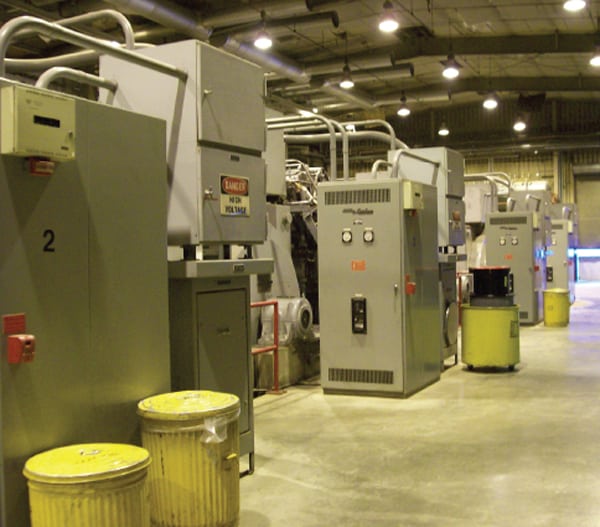 |
| 2. Balance of power. Thule Air Base is powered by five 12-cylinder Cooper-Bessemer diesel engines, each producing 3 MW burning jet fuel. Package boilers, also firing jet fuel, supplied the plant’s thermal energy needs. A project is under way to add heat recovery exchangers to each of the diesel engines to produce heating steam and hot water for the base. These upgrades will save several million dollars each year. Courtesy: JoAnne Castagna, U.S. Army Corps of Engineers, New York District |
“The diesel engines that drive these generators are very much like those found in today’s vehicles, only much larger and stationary,” said Robert Philbrick, Air Force Team Leader, U.S. Army Corps of Engineers, New York District.
“They convert fuel oil into mechanical energy to turn the electric generators, instead of turning vehicle wheels. The exhaust gas from these engines is usually released directly to the atmosphere via an exhaust pipe,” said Philbrick.
“The new boilers the Army Corps is installing are energy efficient and economically feasible because they’re taking the exhaust gas to create steam that can be used for heating and hot water throughout the base. The old boilers, due to their age and disrepair, wasted the energy to the atmosphere,” added Philbrick. When the steam reaches a building, it goes into a mechanical room, where it enters a heat exchanger and the steam is used to create hot water. The hot water flows through the building’s radiators and heats the rooms (Figure 3).
 |
| 3. Cool runnings. The M-Plant control room manages the supply of electricity and heating steam to the base. Courtesy: JoAnne Castagna |
Construction Work in an Arctic Environment
Construction can be challenging due to severe weather and limited daylight, which requires the use of unique building techniques and fast-paced construction.
Construction is limited to the summer and autumn months, from May through October, when there is sufficient sunlight, and temperatures are bearable to work in. From June through August, temperatures can reach 40F, and there are 24 hours of sunlight.
During the remainder of the year, there are severe storms, and temperatures have dropped as low as –47F. There are also 24 hours of darkness from November through February.
It is also only during the summer months that shipments of building materials and fuel can be received via cargo. Greenland is locked in by ice nine months out of the year, but during the summer, its iced shipping lanes can be broken up to allow supply ships into port. Shipped-in building materials include prefabricated parts that enable workers to perform construction rapidly.
In addition to having a small construction window, workers have other challenges, including a ground foundation composed completely of ice. Most of northern Greenland is covered with permafrost—permanently frozen ground—ranging from 6 to 1,600 feet in depth. Because of the permafrost, most structures have to be elevated, including the M-Plant building extension. “If buildings are not constructed off of the ground, the heat from inside the building can melt the permafrost, making the ground unstable and causing buildings to sink,” said Paul Jalowski, resident engineer, U.S. Army Corps of Engineers, New York District (Figure 4).
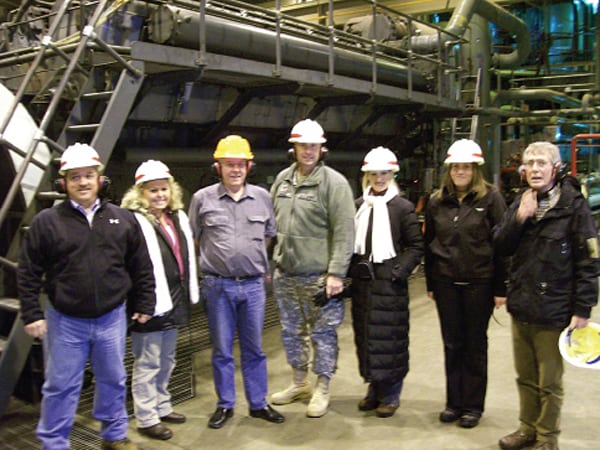 |
| 4. Command staff. Army Corps of Engineers personnel responsible for the Thule Air Base central plant include (left to right): Paul Jalowski, Stella Marco, M-Plant Supervisor Svend Nielsen, New York District Commander Col. John R. Boulé, JoAnne Castagna, Lucia Gamba, and Robert Philbrick. Courtesy: JoAnne Castagna |
Buildings need to be elevated 3 feet above ground with the use of spread footing that goes down about 10 feet deep; concrete columns come up and support the floor system above the ground. For the M-Plant building extension, the building’s flooring was also insulated to prevent any heat from the building or its equipment, such as the boilers, from heating the permafrost. In addition to buildings, the base’s steam and electrical piping conduits also need to run above ground for the same reason.
Thule Air Base is now in the middle of its winter storm season, and the severe temperatures can cause frostbite in less than a minute. The base is now benefiting from its more efficient heating system, and fuel costs will take a smaller bite out of the U.S. Air Force budget.
—Contributed by Dr. JoAnne Castagna (joanne.castagna@usace.army.mil), a technical writer-editor with the U.S. Army Corps of Engineers, New York District. For additional information about Thule Air Base, visit www.thule.af.mil.