Business strategies today include a focus on securing a reliable supply of electricity to sustain operations.
Businesses in the commercial and industrial (C&I) space put a premium on a reliable and resilient power supply. Downtime, whether caused by equipment failure, power outages, or other reasons, brings disruption and financial losses at a time when many groups are operating on narrow margins.
Customized power solutions that provide reliability, resiliency, and energy autonomy no longer are a “nice to have,” but rather a “must have” for many businesses, not just for critical sites such as hospitals and military bases but also for other enterprises. It’s why technology companies are seeking their own power solutions for data centers and other artificial intelligence (AI)–driven locations, and why many businesses are looking at on-site power stations and advanced electricity backup systems to enable uninterrupted operations and realize cost savings from producing their own energy.
Energy industry experts who spoke with POWER said businesses with C&I power systems that support their operations are likely more efficient, which itself brings cost savings, as does being self-sufficient when it comes to power. Businesses with a backup plan for power, enabling reduced reliance on the grid, can operate with more confidence they’ll remain online during extreme weather events or other emergency situations.
“Decentralization has reshaped how C&I power systems are planned and operated. Instead of relying solely on the central grid, many customers are adopting distributed energy resources, such as on-site generation, energy storage, and microgrids, to improve resilience, manage peak demand, and reduce energy costs,” said Dr. Thomas Sisto, co-founder and CEO of XL Batteries. “This shift has been accelerated by grid congestion, more frequent extreme weather events, and the growing need for uninterrupted power.
“That said, the central grid will continue to play a critical role. For most C&I customers, the goal is not full independence but a more balanced, hybrid approach,” said Sisto. “On-site and distributed resources offer flexibility and backup when the grid is constrained or unavailable. As decentralization continues, the most effective systems will be those that can seamlessly integrate local resources with the broader grid to enhance reliability, resilience, and cost efficiency.”
In This Issue
Full issue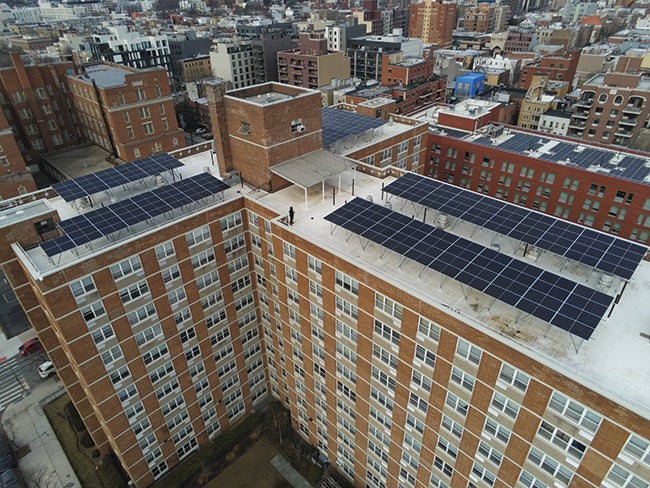 |
|
1. This rooftop 100.88-kW direct-current (DC) solar photovoltaic system at Catherine Sheridan, an affordable housing senior facility in Astoria, Queens, New York, is part of the Catholic Charities of Brooklyn and Queens’ 1.3-MW portfolio. Courtesy: Sam Dorbor, Crauderueff Solar |
An example of finding the right approach is a project in New York. The Catholic Charities of Brooklyn and Queens decided to install 17 solar energy projects, totaling 1.3 MW, on its housing stock (Figure 1), which is 100% regulated affordable housing. New York-based Crauderueff Solar guided the group through the development process, including design.
The system was designed to be behind-the-meter to take advantage of federal bonus tax credits. Catholic Charities set up the Laudato Si Corp. (LSC, a special purpose entity) to own and operate the solar assets in the context of broader sustainability efforts. Under this business configuration, LSC’s solar projects create a virtuous cycle whereby the income from the solar projects will be re-invested to generate deeper energy savings across the housing portfolio, helping to preserve the housing as affordable for the long-term. The 17 projects in total are designed to generate 1.5 GWh annually to offset an average of 45% of on-site electric load. (For more information about the Catholic Charities project, please read “New York Solar Project Addresses Energy, Housing Affordability” online at powermag.com.)
Cogeneration, Microgrids, and More
C&I power systems can include what are known as “captive” power plants, which operate independently from the power grid, or alongside it. Cogeneration, which includes combined heat and power (CHP) installations, enables C&I enterprises to generate electricity and also utilize the heat that otherwise would be wasted. Microgrids, which can utilize several technologies both thermal and renewable, also have experienced growth. Microgrids have become a popular choice as a backup power source, and in some cases a primary electricity provider, particularly in rural areas.
Robert Haley, PhD, CISSP, vice president, Global Data Center Operations, with Jacobs told POWER: “Power system design for commercial and industrial facilities is being reshaped by rising power density, extended utility lead times, and the need to compress project schedules. Grid interconnection has become one of the most critical challenges, requiring early evaluation of available capacity, upgrade pathways, and alignment with construction timelines.
“At the same time, power delivery, permitting, site preparation, and equipment procurement increasingly need to advance in parallel to optimize speed-to-market. Without careful upfront coordination, projects risk delayed energization or costly redesigns. As C&I facilities grow larger and more complex, particularly industrial developments such as data centers and advanced manufacturing plants, early-stage planning and system modeling are essential to mitigate risk and ensure operational readiness.”
Said Haley, “Decentralization is driving a fundamental shift in how our customers approach power reliability. While the central grid remains foundational, many facilities can no longer depend on it as their sole energy source—particularly where grid expansion timelines have fallen behind demand growth. To address this, operators are adopting hybrid power strategies that combine utility power with on-site generation, temporary feeders, or mobile substations.
“These approaches enable phased commissioning and reduce exposure to grid delays,” said Haley. “The appropriate balance between centralized and decentralized power depends on site conditions, facilities’ power demands that cannot be provided by the utility, and regulatory constraints, but resilience increasingly requires diversified sources rather than single-point dependence.”
Rodney Durban, vice president of Heavy Industry with Hitachi Energy North America, noted a handful of challenges for those designing C&I power systems, including supply shortages of critical equipment to produce and distribute incremental power. Durban also noted “long and increasing lead times for transformers, switchgear, etc.” Durban said Hitachi Energy is addressing the issues with aggressive investment in its supply chain.
“While C&I players aren’t directly contributing to the excess demand [that is primarily from data centers], they are experiencing ripple effects as they must compete with other players to secure the equipment they need for their own expansion projects,” said Durban, who added that “capacity expansion planning is constrained more by supply chain than technology.” Durban said there is a need for longer-term, such as five-year, planning, and closer supplier coordination—a newer requirement for these types of customers.
Kurt Steinert, head of external communications for Hitachi Energy North America, said, “We are developing more modular, pre-integrated solutions to accelerate deployment times.” Steinert said that while some new technologies may not be “exactly UPS [uninterruptible power supply], we do see new power architectures facilitating the build-out of larger data centers.” The company recently announced support for the 800-volt direct-current, or VDC, power architecture announced by NVIDIA, a technology to support larger, more energy-efficient “artificial intelligence factories” at a global scale.
Beth Crouchet, director of Energy Markets and Resource Planning at Budderfly, said, “Designing power systems for commercial enterprises is uniquely challenging because many customers are small- and mid-sized businesses operating large portfolios of similar sites, such as franchises, convenience stores, gyms, and quick-service restaurants. These facilities were not designed to function as energy assets, yet collectively they represent a massive, underutilized source of demand-side capacity.
“The challenge is both high energy use and repeatability at scale. Systems must be designed to work across hundreds or thousands of locations with different vintages, layouts, utility tariffs, and operating constraints, all while keeping businesses open and uninterrupted,” said Crouchet. “Most customers lack the capital, in-house expertise, or time to coordinate HVAC [heating, ventilation, and air conditioning], lighting, refrigeration, controls, solar, storage, and utility programs as a single system. As a result, energy infrastructure is fragmented, reactive, and difficult to optimize portfolio-wide.”
Data Centers Drive Change
Companies today are looking to align their business goals with their power supply, as they look for more reliable, resilient, and affordable energy. That’s particularly true of technology companies in need of reliable power supplies for data centers and other AI-driven sites.
 |
|
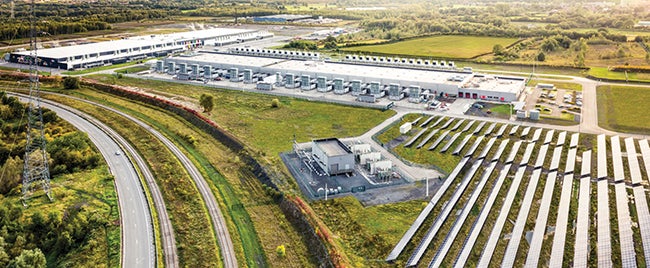
2. Fluence in 2022 installed a 2.75-MW battery-based energy storage system for Google, in a first-of-its-kind project at the St. Ghislain data center in Belgium. Courtesy: Fluence |
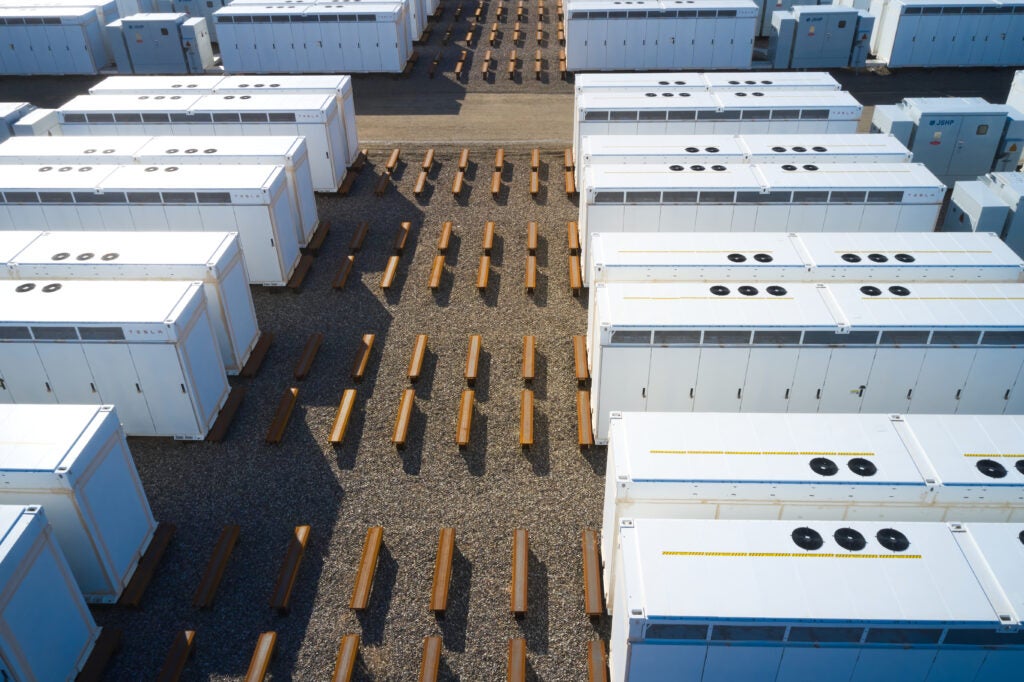
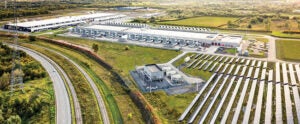
Fluence in 2022 installed a 2.75-MW battery-based energy storage system for Google, in a first-of-its-kind project at the St. Ghislain data center in Belgium (Figure 2). The system was done in collaboration with Centrica Business Solutions. While Google has touted the use of nuclear energy to power data centers and achieve its emissions goal, it also is looking at technologies such as battery energy storage. The installation of Fluence’s Gridstack energy storage product at St. Ghislain was designed to serve as a proof-of-concept for wider use of battery-based energy storage at Google’s facilities. Centrica connected the battery storage assets to the Belgian electricity grid.
Though energy storage and renewables such as solar and wind are part of the equation for securing energy, thermal assets still have a role. Mukesh Chatter, CEO and co-founder of Alsym Energy, said, “As C&I customers look to cleaner energy, coal and natural gas will continue to play a near-term stabilizing role while renewables, storage, and transmission infrastructure scale. This transition is being accelerated by AI-driven load growth and long interconnection timelines, which are forcing operators to rethink how reliability is delivered in the near term. However, leading operators are already demonstrating that it is possible to minimize reliance on thermal generation. One of Google’s three new Texas data centers in Haskell County is being co-located with a solar and battery storage facility, and Calibrant Energy recently made news with its first-of-a-kind onsite power solution that accelerates grid interconnection using battery storage.”
Chatter told POWER, “What customers ultimately need is predictability and resilience before thermal generation is phased out. They must be able to ride through grid instability, peak pricing, and outages without disrupting operations. Advanced energy storage is critical to achieving reliability and displacing the use of fossil fuel generation. Already in hybrid systems, thermal assets increasingly shift toward backup roles, while storage and renewables handle day-to-day reliability and control.”
Crouchet noted, “It’s realistic to acknowledge that thermal resources, particularly natural gas, will remain part of the broader U.S. power mix for some time. The grid was built around centralized, dispatchable generation, and fully replacing that overnight isn’t feasible. For C&I customers, especially those operating mission-critical facilities, maintaining reliability today still depends in part on how the grid as a whole is balanced.
“That said, the most effective lever C&I customers have is not deciding which generation assets the grid keeps; it’s reducing and reshaping the demand they place on the system,” said Crouchet. “Energy efficiency, intelligent controls, and flexible load management immediately lower exposure to grid volatility, peak pricing, and outages, regardless of whether the marginal kilowatt-hour comes from gas or renewables. Cutting demand by 20–30% across portfolios materially improves reliability and affordability without waiting on new generation to come online.”
Vishal Patwari, senior manager, Energy Engineering at Budderfly, told POWER that advanced technologies are supporting the move to on-site power generation. “In the U.S. commercial and industrial space, electrical equipment is evolving to better support high-efficiency, heat-pump-driven buildings,” said Patwari. “Switchgear, panelboards, and distribution equipment are increasingly designed with higher short-circuit ratings, arc-resistant features, and digital monitoring to safely handle electrified loads such as VRF [variable refrigerant flow] systems, ERVs [energy recovery ventilators], induction cooking, and EV [electric vehicle] charging. Smart panelboards and breakers now provide real-time visibility into circuit-level loads, power quality, and demand peaks, which is critical for managing electrification without over-upsizing infrastructure, and for verifying energy savings in C&I sites.”
Energy Storage
Sisto told POWER that energy storage is a solution to increased power demand, but said a reliance on lithium-ion systems “exposes the U.S. to material scarcity, rising costs, and national security risks, with more than 90% of lithium processing concentrated in China and new tariffs threatening the stability of critical mineral imports.” Sisto said new battery chemistries are needed to support growth in energy storage systems.
Sisto said, “As grid reliability is threatened by aging infrastructure and the adoption of intermittent renewable energy resources increases, on-site energy storage will play a critical role in helping data center operators maintain reliable 24/7 operations. In addition, data centers, particularly those with large clusters, require robust and agile battery solutions to handle the demanding compute load swings. In response, the UPS [uninterruptible power supply] landscape is evolving beyond traditional short-duration battery systems. There is growing interest in non-lithium, long-duration storage technologies that can provide extended backup, load smoothing, and improved safety profiles.” Sisto noted his company’s organic flow battery could be a more sustainable solution for hyperscale data centers.
Chatter told POWER, “The ‘performance plus safety’ challenge is only magnified in today’s AI and data center environments, where C&I power demands are in uncharted territory. Any power system supporting this kind of infrastructure is continuously pushed to its operational limits, amplifying both performance and safety risks. Unlike traditional C&I facilities, AI-driven data centers introduce rapid, megawatt-scale load swings. The core challenge is finding power solutions that can handle these extreme requirements, that can deploy rapidly, while still being safe enough to site indoors and alongside critical assets.”
“The question is no longer whether commercial customers should rely on the grid, but how they should rely on it,” said Crouchet. “From Budderfly’s vantage point, the grid remains essential. It provides scale, reliability, and backup, but it shouldn’t be a small business owner’s sole source of power. Instead, commercial enterprises benefit from a hybrid model: maintaining grid connection while operating intelligent, behind-the-meter systems that can optimize consumption, reduce peak demand, and respond dynamically to grid conditions.”
—Darrell Proctor is a senior editor for POWER.