
A California-based nuclear energy company with plans to place small modular reactors (SMRs) in mile-deep boreholes said it will break ground December 9 for a pilot project at a site in Parsons, Kansas.
Berkeley-headquartered Deep Fission on December 4 said the company’s Gravity Nuclear Reactor is bring prepared for the Great Plains Industrial Park. Deep Fission is participating in the U.S. Department of Energy’s (DOE) Reactor Pilot Program, an initiative designed to accelerate the deployment of advanced nuclear technologies through a streamlined regulatory pathway under the Atomic Energy Act.
Deep Fission on Thursday said that pending DOE authorization, the company aims to complete construction of its first reactor and achieve criticality at the Kansas location by July 4, 2026. Deep Fission announced that the company and the Great Plains Development Authority have signed a letter of intent outlining their collaboration on the pilot. The groups said they eventually want to develop a full-scale commercial project at the same site.
“This pilot is an exciting first step toward an energy-abundant America,” said Liz Muller, co-founder and CEO of Deep Fission. “We’re proud to partner with the Great Plains Industrial Park and southeast Kansas to show what’s possible with next-generation nuclear. Our Gravity reactor is designed to deliver safer, faster, and dramatically cheaper energy. We’re grateful to the Administration for the opportunity to move from vision to reality through the program.”
Deep Fission was founded in 2023 by the father-daughter team of Elizabeth (“Liz”) and Richard Muller. Liz Muller previously co-founded and served as CEO of Deep Isolation, a nuclear waste disposal company. Her father also co-founded Deep Isolation, and is a professor emeritus of physics at the University of California-Berkeley. He also has served as a national security advisor to the U.S. government.
15-MW Reactors
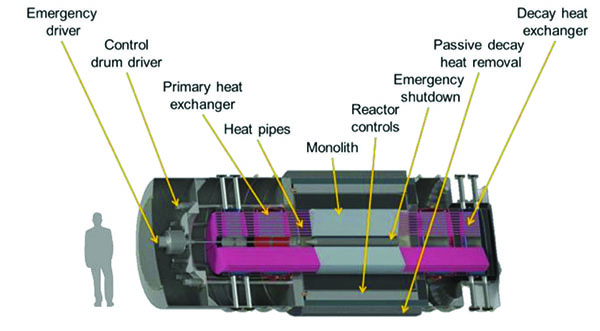
Each Deep Fission Gravity Reactor, which the company has said would be placed in boreholes at least one mile underground, generates 15 MWe. The company has said its technology is scalable, noting that “With a small footprint and dense power output, 10 reactors produce 150 MWe, while 100 reactors on one site can deliver 1.5 GWe, requiring a fraction of the land needed for traditional surface nuclear.”
The company said it uses the traditional pressurized water reactor (PWR) design for its fuel assemblies and power control methods. It said its Gravity reactors “operate at the same ~315°C core temperature, and hydrostatic pressure from a one-mile-deep column of water provides the same 160 atm of reliable pressure, safely and naturally.
“The heat produced is transferred to a steam generator at depth to boil water. This novel deployment approach applies proven geothermal components and processes for energy transfer. Non-radioactive steam rises rapidly to the surface, where a standard steam turbine converts the energy to electricity. Cables attached to the reactor allow it to be raised to the surface, if inspection is deemed necessary.” The company said its PWR uses low-enriched uranium (LEU) fuel.
Deep Fission’s reactor design in August of this year was among 11 projects picked for the government’s nuclear pilot program, which offers to fast-track testing of new designs and expedite commercial licensing. The federal program’s target is to get at least three nuclear reactors operating at a state of steady fission by July 4 of next year, the country’s 250th birthday.
Deep Fission in October said it had signed Letters of Intent (LOIs) with data centers, co-developers, industrial parks, and strategic partners totaling 12.5 GW of power generation. The LOIs outline plans to pursue commercial deployment of Deep Fission’s SMRs.
Proprietary Design
Deep Fission has said its proprietary technology design combines proven methods from the nuclear, oil and gas, and geothermal industries. The company said it will utilize off-the-shelf parts and LEU fuel to simplify supply chains. The group said placing reactors one mile underground takes advantage of surrounding geology, which it said offers billions of tons of passive shielding and natural containment. The company said its approach “aims to enhance safety and security, reduce surface footprint, and enable a faster, more affordable path to deployment.”
The company has said that its reactor could produce power for two to seven years, depending on its design. Once spent, Deep Fission could seal the reactor and leave it in place, or move it to a dedicated site for nuclear waste disposal if the U.S. eventually designates such a location. The company also has said that once a reactor is spent and sealed, new reactors could be placed on top, but only if the original borehole was more than one mile deep, so that any reactor in the same borehole was at least one mile below ground.
Deep Fission has said it estimates its model could reduce overall costs by 70% to 80% compared to traditional nuclear plants, and would deliver an estimated levelized cost of electricity (LCOE) of 5 cents to 7 cents per kWh. The completion earlier this year completed a go-public transaction and private placement financing that raised $30 million.
Regulators’ Stance Unclear
Parsons is a small town in Labette County, Kansas, near the Oklahoma and Missouri borders. It has a population of about 10,000. The Great Plains Industrial Park on the east side of Parsons covers 14,000 acres, and is the former site of the Kansas Army Ammunition Plant.
The Kansas Corporation Commission (KCC), which oversees the Kansas Energy Office, in November said it has “only had introductory meetings” with Deep Fission, and noting it is aware of the demonstration project. The KCC’s potential regulatory oversight of the nuclear power station is unclear. The agency has said Deep Fission would need the KCC to issue a drilling license and permit, and provide authorities with financial assurances, to drill the pilot hole. The agency, though, said, “Beyond that initial pilot hole, the KCC would not have jurisdiction over a nuclear reactor well.”
State political figures have voiced support for the project. “Kansas has long been a leader in energy production, and we’re continuing to diversify our portfolio with innovative technologies such as advanced nuclear,” said David Toland, Kansas’ lieutenant governor and commerce secretary. “As Deep Fission prepares to demonstrate its DOE-supported pilot reactor in Parsons, Commerce will support their efforts to integrate a thoughtful and transparent community engagement process that gives local residents clear avenues to ask questions and be part of the conversation.”
“This project supports American energy independence and will help lower energy rates for Kansans,” said Kansas Republican Senator Jerry Moran. “Our state’s skilled workforce and capabilities continue to attract new investments, and this project will help bolster Kansas’ energy infrastructure to support even more businesses and innovation.”
The state’s other U.S. senator, Republican Roger Marshall, said, “Congratulations to the Great Plains Industrial Park on its partnership with Deep Fission as part of the U.S. Department of Energy’s nuclear energy Pilot Program. As our nation’s demand for reliable, around-the-clock energy continues to grow, advanced nuclear technology will play a critical role in strengthening America’s power grid. Since coming to the Senate, I have strongly supported expanding nuclear energy, and it’s exciting to see cutting-edge innovation and high-quality energy investment come to Kansas.”
“Great Plains Development Authority is excited to welcome Deep Fission, and we are committed to supporting their work at the Kansas Proving Grounds in the Great Plains Industrial Park,” said Great Plains Development Authority Chairman Robert C. Wood. “Deep Fission’s pilot demonstrates a new level of energy innovation, showcasing Kansas’ potential to the world. The board and I look forward to building a long-term relationship with Deep Fission and the positive impacts this collaboration will bring.”
—Darrell Proctor is a senior editor for POWER.