Artificial intelligence (AI) has pushed the idea of a “one-button start-up” from sci-fi closer to engineering reality. But where is industrial AI for energy operations today, and how far away is that fully autonomous facility? A pioneering oil and gas generation project in the North Sea provides a rare, real-world look at how existing technologies are combining to drive a larger vision.
In the energy industry, there is no room for experimentation. Power systems must function reliably—across thousands of variables—every minute of every day. Although we see impressive advances in artificial intelligence (AI) in offices and consumer applications, you cannot simply transfer enterprise AI achievements to industrial environments. An algorithm that produces a slightly different answer each time may be acceptable—or even desirable—when drafting a report. In a process plant, it is not. Here, variability is a risk.
Consider a plant shut-down or start-up on an offshore oil generation field. Pumps, compressors, and subsurface drives must be shut down or brought back online in a precise, interdependent sequence. Pressures at wellheads fluctuate daily. Geological conditions change. A single misstep can cost as much as a week of lost production—or require an emergency dispatch of technicians via helicopter hundreds of kilometers from shore.
Today’s energy industry is not historically an early adopter of new technologies—and for good reason. Safety, reliability, and compliance dominate operational thinking. Yet, the sector needs to evolve. Energy assets are becoming more complex and interconnected; markets are volatile; climate objectives impose new constraints; and experienced operators are retiring faster than their expertise can be transferred. There is no single silver bullet. Instead, companies are integrating AI into operational workflows as a force multiplier, augmenting human expertise and improving decision confidence.
AI Drives Power Demand—and Vice Versa
According to the International Energy Agency, global electricity consumption by data centers is projected to more than double to around 945 TWh by 2030—a quantity roughly equivalent to Japan’s annual electricity consumption today. Power availability has become a top priority in decisions about data center locations.
The paradox: Compute-intensive AI will be one of the fastest-growing drivers of electricity demand while AI is essential for making power systems themselves more resilient, efficient, and flexible. This dual role positions AI not as a peripheral technology, but as a structural enabler of future energy operations.

In This Issue
Full issueThe energy industry needs to carefully embed AI into systems that drive or influence operational decisions. Failures can have severe financial, safety, or environmental consequences. Operators must be able to trace, audit, and verify every decision. Human oversight remains essential. In practice, this means architects need to design industrial AI systems so that: decisions are explainable and verifiable, AI supports existing safety and control frameworks, data security is ensured, human operators retain final authority, systems are seamlessly integrated with deterministic control logic, and cybersecurity is embedded at every layer.
This hybrid model—where industrial AI augments rather than replaces human expertise—is the pragmatic evolution underway in energy operations. And it depends on digital ecosystems and trusted partnerships.
Yggdrasil: A Real Proving Ground
More than 150 kilometers off the Norwegian coast in the North Sea, Aker BP’s Yggdrasil oil and gas development project offers a tangible glimpse of how these ideas are being operationalized (Figure 1). The Yggdrasil area is Norway’s largest ongoing oil and gas project and will be remotely operated from an integrated operations center and control room onshore in Stavanger. It is located between Alvheim and Oseberg and holds several oil and gas fields with gross recoverable resources estimated at about 800 million barrels of oil equivalents.
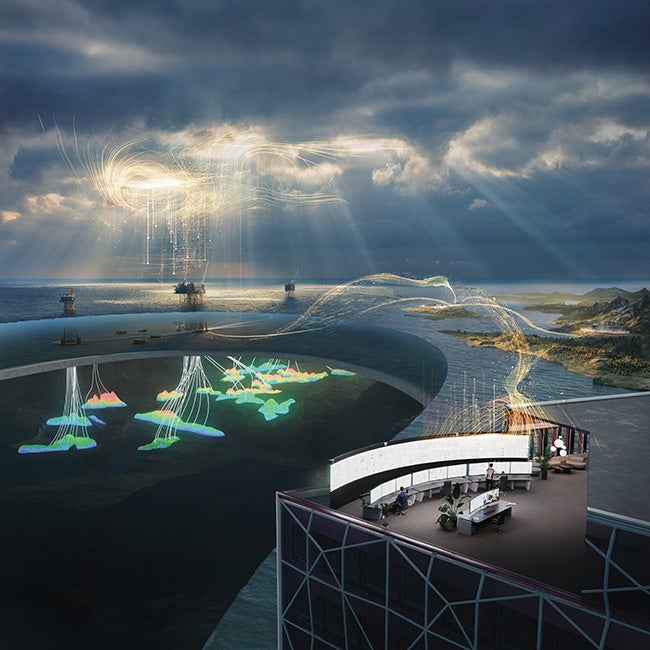
Aker BP is building three—low manned and unmanned—production platforms called Hugin A, Hugin B, and Munin for Yggdrasil with planned start of production in 2027. Electrification, digitalization, and automation will help minimizing offshore personnel exposure while enhancing operational agility.
Siemens Energy is one of the key innovation partners and is supplying electrical, instrumentation, control, and telecommunication (EICT) systems across the three Yggdrasil platforms. Yggdrasil is built to implement AI solutions in the future. Aker BP plans to embed AI in a range of operational contexts—from anomaly detection and predictive analytics to advanced scheduling and coordination tools.
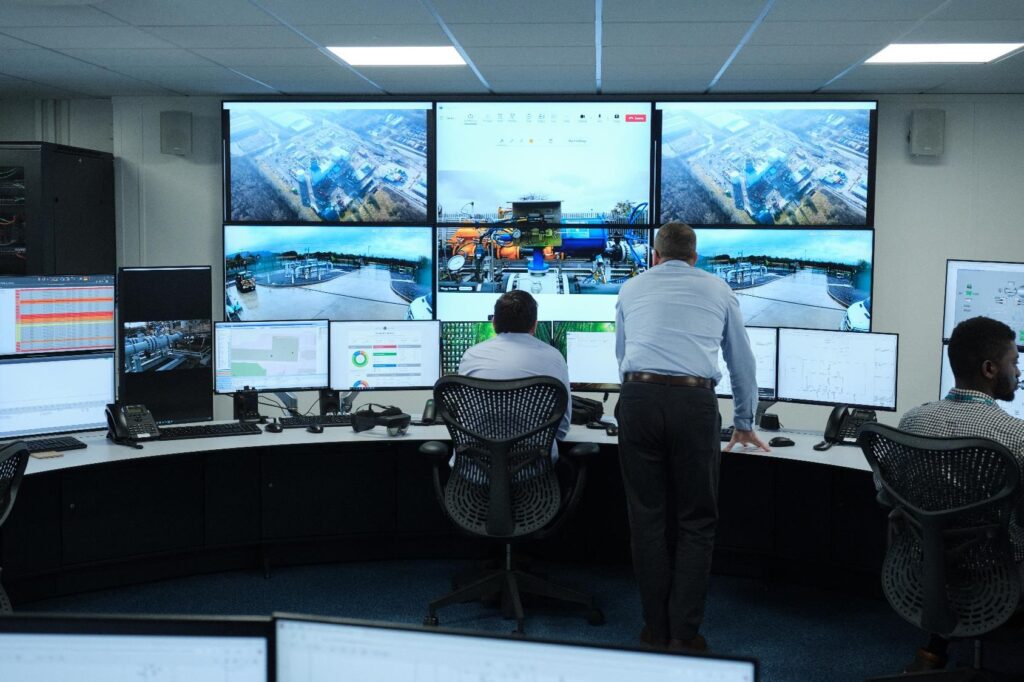
The ultimate ambition is clear: Safe and efficient start and stop, and to operate the three platforms without need for personnel in the process facilities. Two of the three platforms will be normally unmanned, and the area center Hugin A has the ambition of being periodically unmanned. Eventually, Yggdrasil aims at a high degree of autonomous operations with a one-button start-up capability. As Kristian Bay Næss, vice president of Operations in Yggdrasil with Aker BP, puts it, “The future is autonomous. Digitalization and AI are keys to that. In Siemens Energy, we have a capable and trusted partner who shares our vision.”
From Manual Processes to AI-Enabled Operations
For Yggdrasil, Siemens Energy and Aker BP are co-developing systems that enable use of AI to ingest operational data, enrich it with context, and provide timely recommendations to planners and operators. These range from anomaly alerts and prioritized action lists to fully digital shift plans that account for equipment status, safety constraints, and maintenance requirements. Over time, this allows teams to transition from reactive firefighting to predictive and proactive operations (see sidebar).
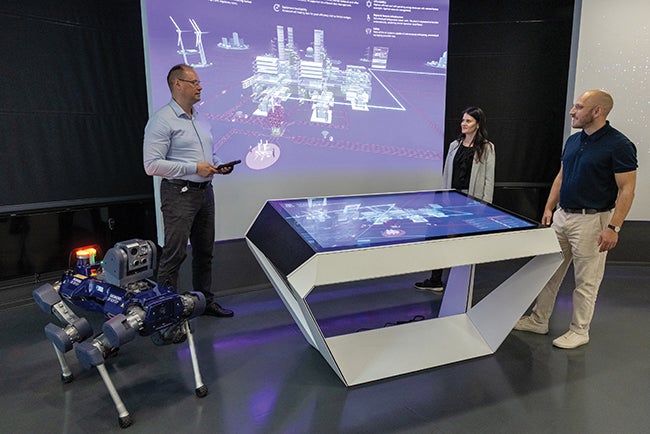
Proven AI Solutions Beyond Oil and GasIndustrial artificial intelligence (AI) doesn’t always need to be part of an ambitious, end-to-end vision to generate value. It’s already built into mature products that are gaining recognition and demand. Siemens Energy has not only integrated AI in its own manufacturing processes, but also offers proven software solutions for asset management. It combines deep domain expertise, the latest AI technologies and methods, and modern, cybersecure software design to cover all power generation core processes and domains, supporting both local and remote teams. Built on a single platform, users gain access to a unified set of data and insights. Seamless workflows between applications enable cross-role collaboration while supporting broader use cases, such as remote operator rounds and inspections, asset performance management, full-plant monitoring, and remote operations on the path to autonomous plants. The company has even gone beyond power generation. Selling power at the best price also demands advanced AI-based simulation. Virtual power plant solutions and dispatch optimization tools help operators determine the most economical generation decisions. With AI, operators can optimize revenue while respecting constraints such as carbon targets or resource availability. Siemens Energy provides these capabilities through its energy management suite, which uses AI to review day-ahead forecasts and plans, predict market prices, and forecast wind and photovoltaic output. The integration of operational data into information technology systems (IT/OT integration) becomes especially tangible in the context of physical AI. Siemens Energy deploys drones and robots to inspect facilities without sending personnel into the field (Figure 2). They focus on condition-based inspection of transmission assets and industrial plants using cameras, thermal imaging, and 3D laser scanning. AI accelerates data analysis, automatically flags anomalies, and prioritizes corrective maintenance. Siemens Energy engineers have also developed an intelligent software “brain” that enables robots to navigate and operate autonomously inside power plants.
|
The advantages of this evolutionary approach to industrial AI can work at multiple levels:
- Operational Agility. Faster start-ups and shut-downs, shorter recovery times.
- Cost Reductions. Lower unplanned downtime and more efficient maintenance.
- Knowledge Capture. Harmonized data frameworks preserve institutional expertise as workforces evolve.
- Energy System Integration. Advanced AI enables better alignment with market prices and renewable generation profiles.
- Safety Gains. Lower risk in harsh working conditions thanks to automated monitoring.
So, no boots on deck? Not yet entirely. The phrase reflects a deeper transformation: from physical presence to digital oversight, from repetitive tasks to strategic decisions, and from reactive fixes to predictive outcomes.
Industrial AI is—and will remain—essential for managing risk, protecting people, and delivering reliable, efficient, and lower-emission energy for decades. It sharpens human judgment, extends operational reach, and enhances situational awareness. But it must always respect the realities of physical systems, safety limits, and regulatory demands. Secure architecture and rigorous verification are non-negotiable for responsible autonomy.
Fully autonomous operations remain a long-term vision, but today’s deployments represent meaningful progress. A one-button start-up isn’t magic—it’s the result of meticulous planning and testing: better data, tighter models, richer simulations, robust control frameworks, and operators who move from overwhelmed to empowered. Yggdrasil’s experience offers a blueprint for offshore wind, grid operations, and hybrid energy systems. This is the pragmatic path toward autonomy in energy operations: built on trust, grounded in safety, and structured around operational determinism.
—Gerhard Koch is vice president of Digital Products and Solutions at Siemens Energy.