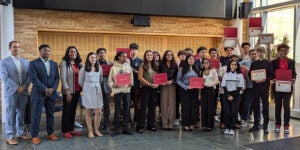
The power industry is staring down a workforce crisis. An aging labor force is heading for the exits, new recruits aren’t arriving fast enough to replace them, and a historic wave of energy infrastructure investment is only widening the gap. Against that backdrop, a partnership between Stony Brook University and Haugland Group—an infrastructure services company specializing in energy and civil construction—offers a compelling blueprint for how academia, industry, and government can work together to build a durable talent pipeline.
In a recent episode of The POWER Podcast, Derek O’Connor, Workforce Development Manager in the Office for Research and Innovation at Stony Brook University, and Rosalie Drago, Vice President for External Affairs and Strategic Engagement with the Haugland Group, discussed the suite of workforce programs they’ve developed, the model that makes them work, and why the industry needs to invest in workers long before they’re ready to step onto a job site.
A Pipeline That Leaks at Both Ends
The challenge facing the energy sector isn’t just a shortage of workers—it’s a shortage of awareness. Young people, O’Connor explained, simply don’t know where their electricity comes from or who builds and maintains the systems that deliver it. On the industry side, Drago pointed out that construction and energy work have an image problem that obscures the sector’s increasingly technical reality.
“People don’t realize how high-tech and innovative and creative the construction side is,” Drago said. “They have a very antiquated view of construction just being hammers and nails and excavators.”
The demand is acute. O’Connor noted that members of Stony Brook’s Industrial Advisory Board, which includes major players such as the New York Power Authority (NYPA), National Grid, Long Island Power Authority (LIPA), and Public Service Enterprise Group (PSEG), have identified power engineering as their single biggest workforce need. One partner, he said, told the university it needed 80 power engineers “yesterday.”
Taste of the Trades
The partnership’s flagship initiative, Taste of the Trades, was born from a deceptively simple insight: many high school students have to work during the summer, and their need for income steers them toward retail and food-service jobs rather than career-building experiences. By combining federally funded summer youth employment wages with industry-designed curriculum, the program pays students to explore energy and infrastructure careers instead.
“One of them said, ‘I would have been working two jobs over the summer, being a hostess in a restaurant,’ ” Drago recalled. “By adding a paid component, they were able to contribute to their family household income and also learn about this career.”
The program adapts its content to reflect the shifting energy landscape. The first year focused heavily on offshore wind to align with Long Island’s Sunrise Wind project; subsequent cohorts incorporated a broader mix of energy sources. The key, Drago emphasized, is making sure the curriculum stays current with market conditions and industry direction.
From Exposure to Employment
What began as a single summer program has grown into five distinct offerings that span from high school through university, each designed to feed into the next. High-performing Taste of the Trades participants can advance into a drone piloting certification program, where they earn their Federal Aviation Administration (FAA) Part 107 credentials. An HVDC (High-Voltage Direct-Current) Power Systems training draws community college students to Stony Brook’s power systems lab. A cybersecurity program called CyberLearn connects undergraduates with utility-sector internships. And EmpowerHER specifically targets young women entering the construction trades.
“What we tried to do is build programs that could either be scaled up for advanced audiences or scaled down for K–12 hands-on audiences,” O’Connor explained. “At the same time, that repository of content is able to be used in the professional education space.”
The results are tangible. Drone program graduates have gone on to study civil engineering at Stony Brook and The State University of New York (SUNY) at Buffalo. One William Floyd High School student who had no interest in college earned his drone certification, interned at Haugland, and was offered a full-time position. A Bellport High School student discovered a passion for government affairs and energy policy while interning at the company. The cybersecurity program grew from 27 to 42 students between its first and second years, with utilities recruiting directly from the cohort.
Opening Doors for Women
A particularly encouraging trend has been the rise in female participation across every program. Drago attributed much of this to visibility—young women need to see people like themselves succeeding in these careers.
“The feedback we got from all of those young women was, ‘I needed to see that someone like me was doing this work. I didn’t really know if I could succeed in that space,’ ” Drago said.
The EmpowerHER program was born from conversations with women already working in the field, all of whom said they got into the industry through a program specifically designed for women. Each week, participants learn about a different construction trade—soldering, pipe cutting, welding—visit union halls, and complete a final project.
Braided Funding
What makes the Stony Brook–Haugland model distinctive is its funding architecture. Rather than relying on any single source, the programs braid together government workforce dollars, industry sponsorship, university seed funding, and in-kind contributions. The Suffolk County Department of Labor covers student wages. Haugland provides wraparound services and recruits other industry partners to share costs. Stony Brook contributes research expertise and curriculum development. Community colleges and national labs host training sessions.
“This partnership is government, industry, education, and community organizations all together,” Drago said. “That is probably one of the most unique aspects, and really one of the reasons for success.”
The approach addresses a structural gap in the talent pipeline: employers have well-established internship programs for college students, but few mechanisms to invest in high schoolers. By using government-funded youth employment dollars to cover student wages at the high school level, the model lets employers focus their resources on the college interns they’re already set up to support, while ensuring younger students don’t fall through the cracks.
Training the Teachers
A less obvious but critical element of the model is its investment in teacher training. Rather than delivering one-off programs that disappear when the summer ends, the partnership trains high school teachers to bring current industry knowledge back into their classrooms during the school year.
“We invested in not just training the students, but in training teachers so they could go back during the year and bring that back into the school district for sustainable knowledge,” Drago explained. “They’re getting industry knowledge that’s not stale—whatever the industry is looking for now, they can bring that back.”
Educating the Community
Drago made the case that workforce development programs deliver a return on investment that goes well beyond filling job openings. When students learn about power generation and delivery, they bring that understanding home to their families and communities, helping to demystify energy projects that often face public skepticism.
“When the students gave their presentations on graduating, they said, ‘I completely have changed my thinking about these different types of power delivery. My parents had heard X, Y, and Z, but I was able to go back and actually explain it now,’ ” Drago said. “That doesn’t have a dollar amount on it. That’s something we need to do as part of the civic fabric of the communities we live and work in.”
Scaling the Model
The partnership is already replicating its approach. A program with Con Edison was modeled directly on the Stony Brook–Haugland template. Regional think tanks have adopted it as a framework for workforce grant applications. And Stony Brook recently received approximately $700,000 from NYPA to run multiple cohorts of Taste of the Trades and drone training in the Brentwood area, along with teacher training in solar panel and heat pump installation.
Looking ahead, O’Connor sees opportunities in geothermal energy, battery storage, utility-scale solar, and potentially nuclear energy. He urged industry stakeholders to reach out with their specific workforce needs.
Come to the Table with a Partner
For utilities and companies looking to replicate this model, O’Connor offered a clear starting point: don’t go it alone.
“Come to the table with at least one partner ready to go,” he said. “I’ve never launched a program here completely just out of this office. All of our programs are with an industry partner, a government sponsor, a community organization, or a K–12 school.”
Drago echoed the point, noting that every community in the country already has the building blocks: a university, a workforce training center, a government employment agency with federal summer youth funds, and local employers. The challenge isn’t a lack of resources—it’s getting the right people in the same room.
“Everyone’s got the tools,” she said. “They just need to get together and work to use them.”
To hear the full interview with Drago and O’Connor, listen to The POWER Podcast. Click on the SoundCloud player below to listen in your browser now or use the following links to reach the show page on your favorite podcast platform:
For more power podcasts, visit The POWER Podcast archives.
—Aaron Larson is POWER’s executive editor.
[Ed. note: Some quotes have been lightly edited for clarity and length.]