Ameren Illinois and Ameren Missouri found a “creative” way to strengthen their utility service territory by strategically installing fiber reinforced polymer (FRP) composite utility poles by Creative Composites Group every fifth pole on high-risk lines.
America’s Heartland is known for its commitment to hard work, industrial and agricultural achievement, and, of course, severe weather. Climate Central reported 23 billion-dollar severe weather events in the U.S. in 2025 alone. A huge cluster of the year’s severe storms and tornadoes occurred in the area served by power provider Ameren.
Ameren Illinois and Ameren Missouri needed an effective, economical, lasting way to strengthen their power grid. They found their solution in a staggered configuration of wood and TridentStrong fiber reinforced polymer (FRP) poles.
The Cost of Heartland Storms
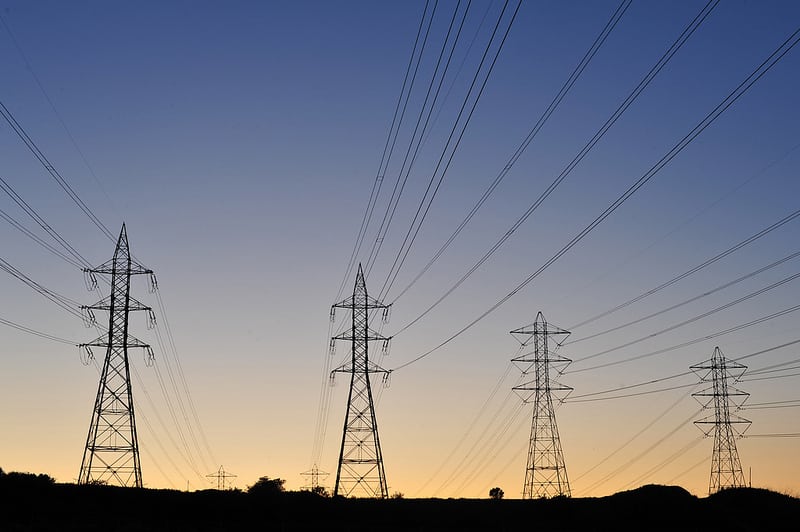
Ameren Illinois and Ameren Missouri serve approximately 2.5 million customers across these two Heartland states, covering a service territory of about 64,000 square miles. While this geography is generally safe from earthquakes and hurricanes, the region faces significant weather-related risks. Tornadoes, severe thunderstorms, and straight-line winds sweep across the Midwest’s flat terrain with regularity, producing damaging winds that can cause widespread and prolonged power outages.
Straight-line winds and severe storms can cost utilities millions, or even billions, of dollars each year. The August 2020 derecho, for example, caused an estimated $7.5 billion in damage to Heartland states in just 14 hours. And this is just the financial cost. Outages can put customers in inconvenient or even dangerous conditions, and line workers may spend days of overtime getting the power back.
Ameren is no stranger to wind-related outages. Along their lines, wind and storm damage have pulled wood poles out of the ground and even snapped them (Figure 1). Felled poles pull their wires with them, which can pull down further portions of the line, creating a “cascading outage.” Imagine a tornado hitting a quarter-mile stretch of poles directly; a cascading outage could cause a miles-long line outage.

In This Issue
Full issue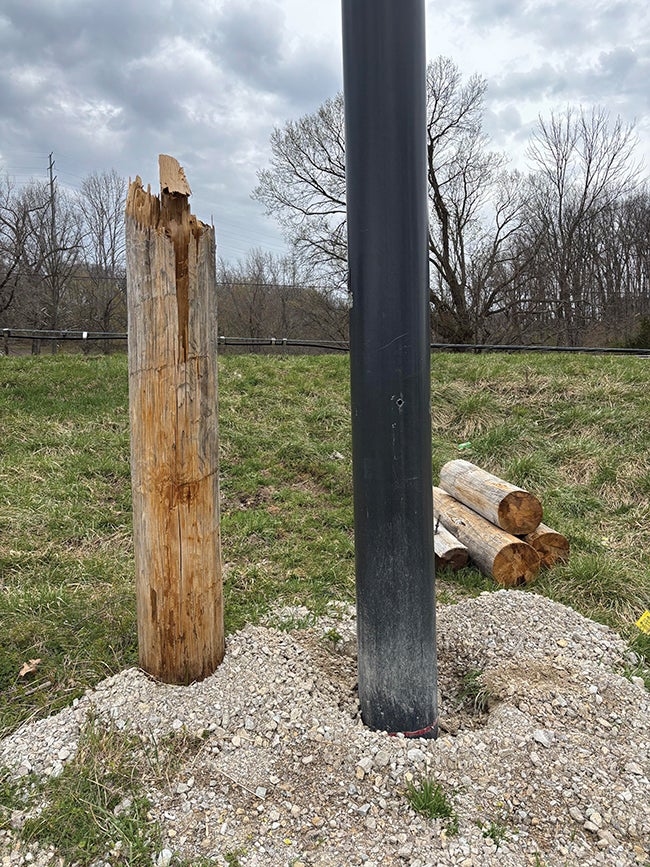 |
|
1. Strong winds can snap wood poles, such as this one, which was damaged by a storm that ripped through Wildwood, Missouri. Replacing them with fiber reinforced polymer (FRP) poles, which can withstand more force, prevents outages. Courtesy: Creative Composites Group |
A Staggering Difference
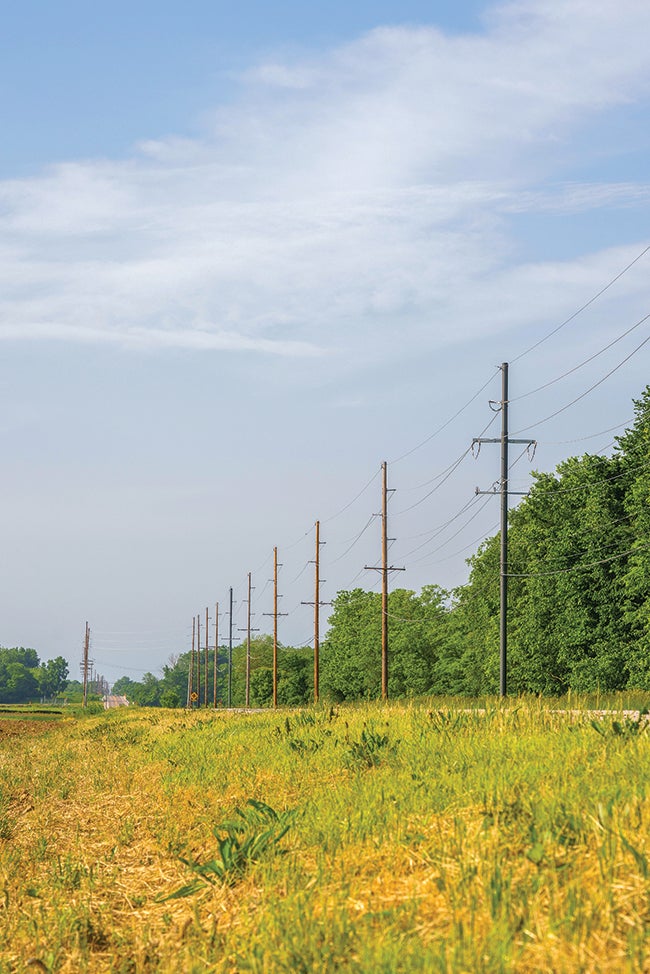
To strengthen their grids in high-wind zones up to 20 miles long, Ameren Illinois and Ameren Missouri tested a staggered installation that mixed conventional wood poles with TridentStrong poles (Figure 2), made of pultruded FRP composite. Ameren calculated the interval by measuring the number of sub-transmission poles a single line crew could replace in a single working day during storm conditions. Both Ameren companies identified their most at-risk areas and installed single-layer, 14- to 15-inch diameter sub-transmission poles every fifth pole, separating each FRP pole with four conventional wood poles.
 |
|
2. Interspersing FRP poles every so often between wood poles is a grid-hardening technique that has proven to work. Courtesy: Creative Composites Group |
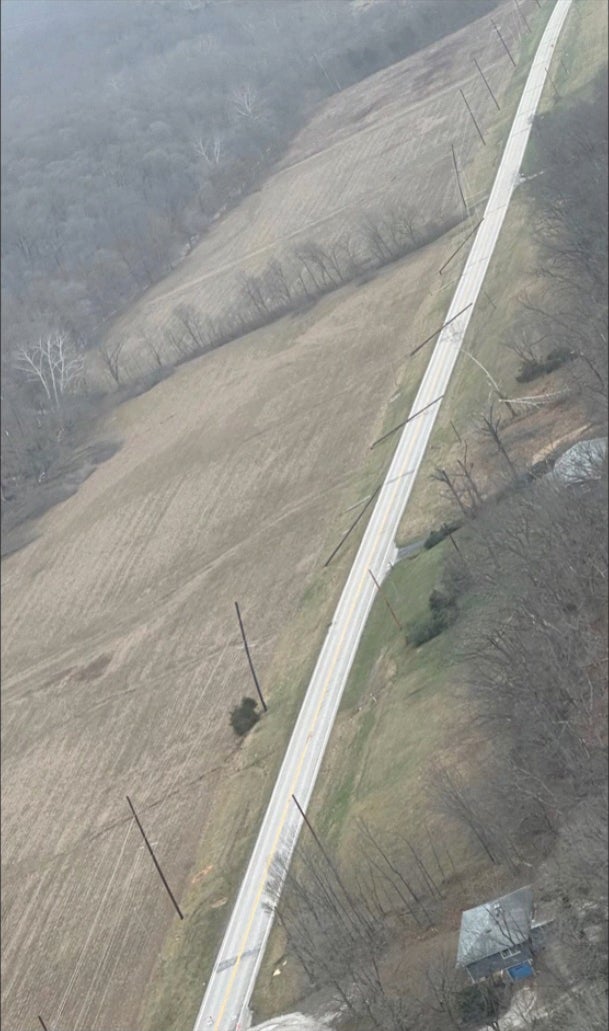
The staggered installation proved extremely successful when tested by strong storms: some wood poles along the hardened lines snapped in the wind, but the composite poles remained standing (Figure 3). This prevented a cascading outage and isolated the impact to a much smaller segment of the line.
 |
|
3. This view from the air shows wooden poles that broke, but FRP poles remained standing. The staggered installation method avoided a cascading outage. Courtesy: Creative Composites Group |
Even better, this configuration is more than 10 years old, and Ameren’s FRP poles are still performing like new after more than a decade of storms. A spring 2025 storm took out many of Ameren Missouri’s wood poles, but its TridentStrong poles remained upright, significantly minimizing damage and outages. The excellent total life-cycle cost of FRP poles has made Ameren’s phased integration highly successful, with more than 10,000 FRP poles currently in service across the two states (7,000 in Missouri alone). These poles have remained in service far longer than many standard wood poles, which sometimes must be replaced as quickly as two years after installation.
At the core of FRP’s success is the unique combination of strength and stiffness inherent to composite materials. Decades of use have shown that pultruded FRP utility poles can absorb strain energy far more efficiently than traditional construction materials, delivering flexibility without compromising strength. Like poles of any material, composite poles are designed and specified based on strength and stiffness criteria. FRP materials are inherently strong in tension, compression, and bending.
Comparing equivalent geometries, most FRP poles exhibit bending strengths that exceed those of Grade 50 (50,000 pounds per square inch) steel. The pultruded poles Ameren selected have a longitudinal Young’s modulus of elasticity (the ratio of stress to strain) of approximately one-sixth that of steel. This results in a structural member that combines high bending strength with a relatively moderate modulus of elasticity. When straight-line winds blast through Ameren’s lines, the FRP poles can flex, keeping any damage to the lines isolated to the staggered section, as the images show.
More Than Storm-Hardening
Composite utility poles can deliver benefits beyond wind resistance. Composite poles now have a dedicated ANSI/ACMA standard to ensure consistent, quality specification and design. The brand Ameren chose for its grid-hardening efforts are also more resistant to:
- ■ Impacts, with the ability to “spring back” after being bent or hit better than other pole materials.
- ■ Corrosion, inherently resisting damage from water and salts, like from humidity, weather, and road treatment products.
- ■ Pests, proving unattractive to wood-loving critters like termites, woodpeckers, and beavers.
- ■ Conductivity, with an excellent dielectric strength, far greater than steel and even wood.
Their choice has also helped to shorten lead times and to meet Build America, Buy America (BABA) requirements, as TridentStrong poles are completely sourced and made in the U.S. Other utility providers, including Dominion Energy, have seen similar supply chain-related benefits from integrating composites into their lines.
And FRP’s excellent strength-to-weight ratio means that the poles are easier to transport to installation sites, even to poorly accessible rural areas. The poles are durable but lighter weight, making them safer and easier for line crews to move around a job site during installation and maintenance. They can also come with factory-drilled holes to minimize on-site drilling and with ground wires pre-installed inside the pole to discourage copper theft and to streamline installation.
Stronger Together
Ameren’s case is just one of many that demonstrates the value of a multi-medium approach to power grids. FRP is another tool in the proverbial toolbox that can bring substantial benefits to users. Using both wood and composite poles has certainly been a winning combination in Tornado Alley.
—Ted Fotos is the president of Trident Industries, a member of Creative Composites Group.