Data centers are connecting to the transmission system faster than the reliability rules were built to handle and behaving nothing like the passive load those rules assumed. Here’s what the North American Electric Reliability Corp.’s (NERC’s) Large Loads Action Plan, a new class of registered entity, and a hard 2026 deadline mean for anyone planning, studying, or building these interconnections.
At about 7 p.m. on July 10, 2024, a lightning arrester failed on a 230-kV line in the Eastern Interconnection. The protection system cleared the resulting permanent fault and ultimately locked out the line. Its automatic reclosing scheme was configured for three attempts staggered at each end, producing six voltage depressions in 82 seconds. Each lasted between 42 and 66 milliseconds, while voltage in the affected load area fell to between 0.25 and 0.40 per unit.
None of that was particularly unusual. Faults occur, and protection systems clear them.
The load side is where it stopped being routine. Coincident with the six voltage depressions, about 1,500 MW of demand disappeared from the system—all of it data center-type load in an area with a high concentration of data centers. Utility equipment did not disconnect the load; customer-side protection and controls did.
Frequency climbed to 60.047 Hz and returned to 60 Hz in about four minutes. Voltage rose as high as 1.07 per unit, prompting operators to remove shunt capacitor banks to return it to normal operating levels. NERC documented the disturbance in a January 2025 incident review that has since become an important case study in the reliability risks posed by large, voltage-sensitive loads.
Here is the part that should bother anyone who plans a grid: The data centers weren’t even on the faulted line. A disturbance elsewhere on the system was enough to make a power plant’s worth of load vanish in seconds because that load had come onto the grid through a process designed for ordinary, passive demand and then acted nothing like it.
The bulk system is extensively planned and studied around the loss of large generators. It has far less experience and standardized modeling for the synchronized loss of hundreds or thousands of megawatts of load. Close the gap between how these loads connect and how they actually behave once they’re energized, and you’ve described most of what NERC has been working on for the past two years.
It starts at interconnection.
The numbers are what make it urgent. NERC’s 2025 Long-Term Reliability Assessment expects North American summer peak demand to grow by about 224 GW over the next decade—more than 69% above the growth projected just a year earlier—with new data centers for artificial intelligence and the digital economy accounting for most of the increase. Individual campuses now run from hundreds of megawatts into the gigawatts, the size of a large power plant, except they sit on the demand side and are far harder to predict.
And they arrive fast. A data center can go from a plan to a live load in one to two years, while the transmission needed to serve it reliably takes years, often much longer. The interconnection rules were written for a world where the largest, most dynamic things joining the grid were generators. That world is gone, and the rulebook hasn’t caught up.
A Process Built for Generators, Applied to Loads
In its March 2026 gap assessment, NERC’s Large Loads Working Group concluded that existing reliability standards, interconnection requirements, and industry practices are inadequate to reliably integrate emerging large loads.
On paper, two Facilities Design, Connections, and Maintenance standards already address the interconnection process. FAC-001 requires applicable entities to establish facility interconnection requirements, while FAC-002 requires planners to study the reliability impact of new or materially modified interconnections, including electricity end-user facilities. FAC-002 calls for steady-state, short-circuit, and dynamic studies as necessary.
It helps to look at how a generator connects. That process is broadly standardized: defined studies, defined performance requirements, dynamic models, and increasingly ride-through obligations that must be met, enforceable through NERC standards such as PRC-024 and PRC-029, with the voluntary Institute of Electrical and Electronics Engineers (IEEE) 2800 framework for inverter-based resources sitting alongside them.
Large-load interconnection has no settled equivalent. Because it usually proceeds through state-jurisdictional utility tariffs, study requirements and performance expectations vary from one utility to another. No uniform NERC-wide framework yet matches the generator-side requirements for model validation and commissioning or comprehensively verifies that an emerging large load’s as-built dynamic behavior matches the assumptions used in the interconnection study. There is no standard commissioning test for how the facility behaves on the grid and no uniform obligation to keep those models current once it is operating.
So planners end up studying these facilities half-blind to how they’ll actually act.
Then there’s the specific gap that emerged in July 2024, and at bottom it’s a coordination problem. On the utility side, the transmission owner sets relay pickups, breaker clearing times, and reclosing schemes. On the facility side, the owner programs the ride-through logic buried in the uninterruptible power supply (UPS) systems and drives. Historically, neither side had any reason to show the other its settings, so the two protection schemes run blind to each other.
A fault the utility clears exactly as intended can still knock the load offline because the facility’s own protection reads the voltage sag as a threat to its equipment and jumps to backup. Some sites take it further: They count disturbances, and after a set number of sags in a short window—commonly three in a minute—they transfer to backup and stay there until someone reconnects them by hand.
In the July event, that counting logic did the real damage. About 1,260 MW dropped out at the third reclose and didn’t return for hours. Put a cluster of facilities running the same logic in the same area, and a routine fault becomes a contingency the size of a power plant.
Underneath it all sits a data problem.
Most large loads aren’t NERC-registered entities, and the load-serving entity function that might once have covered them was taken out of the registry about a decade ago. That means these facilities are not directly obligated under NERC reliability standards to provide planners with accurate dynamic models, ramp rates, or performance data.
In practice, it’s worse than that. The company developing the site often isn’t the one that will operate it, so the details a study actually needs may not exist until late in the game, and operators may guard what they do know as commercially sensitive.
You end up with exactly what you’d expect: models that don’t match reality, feeding studies that can’t see the risk coming.
Rebuilding the Rulebook
NERC’s answer is a three-part action plan, and it’s moving unusually fast for a standards body.
The centerpiece is registration. For the first time, NERC has proposed a new class of registered entity—the computational load entity (CLE)—so qualifying facilities would fall directly under mandatory reliability standards instead of sitting outside them as ordinary customers. The criteria proposed in April 2026 would capture computational facilities with at least 20 MW of aggregate connected load, connected at a single point to the bulk power system at 60 kV or above, and hosting at least 1 MW of computational load. The proposal would require changes to NERC’s Rules of Procedure.
Everything else hinges on this step because without registration, standards can reach utilities on the grid side but have much less direct reach into the facilities actually creating the behavior. NERC is working toward filing the criteria by the end of 2026.
Running alongside it is the standards work itself. Project 2026-02, launched in March 2026, is developing the requirements that would apply to computational loads. The first phase is moving on an accelerated 2026 schedule, with broader work expected to follow in 2027.
Read the issues under discussion, and it looks a lot like parts of the generator playbook ported to load: better dynamic models and model maintenance, commissioning and validation, closer operational coordination, and more explicit treatment of protection and ride-through behavior. The precise requirements are still being developed, and NERC has indicated that some broader requirements, including industrywide minimum voltage- and frequency-ride-through thresholds, may fall outside the initial 2026 standards package.
The third piece is guidance operators can use today. NERC’s May 2026 reliability guideline, Risk Mitigation for Emerging Large Loads, is voluntary, but it addresses many of the same issues driving the standards work, with chapters on data collection and modeling, interconnection studies and re-study triggers, commissioning, real-time monitoring, and stability.
Two alerts back it up. First, a Level 2 industry recommendation issued in September 2025, Large Load Interconnection, Study, Commissioning, and Operations, took stock of how ready the industry actually was on modeling, interconnection requirements, study processes, and commissioning.
The second carried more weight. A Level 3 essential actions alert issued May 4, 2026, identified seven immediate actions across modeling, studies, instrumentation, commissioning, operations, protection, and control. Registered entities were required to report by Aug. 3 on the status of their activities related to those actions.
What turned all of this from a schedule into a deadline was the Federal Energy Regulatory Commission (FERC).
On July 16, 2026, FERC ordered NERC to file its computational-load reliability standards by the end of the year, having concluded that the pace of data center growth left no room to wait. The commission also directed NERC to file associated revisions to its Rules of Procedure, including computational load entity registration criteria, by Dec. 31, 2026.
Separately, FERC has been examining broader interconnection reform for large loads in Docket No. RM26-4. In June, the commission opened six regional show-cause proceedings focused on large-load interconnection practices at regional transmission organizations and independent system operators. FERC also has an open co-location proceeding.
NERC must now file the registry criteria alongside the standards by the end of 2026, submit a March 2027 filing laying out the next phase, and continue building the broader standards through 2027.
What It Means at the Point of Interconnection
For anyone who plans, studies, or builds these interconnections—and we spend our days on the facility side of them—the direction is now clear enough to design toward, and it’s cheaper to build for it now than to retrofit later.
The process is converging on parts of the generator model. Expect greater scrutiny of dynamic models and model maintenance, more formal commissioning and validation, and closer operational coordination with grid operators. The protection blind spot—utility relaying on one side, facility ride-through logic on the other—is exactly what a serious interconnection study ought to be dragging into the open now, with settings shared both ways.
There’s an opportunity buried in all of this, and it favors whoever gets ahead of it. A facility built from day one to ride through normally cleared faults, coordinate its protection with the transmission system, and smooth its own swings is a facility less likely to show up as a hidden contingency once it connects.
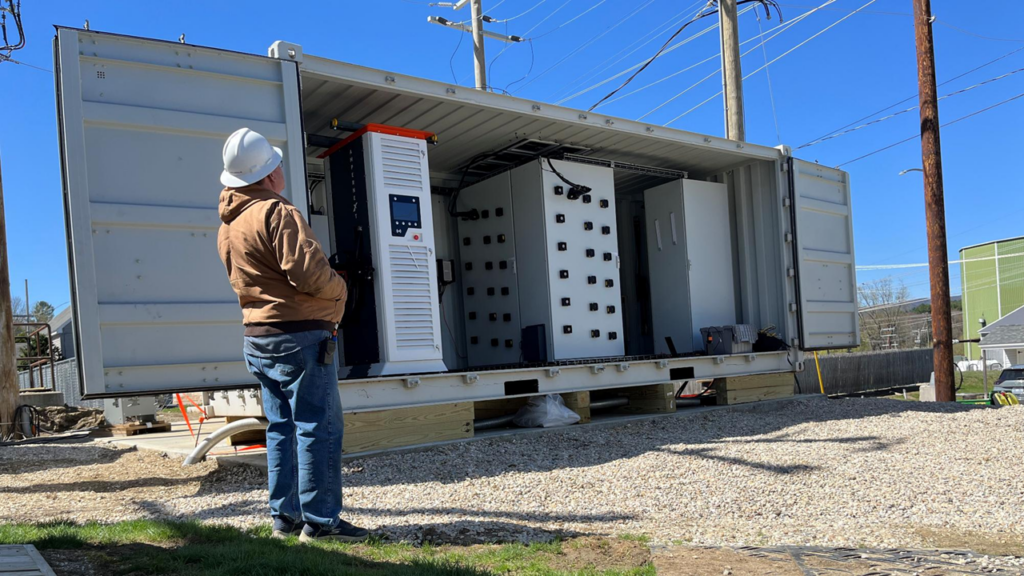
Most of the engineering already exists. NERC’s own analysis notes that pairing large loads with utility-scale batteries and grid-forming inverters can take roughly 70% off the subharmonic currents some AI workloads throw onto the system. Load smoothing can blunt the ramps that make these sites so difficult to balance, while better modeling, monitoring, protection coordination, and control strategies can address some of the reliability risks NERC has identified.
Not everything is solved. NERC is candid that some stability behaviors are still poorly understood. But for ride-through, protection coordination, and raw volatility, the tools are increasingly understood. Using them is about to become much more important.
The question at the point of interconnection isn’t the one it used to be. For years, it came down to whether the system could physically deliver enough power to a new load. Now that a power plant’s worth of demand can show up at a single site, and the standards are being written more or less in real time to keep pace, the question is whether that load can connect in a way the grid can live with during the next fault.