
Articles By

-
 News
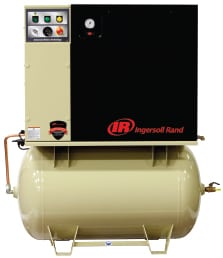
NewsRotary Screw Air Compressor
Ingersoll Rand is offering a newly improved single-phase control scheme for its 5 and 7.5 versions of the small UP6 5-15c line of air compressors. It has added a run-on timer and load/unload and blowdown solenoids to improve the reliability and performance of single-phase units in general industrial applications up to 28 cfm. The company […]
-
 Marmaduke
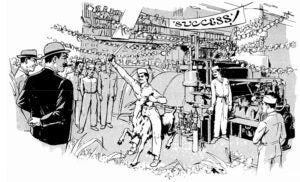
Marmy’s One-Squirt Celebration
Steve Elonka began chronicling the exploits of Marmaduke Surfaceblow—a six-foot-four marine engineer with a steel brush mustache and a foghorn voice—in POWER in 1948, when Marmy raised the wooden mast of the SS Asia Sun with the help of two cobras and a case of Sandpaper Gin. Marmy’s simple solutions to seemingly intractable plant problems remain timeless. This Classic Marmaduke story, published more than 50 years ago, reminds us that an overhaul or startup may not go as planned, but it can still have a happy ending.
-
 News
NewsCompact Electric Pump
A new compact electric pump designed for bolt tensioning applications in the wind turbine industry is now available from specialist bolt tensioner manufacturer Boltight Ltd. The standalone power pack is lightweight (19.5 kg) and portable, as the pump, reservoir, and motor are combined into one easily handled package. The 0.75-kW rated pump is driven by a 220-240 V single-phase electric […]
-
 O&M
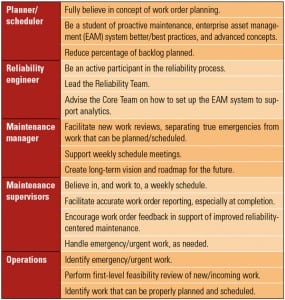
O&MBreaking the Cycle of Reactive Maintenance
Nobody can schedule unplanned events that will affect power generation. And no one wants to start a day expecting an emergency to occur. But when critical systems fail in the power supply system, it’s time to respond. That’s a given of power plant maintenance.
-
 News
NewsFlowmeter for Utility Gases
Endress+Hauser released the Proline t-mass 150 thermal mass flowmeter for measuring gases such as compressed air, nitrogen, carbon dioxide, and argon. The flowmeter measures mass flow, gas temperature, free air delivery, and corrected volume—all without the need for pressure or temperature compensation. The t-mass 150, with its high turndown of 100:1, can reliably measure small […]
-
 Business
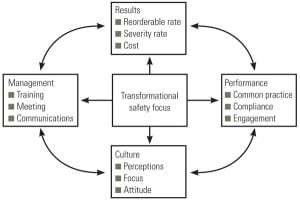
Safety Measurement: Culture Shaping or Failure Avoidance?
“It is a new month. I want you all to work very hard to fail less than previous months. I’ll be measuring. Failures will not be tolerated. Anyone caught doing so will be disciplined by his or her peers and/or leadership.”
-
 News
NewsComprehensive Spectrophotometer
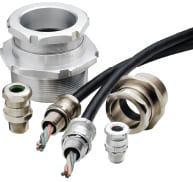
Hach Co.’s new DR 6000UV-Vis spectrophotometer was designed to fulfill any water testing needs using one spectrophotometer. It is equipped with RFID technology, integrated QA software, and more than 250 testing methods and guided procedures. The instrument is programmed to take absorbance readings of a single sample at different wavelengths or over a specific period […]
-
 Business
Women in Power Event Provides Networking Opportunities
From success stories to war stories, members of the Women in Power Panel Discussion shared their insights about working as women professionals in the U.S. electric power industry at the 2012 ELECTRIC POWER Conference in Baltimore on May 16. The gathering featured lively exchanges between panelists and a large number of attendees (Figure 4). The panel discussion was organized by co-chairs Angela Neville, JD, senior editor of POWER, and Colleen Campbell, business development director at CH2M HILL.
-
Commentary
Wind Energy Blown Away by Natural Gas
The environmental push for renewables and mandates to force them into existence are rightly facing some serious headwinds. The American Renewable Energy Production Tax Credit Extension Act of 2011 foundered in Congress, and more states are experiencing significant power rate increases to cover renewable energy production costs. While renewables are generally not ready for prime time in large quantity on today’s power grid, that doesn’t mean environment concerns ought to be trashed, especially when a more effective off-the-shelf solution is available.
-
Coal
Tactical Advantage
A three-judge panel of the U.S. Court of Appeals for the D.C. Circuit on June 26 unanimously rejected all pending legal challenges against the U.S. Environmental Protection Agency’s (EPA’s) interpretation of the Clean Air Act (CAA) that allows the agency to regulate greenhouse gases (GHGs). What is the EPA’s future strategy in its war on coal?
-
Legal & Regulatory
Proposed Cooling Water Rule’s Ripple Effects
The U.S. Environmental Protection Agency (EPA) has a long history of making waves with the electric power industry because of its efforts to regulate the way thermal power plants construct and operate their cooling water intake structures (CWIS). These structures divert billions of gallons of water into power plants’ cooling systems and can injure or kill billions of aquatic organisms.
-
-
 O&M
O&MPlant of the Year: AES Gener’s Angamos Power Plant Earns POWER’s Highest Honor
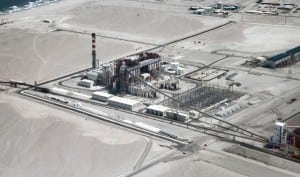
AES Gener recently completed construction of twin coal-fired, 260-MW units in the electricity-starved desert of northern Chile that may serve as models for future hybrid-fossil plant designs. For meeting an aggressive construction schedule, integrating a 20-MW battery energy storage system, embracing desalination, using the first-of-its-kind seawater cooling tower in South America, and employing innovative financing methods, the AES Gener Angamos plant has earned POWER’s 2012 Plant of the Year Award.
-
 Hydro
HydroMajor Developments for Solid Oxide Fuel Cells
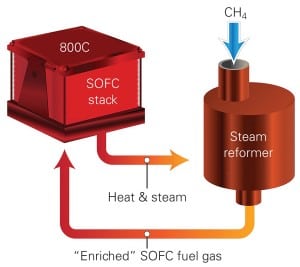
Solid oxide fuel cells (SOFCs), which oxidize a fuel to produce electricity, have received much attention of late for the technology’s myriad benefits, including high efficiency, long-term stability, fuel flexibility, and low carbon emissions—all at a relatively low cost.
-
 Waste to Energy
Marmaduke Award: Combined Solar Technologies’ Hybrid Plant: Using Wastewater and Olive Pits to Produce Clean Water and Clean Energy
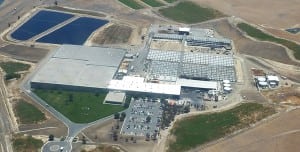
Combined Solar Technologies (CST) has designed, built, owns, and operates a water purification system located at the Musco Family Olive Co. facility in Tracy, Calif., that burns olive pits to purify highly saline wastewater through a distillation process while also producing electric power. For its pioneering approach, CST is the winner of POWER’s 2012 Marmaduke Award for excellence in plant problem-solving. The award is named for Marmaduke Surfaceblow, the fictional marine engineer and plant troubleshooter par excellence, whose exploits were chronicled in POWER beginning in 1948.
-
 Wind
WindThe Age of the Mammoth Wind Turbine Blade
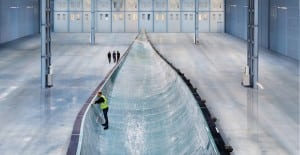
Siemens Energy in June announced it had produced the first batch of its new B75 Quantum wind turbine rotor blades, fiberglass components 75 meters (m) in length that were cast in one piece (Figure 3). The blades were manufactured to be installed this fall on Siemens’ second prototype of the German firm’s SWT-6.0 6-MW offshore […]
-
 Solar
SolarSmart Grid Award: Customers Motivate San Diego Gas & Electric’s All-Inclusive Smart Grid Vision
“If you build it, they will come” has proven a risky strategy for some smart grid projects. One of California’s largest investor-owned utilities faced the opposite challenge—customers whose behaviors necessitated a smarter grid. Customer involvement in and support for smart grid plans is a major reason SDG&E’s smart grid efforts continue to garner accolades, including the 2012 POWER Smart Grid Award.
-
General
Too Soon to Make Sense of the India Blackouts
By Kennedy Maize (@kennedymaize) Washington, D.C., 31 July 2012 – What to make of the two successive, horrendous electric power failures in India? The smart money avoids conclusory leaps. When the first cascading blackout hit on Monday, there was much media chatter about generating capacity. The implication was that the outage was demand-driven. But there […]
-
Coal
WPL to Retire Three Coal Units, Tamp Down Pollution Emissions with New Controls
Wisconsin Power and Light (WPL) Co. plans to retire three of its oldest and smallest coal-fired generating units and invest $1.4 billion into the company’s generating fleet over the next five years to ensure it will be able to manage "current and emerging environmental regulations," the Alliant Energy Corp. subsidiary announced on Friday.
-
Coal
Consent Decree Could Force Closure of FirstEnergy Coal Ash Impoundment Facility in Penn.
A lawsuit filed in federal court on Friday by Pennsylvania’s Department of Environment Protection (PDEP) alleges that FirstEnergy’s Little Blue Run Dam coal ash impoundment pond in Beaver County, a facility that stores coal ash from the generator’s 2,470-MW Bruce Mansfield coal-fired power plant in Shippingport, Pa., has leached heavy metals in drinking water supplies and surface water. A proposed consent decree could force the generator to shut down the impoundment facility.
-
Too soon to make sense of the India blackouts
Washington, D.C., 31 July 2012 – What to make of the two successive, horrendous electric power failures in India? The smart money avoids conclusory leaps. When the first cascading blackout hit on Monday, there was much media chatter about generating capacity. The implication was that the outage was demand-driven. But there was nothing particularly unusual […]
-
Coal
Eight Oxy-Combustion Projects Get DOE Awards to Advance CCUS
The Department of Energy (DOE) on Thursday announced it would award $7 million to eight projects to advance the development of transformational oxy-combustion technologies capable of high-efficiency, low-cost carbon dioxide capture from coal-fired power plants. Leveraged with recipient cost-sharing to support about $9.4 million in total projects, the awards are expected to support the development and deployment of “carbon capture, utilization, and storage (CCUS)” by focusing on further improving the efficiency and reducing the costs associated with carbon capture.
-
Coal
Federal Court Rejects Challenges to EPA Industrial, Automotive GHG Rules
A three-judge panel of the U.S. Court of Appeals for the D.C. Circuit on June 26 ruled that the U.S. Environmental Protection Agency (EPA) was "unambiguously correct" in its interpretation of the Clean Air Act (CAA) to regulate carbon dioxide emissions. The federal agency’s endangerment finding that greenhouse gases (GHG), including carbon dioxide, are a threat to public health and welfare, and its decision to set limits for industrial and automotive emissions of GHGs, was "neither arbitrary nor capricious," the court ruled. The court, however, found that it lacked jurisdiction to review the timing and scope of the GHG rules that affect larger stationary sources, including new coal-fired power plants.
-
Coal
EPA Proposes Clean Air Standards for PM2.5
In response to a court order, the U.S. Environmental Protection Agency (EPA) proposed updates on June 15 to its national air quality standards for harmful fine particle pollution, including soot (known as PM2.5). The agency says that 99% of U.S. counties are projected to meet proposed standards without any additional actions.
-
O&M
Coal Could Regain Ground from Gas as Summer Demand Ramps Up
Natural gas-fired generation enjoyed a competitive advantage through this past winter and spring as historically low prices for the commodity combined with mild weather and relatively light demand to turn the dispatch stack on its head and favor gas over coal. That advantage is narrowing as summer demand approaches. A senior market analyst with Bentek Energy expects coal-fired generation to be advantaged at least until the fall shoulder season.
-
 Commentary
Changing of the Guard
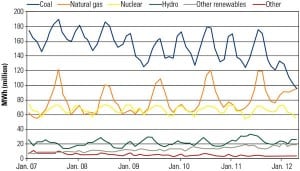
Preliminary data published by the Energy Information Administration shows that the amounts of power generated by coal and natural gas in April were virtually equal. Was this a one-time event or an indicator of a future trend?
-
Commentary
Stopping the EPA: The Long Game
The D.C. Court of Appeals recently declined to examine the science behind the EPA’s Endangerment Finding that is the foundation beneath the its greenhouse gas rules. The next step is to challenge the EPA’s science.
-
Commentary
Green Jobs Count: Fewer Than Before, Sillier Than Ever
The Bureau of Labor Statistics has released another report on green jobs. According to the BLS, an oil industry lobbyist could be considered as having a green job. The report’s definitions still lack common sense.
-
 O&M
O&MWhy Coal Plants Retire: Power Market Fundamentals as of 2012
Announcements about coal plant retirements have become commonplace. Are new EPA rules completely to blame, or are there other power market pressures at play?
-
 Coal
CoalDesign Features of Advanced Ultrasupercritical Plants, Part III
Advanced ultrasupercritical (A-USC) is a term used to designate a coal-fired power plant design with the inlet steam temperature to the turbine at 700C to 760C. In the first two parts of this three-part report, we introduced the A-USC boiler and the metallurgical advancements required for the A-USC boiler to operate at such high temperatures. This final report explores the A-USC boiler’s unique design challenges.