INSTRUMENTATION & CONTROL
Single-window control of CHP plant’s energy converters
In February 2005, APS Energy Services and its Northwind Phoenix subsidiary together began building a gas-fired combined heat and power (CHP) plant on the campus of Arizona State University (ASU) in Tempe. Northwind markets, develops, designs, finances, constructs, and operates district-heating plants throughout Arizona.
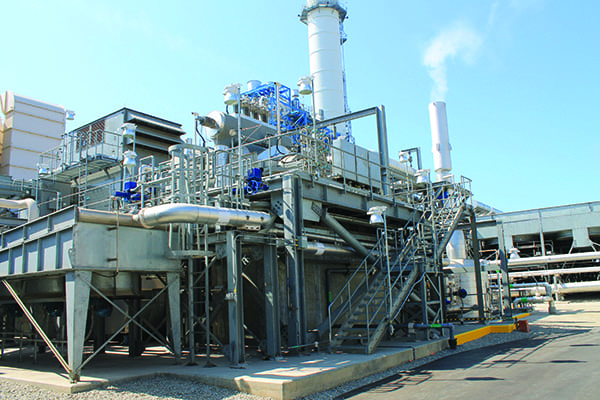
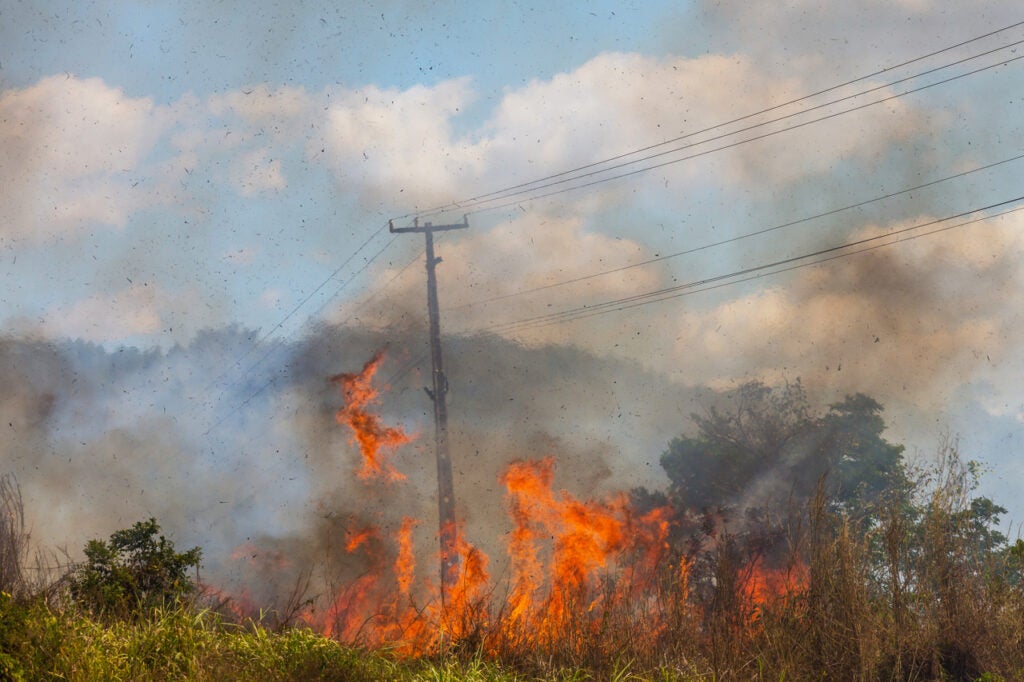
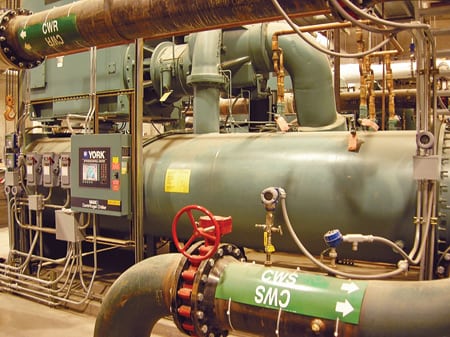
Phase I of the ASU plant is now on-line. It has five 2,000-ton water chillers (Figure 1) from York (www.york.com), a 7.2-MW natural gas–fired combustion turbine (CT) from Solar Turbines Inc. (mysolar.cat.com), a 2-MW Murray steam turbine (www.dresser-rand.com), an 80,000-lb/hr heat-recovery steam generator (HRSG) from Rentech Boiler Systems Inc. (www.rentechboilers.com) equipped with a Coen duct burner management system (www.coen.com), and a pair of 2-MW diesel engine generators from Cummins Power Generation Inc. (www.cumminspower.com).
|
1. Keeping the kids cool. The combined heat and power plant on the campus of Arizona State University includes five 2,000-ton chillers like this one. The plant’s chilled-water capacity is currently being expanded to 24,000 tons. Courtesy: APS Energy Services
|
Subsequent construction phases will more than double the chilled water capacity and increase the power and steam outputs of the cogeneration system to levels suitable for supplying ASU’s rapidly growing research facilities. The CHP plant will ultimately generate 160,000 lb/hr of steam, 18.4 MW of electricity, and 24,000 tons of chilled water, making it perhaps the largest university central plant in the U.S.
The plant, which operates 24/7, required a state-of-the-art control system that also is easy to use. So APS and Northwind specified a Matrix Total Control unit from MTL Open System Technologies (www.mtlmost.com) that puts all operator functions within a single display window. According to Ray Tena of ASU’s facilities department, “the system’s graphics and controls are easy to navigate and provide an effective and responsive operator interface.”
The control system comprises four redundant pairs of Matrix hybrid controllers, eight remote nodes, each with a redundant pair of Ethernet bus interface and I/O modules, two double-tier operator consoles, one remote interface terminal server, and one engineering station and industrial SQL server historian, all of which communicate over a fault-tolerant Ethernet network (Figure 2). The system oversees the five chillers, the HRSG burner management system, and the two diesels and two turbines, and also operates the facility’s primary circuit breakers.
|
2. Tightly integrated controls. Parts of the control system communicate with each other over a fault-tolerant Ethernet network. Courtesy: APS Energy Services
|
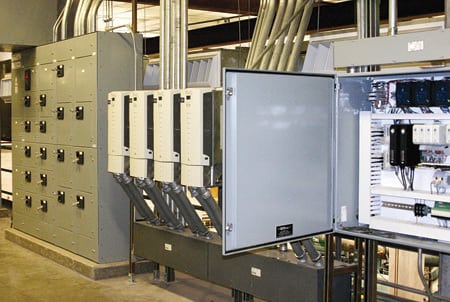
Interfaces to multiple intelligent devices (including Rotork smart valves, GE smart relays, and ABB variable-speed AC drives) were essential to providing the single-window operator environment. More than 20 separate system interfaces enable more than 75 devices to talk to each other. Additionally, there are Ethernet interfaces to the programmable logic controllers of the combustion turbine and the HRSG duct burner management system.
Working with the control system, an industrial applications server and a FactorySuite Model A2 human-machine interface from Wonderware (www.wonderware.com), a subsidiary of Invensys Systems Inc., provide the single control window to all areas of the plant. The chillers and the combustion turbine are operated separately by the same operator from the facility’s only control room (Figure 3). Different-color backgrounds (blue for the chillers, green for the CT) distinguish the two systems.
|
3. Screening room. Color-coded backgrounds differentiate the controls of the chillers and the combustion turbine. Courtesy: APS Energy Services
|
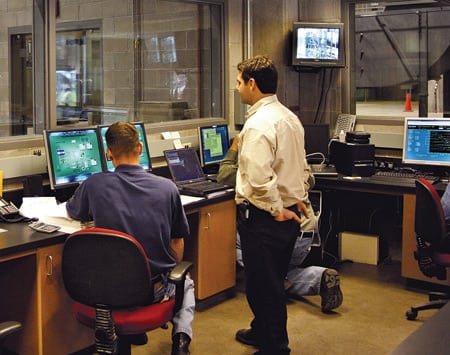
Significantly, the control system enables all equipment of the CHP plant at ASU to be monitored and controlled remotely by operators at another Northwind site via the company’s wide-area network. That feature allowed operators of the ASU plant to be trained onsite without disrupting operations on campus while the system was operated from Northwind’s downtown Phoenix headquarters.
The Tempe plant’s control system also shares information with ASU’s energy information system (EIS) through a Modbus interface. The EIS, which is maintained by APS Energy Services, provides detailed information about individual buildings’ energy usage. The university uses that data to develop building-specific invoices for electricity, gas, chilled and hot water, and steam usage.
—Contributed by Ed Antone (edmund.antone@apses.com), senior project manager of APS Energy Services and Tim Schweitzer (tim.schweitzer@mtlmost.com), project manager for the control system vendor.
SAFETY
Safety stuffers entertain as they inform
Ordinary Coffee spilled on the stairs turned them into a Deathtrap! Those stairs were … Deadly When Wet. Starring Slick DeMise. Rated P for Perilous.
Is that an advertisement for the latest direct-to-video horror movie? No, it’s text from the front of a “safety stuffer” published by the Mechanical Contractors Association (MCA) of Chicago and United Association Local Union (LU) 597. The small flyers accompany the weekly paychecks of LU 597 workers employed by member contractors of MCA Chicago (Figure 4). The one quoted above has its key message on the back: Please, clean up spills as soon as possible.
|
4. Always think safety. Chicago contracting unions have developed a series of unique “safety stuffers” that are distributed in weekly paycheck envelopes to remind members about the importance of safety. Source: Nehlsen Communications
|
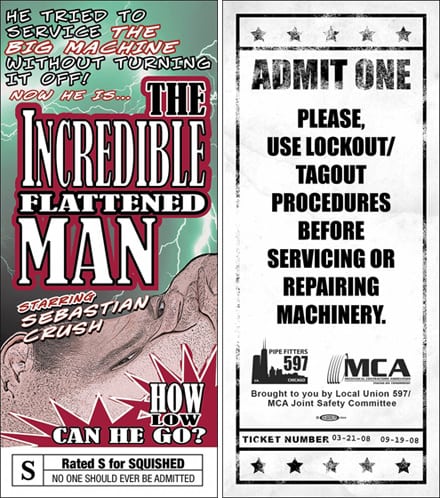
Twenty-six different stuffers are being distributed, each conveying its safety message in the form of a scary movie ad, complete with eerie illustrations. The safety stuffers are being paid for by the LU 597/MCA Joint Safety Committee.
“The safety stuffers remind workers to observe important safety measures on the job,” explained Stephen Lamb, executive VP of MCA Chicago. Its mechanical contractors install and service heating, ventilating, air conditioning, and refrigeration systems, as well as fire sprinklers and plumbing and process piping. “We have the safest workforce in the industry, and we hope that stuffers help keep it that way.”
“The safety stuffers cover a wide variety of vitally important worksite issues,” added James Buchanan, LU 597’s business manager. “There are stuffers that explain appropriate lifting techniques, proper ladder usage, the need for personal protective equipment, lockout/tagout procedures, ergonomics, fire safety, and more. There are even stuffers covering sexual harassment and workplace violence.”
Nehlsen Communications, a marketing and public relations firm, helped MCA Chicago develop the safety stuffers. “Safety is a huge issue to all of our construction clients,” said Nancy Nehlsen, president of the agency. “We have to find ways to get workers’ attention and make them constantly aware of hazards on the job. Today’s younger workers are used to the Internet and high-energy video games, so they like their information quick and engaging. If you can’t excite their interest, you’ve lost them. So for maximum impact, we made each safety stuffer eye-catching and entertaining, with little text.”
“The safety stuffers are just one of many educational tools used by MCA Chicago and Local Union 597 to increase safety awareness,” Buchanan emphasized. “For example, we also hold Toolbox Talks at worksites. At the start of each workday, workers gather so the foreman can share the day’s prepared safety advice. Because everyone hears the talks, everyone ends up on the same page, safety-wise. Most talks remind them to work together and watch out for each other.”
MCA holds numerous safety classes in its own Construction Education Institute, a learning facility with course offerings for all levels in the mechanical construction industry. Lamb said, “We now offer classes in CPR and first aid, automated external defibrillator training, electric arc safety, as well as OSHA’s 10-hour and 30-hour safety courses, and we add new courses constantly.”
Combined, these educational tools instill in MCA Chicago’s member contractors and their LU 597 workforce a high level of safety awareness. Considering the high costs that accident-related injuries and lost work time can incur—including lost productivity, medical bills, administrative expenses, workers’ compensation fees, higher insurance premiums, the expenses of training replacements, and overtime for uninjured workers—it’s clear that any step to improve worker safety is worth the time and effort.
—For more information on MCA Chicago, visit www.mca.org. For more information on UA Local Union 597, visit www.pf597.org. For more information on attention-getting safety stuffers, contact Mark McLaughlin (mark@ncpr.com), a public relations specialist for Nehlsen Communications.
TRANSPORTATION
Doubling up for a heavy load
|
5. Close quarters. Barnhart used a 14-line Goldhofer electronically steered trailer to maneuver a new transformer into place at this combined-cycle plant being built in Kansas. Courtesy: Barnhart Crane & Rigging
|
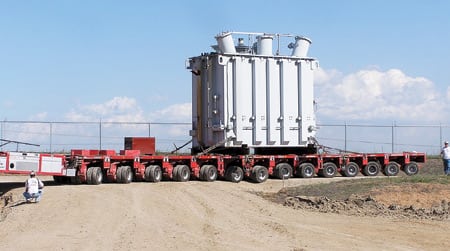
Last summer, Barnhart Crane & Rigging was hired to receive one generator and one turbine from a railroad, haul them more than 8 miles to a power plant rising near Emporia, Kansas (Figure 5), and then set them on their foundation. As part of the contract, the company also was supposed to install three transformers that it had hauled to the site earlier and had placed on stands and beams for temporary storage.
The major delivery challenge was a bridge crossing. Fearing a collapse, the bridge’s engineer would not allow the generator and turbine to cross on a single-wide Goldhofer. He insisted that Barnhart spread the load.
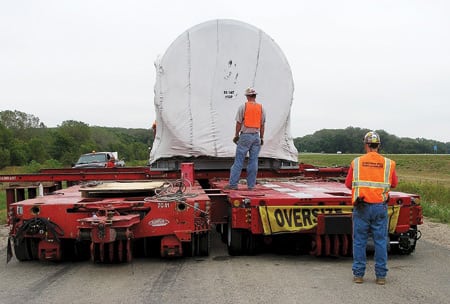
The solution was to begin the haul using a single-wide Goldhofer. Then, as the bridge was approached, another Goldhofer was brought alongside. The crew then slid the generator over to the middle of the now double-wide trailer (Figure 6). Once the bridge was crossed, the operation was reversed and the journey continued in a single-wide configuration.
|
6. Double-wide load. Bridge load limits required Barnhart to double up single-wide trailers. Courtesy: Barnhart Crane & Rigging
|
—Contributed by Barnhart Crane & Rigging (www.barnhartcrane.com)