The assertion that the U.S. will need 900 nuclear power reactors by 2035 to meet its power demand and environmental obligations could only be made by a proponent of nuclear technology. That’s no surprise. What is noteworthy: The person who made that statement, Dr. Samim Anghaie, is fully aware of the myriad challenges that would have to be overcome to make that vision a reality.
Is this simply a case of asking for the moon and the stars so you can be sure of getting the moon? Time will tell.
Anghaie is professor of nuclear and radiological engineering and director of the Innovative Nuclear Space Power & Propulsion Institute at the University of Florida. But he’s not just an academic. He has been an advisor and consultant to companies and government agencies, national labs and policy makers, and his involvement in nuclear technology is global in scope. (Watch for his comments on the status of Generation IV reactor development in the June issue of POWER.)
I recently had the opportunity to hear Anghaie at a colloquium hosted by Los Alamos National Laboratory (LANL). His audience consisted almost exclusively of LANL staff, several of whom Anghaie has consulted with over the years. His topic was the challenges and opportunities—especially for national labs—presented by the resurgence of interest in nuclear power.
Preaching to the Choir
Nuclear technology is in LANL’s DNA, so the audience needed no introduction to the topic. Instead, Anghaie provided a comprehensive overview of the case for more commercial nuclear power and the factors that could make building additional nuclear capacity difficult to achieve.
He began by putting the focus on global energy security, which he characterized as being a matter of national security, environmental security, and economic security. Nuclear power, he argued, can help the U.S. and the world achieve security on all those fronts.
Global demand for economic development that’s compatible with a small carbon footprint has led to new nuclear power projects around the world. For many nations without fossil fuel resources that wish to avoid dependency on other nations for continuous fuel supplies, nuclear seems like the right technology choice.
The irony that the U.S. was an early leader in developing commercial nuclear power but now lags well behind many other nations in deploying it was obvious when Anghaie displayed a slide identifying all the nations with recently completed and current construction projects. (See Global Monitor in the February issue of POWER for stories on ambitious nuclear plans in China and Eastern Europe.)
His overview of nuclear safety and waste issues argued that those factors aren’t showstoppers. Even in the U.S., opposition to nuclear power is far softer than it has been in many decades—in large part because many former opponents, including environmental groups, are coming to grips with the need to limit greenhouse gas emissions.
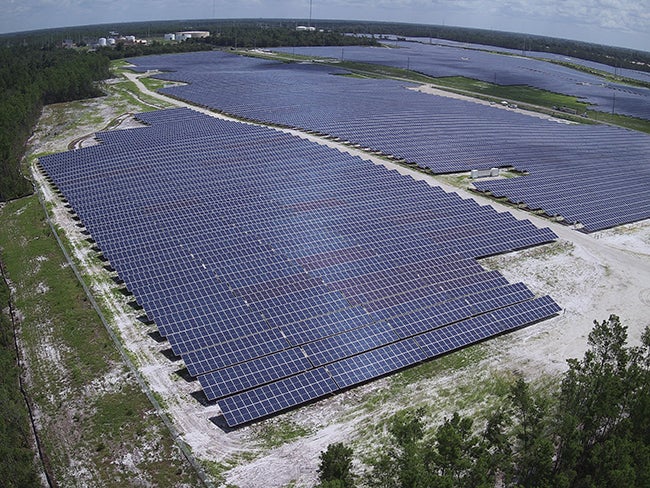
Then Anghaie addressed a different sort of footprint: the land use required by various low-carbon power-generating technologies per 1,000 MW. His chart showed nuclear power needing the least space—less than 1 square kilometer, compared with 100 square kilometers for photovoltaics at 10% efficiency, and far more space for biomass.
Getting from 104 to 900
The U.S. currently has 104 operating nuclear power plants. Why would it need almost an order of magnitude more units in roughly a quarter century?
Anghaie displayed a chart that showed a steep drop in the number of remaining reactors as 2035 nears, so he started with 104 that are needed to replace the current fleet as relicensing options expire. Then he added 300 reactors to replace “old coal plants” and 500 “to meet environmental obligations.” Total: 904.
This calculation hinges on a few large assumptions. First, it assumes that the U.S. will commit to dramatically lowering greenhouse gas emissions and will drive that reduction at least in part by eliminating coal-fired generation—or at least any coal-fired generation that doesn’t use carbon capture and sequestration (CCS) technology, which, Anghaie noted, does not yet exist at utility scale (though his figures seem to suggest that CCS won’t be online by 2035 either).
The second assumption is that other low-carbon technologies, such as renewables, will not win the battle for financial and policy support. Renewable generating technologies, he claimed, are not technically ready, can’t provide the needed capacity, and have a larger footprint compared with nuclear power.
Then there’s the unanswered question of where all the nuclear engineers will come from to operate those 900 reactors.
As for the costs of generation, Anghaie claimed that nuclear power is already cost competitive, especially if environmental costs are internalized.
Even if one rejects some—or all—of Anghaie’s premises, it’s hard to ignore the fact that the U.S. is making no measurable progress toward replacing those plants that will reach the end of their economic operating life by 2035.
Playing a Global Game of Risk
There are obvious and less-obvious reasons for the lack of progress in building new nuclear power plants on American soil.
First, there’s the status of combined construction and operating license applications in the Nuclear Regulatory Commission queue. Anghaie said he expects delays there.
Then there’s the enormous lag time—during which expertise was lost—between any new projects and the last ones that were built. New plant construction costs, of which more than a third are for labor, he said, also represent a daunting hurdle, especially when you factor in six years to build an EPR.
But one of the thorniest challenges may be the cost of risk-management.
Given high construction costs, and utilities’ bad experiences with cost overruns in the 1970s and ’80s, utilities, Anghaie said, now want “zero risk.” They’re wanting cost guarantees from the reactor vendors, not from their engineering, procurement, and construction contractors. Zero risk, he noted, carries a high price tag: increased costs—which is where this circle started.
There’s no way to completely eliminate risk, so it just gets moved around. Without naming names, Anghaie said that there are vendors engaging in “highly risky risk-taking” because of the cost and schedule guarantees they’re giving.
Given this cost/risk dynamic, cost and schedule predictability favor more mature technologies, he noted, just as design simplicity favors passive safety systems and large baseload power needs favor large-capacity plants.
If you make all the “right” technology choices, can you be guaranteed that the reactor design you choose is 100% ready for prime time? Maybe not.
A Role for the National Labs
According to Anghaie, the reactor industry needs immediate help with research and development (R&D), and that’s where national labs like LANL could help. His vision is that LANL develop a pool of scientific and technical expertise to start R&D partnerships with industry to meet such needs as:
- Modeling and simulation.
- Large-scale testing facilities.
- The development of new fuel cycle and proliferation-resistant technologies.
- Support for the economic and institutional aspects of nuclear power.
Even if Anghaie has overstated the case for nuclear power, and even if constructing 900 reactors turns out to be unrealistic (for any number of reasons), his argument for using all R&D resources at our disposal to expedite development of the next generation of reactors, and to ensure the safe construction and operation of them, is sound. It remains to be seen if the national labs, and the politicians who fund them, will get the message.
—Gail Reitenbach, PhD is managing editor of POWER.