The pressure on power producers to supply reliable electricity is unyielding. Forced outages, which usually are caused by unexpected component failure or systemic problems, can prove very costly to both bottom line and reputation. To reduce the frequency and duration of unscheduled outages, many gencos are implementing comprehensive predictive maintenance (PdM) programs. Such is the case at Calpine Corp. (San Jose, Calif.), America’s largest independent power producer (IPP).
Calpine was the first IPP to integrate regional operations of its power plants in the U.S., where it has almost 27,000 MW of capacity fueled by natural gas and geothermal energy. By pooling the output of its plants, the company can supply customers with customized packages of electricity generated by specific shares of fuels.
For the past six years, Calpine has been applying the same integrated approach to PdM. Only a handful of its plants routinely practiced PdM techniques back in 2000, and each developed and implemented its own program for handling equipment failures. As a result, there was no uniform PdM technology or strategy and no sharing of best practices and successes.
After reviewing the options and potential strategies for meeting availability, reliability, and profitability goals, Calpine’s senior management decided to begin developing and implementing a fleetwide PdM program. “The program’s main goal was to reduce forced deratings and outages, both of which we consider catastrophic events,” explained Kevin Nordenstrom, the company’s PdM engineering manager. “Our customers depend on our reliability. To minimize blackouts and brownouts, we needed a uniform PdM program that the majority of our plants could easily adopt.”
Among the program’s key design imperatives were user-friendly interfaces, compatibility and interoperability across a variety of enterprise computing and operating systems, fleetwide integration of PdM data, and the ability to share information with maintenance application suites—such as Calpine’s Maximo computerized maintenance management system. After considering how well the products of several maintenance solutions providers met these criteria, as well as their future development directions, Calpine chose Entek Emonitor Enterprise software from Rockwell Automation Inc. (Milwaukee, Wis.) as the foundation of the uniform PdM program it sought to create.
The program, which began its rollout to individual plants in late 2000, comprised a variety of proactive tools and techniques, including condition-monitoring hardware and software. Implementing common procedures and practices among its U.S. plants gives plant and corporate managers alike the ability to share experiences and documented successes. Through the sharing of lessons learned, the fleet’s efficiency, availability, and cost savings can be maximized.
“In 2000, no two of our plants managed maintenance in the same way,” recalled Nordenstrom. “For example, at plants that were dispatched most of the time, some critical equipment was allowed to run to failure because too much revenue would have been lost by taking the equipment off-line for repair or replacement. As a company, we wanted to move away from this reactive approach by viewing maintenance as a strategic, profit-boosting, performance-enhancing tool.”
The capacious database of the Emonitor Enterprise system serves as a central repository for all information gathered from Calpine power plants using the PdM program. The system allows Nordenstrom and plant engineers and technicians to access any site’s records. Doing so enables them to analyze equipment lifecycle trends and to determine if specific types or models of equipment are experiencing common failures or failing repeatedly at the same plant.
Implementing the program
As each Calpine plant joins the PdM program, Nordenstrom works with its maintenance staff to identify which equipment is considered critical. “We put a piece of equipment in that class if it meets either of two criteria: its failure would cause a forced outage or a unit derating, or the cost to repair or replace it is high enough to warrant monitoring its condition,” he explained. ”For critical equipment, we may have a backup waiting in the wings, ready to be activated to avoid a plant shutdown should the primary need to be taken out of service.”
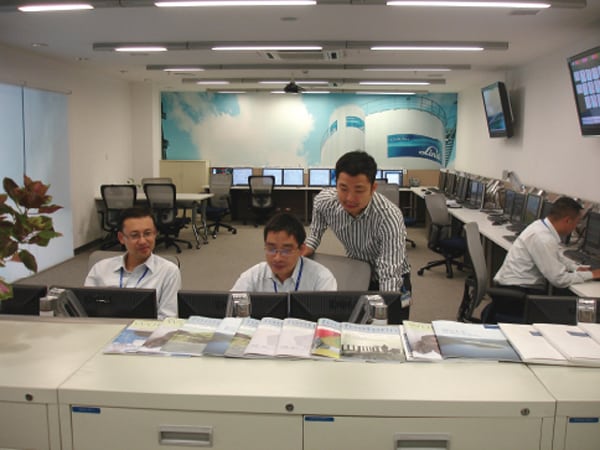
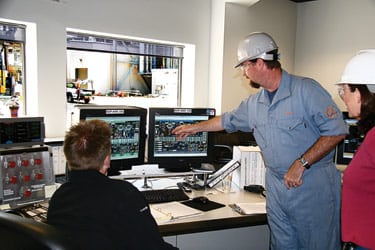
Working as an internal service provider, Nordenstrom and his team of eight PdM engineers and technicians (Figure 1) do different things at different plants. Their typical activities include performing infrared thermography as well as analyzing equipment vibration, motor performance, and the quality of lubricating and transformer oil.
|
1. Get with the program. Brad Thorp, a PdM engineer with Calpine, routinely travels to various plants to collect data and work with site maintenance teams. Courtesy: Rockwell Automation
|
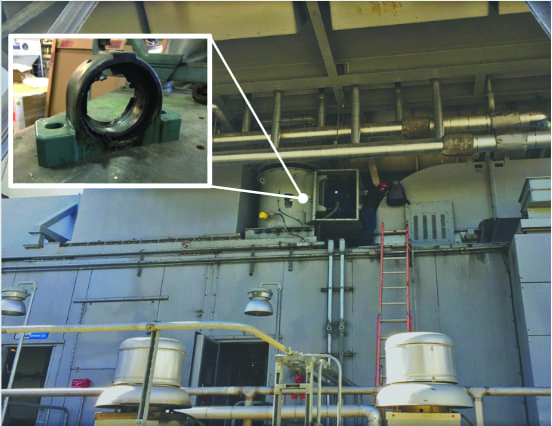
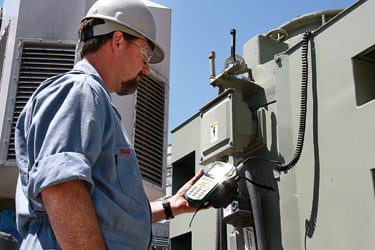
Because elevated levels of vibration can indicate that a piece of equipment is on the road to failure, Calpine plants watch that parameter like a hawk. Vibration readings are collected from all turbines, key oil and water pumps, and cooling fans at a plant once a month using Entek Enpac handheld data collectors from Rockwell Automation (Figure 2). The readings are then trended to facilitate analysis (Figure 3).
|
2. Collect, then aggregate. Data sets entered into handheld collectors are uploaded to Entek Emonitor Enterprise for sharing across the Calpine fleet. Courtesy: Rockwell Automation
|
|
3. Shake, rattle, and roll. Thorp takes a vibration reading from a pump whose repair records he’s seen on-screen. Courtesy: Rockwell Automation
|
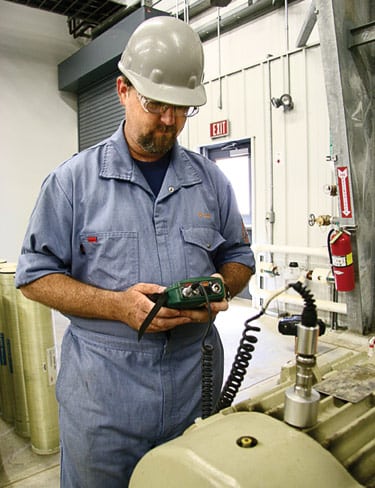
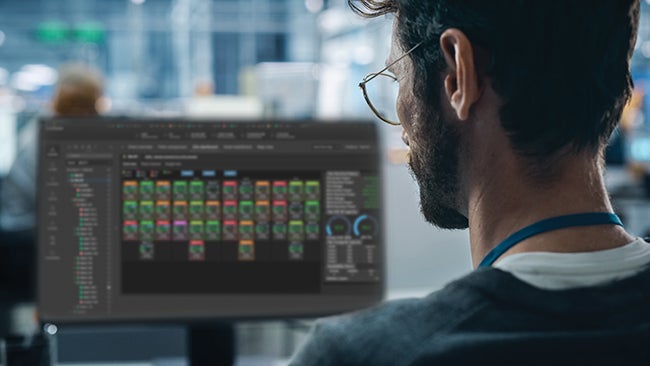
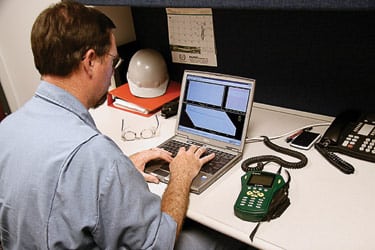
At the typical plant, vibration readings and 10 other types of data are collected from about 60 pieces of equipment. After a set of readings has been entered into a handheld data collector, it is uploaded to Entek Emonitor Enterprise. The software processes the data, compares it against setpoints, and provides advance warning of equipment abnormalities and potential failure. Armed with this information, Nordenstrom’s team can recommend corrective actions before unit performance is affected (Figure 4).
|
4. Trendspotting. Thorp uses his laptop to check the maintenance history of a troublesome motor-driven pump. Courtesy: Rockwell Automation
|
Show me the money
One of Nordenstrom’s early challenges was convincing Calpine plant managers to join the PdM program. In fact, he still has trouble justifying the cost of participation in abstract terms because it’s impossible to quantify the benefit of avoiding a catastrophic event, which is PdM’s only goal. “Cost avoidance is a difficult concept to communicate,” Nordenstrom said, “and the complexity of the calculations don’t make it any easier.”
Now, however, Nordenstrom has a raft of hard figures to fortify his pitch. Some plants have racked up impressive savings from PdM. At one plant, Nordenstrom and his team used the Rockwell software to predict the imminent failure of a water pump whose 2,000-hp motor had gone south. The warning motivated the plant manager to pull the motor, replace the bad bearing, and return the motor to service. Doing so incurred only minor downtime and repair costs. Had the problem not been detected, the motor would have failed catastrophically and required replacement. The plant manager estimated that shutting the unit down to swap in a new motor would have cost Calpine about $370,000 in lost revenues.
Over the past six years, Nordenstrom and his team have used the Rockwell PdM system to identify four similar problems, which then were corrected at minimal cost. On average, the four avoided failures represented a cost saving to Calpine of about $200,000 per incident. According to Nordenstrom, the big savings have helped foster acceptance of the PdM program by plant managers and corporate management.
To date, 47 of Calpine’s 92 U.S. plants have enrolled in the PdM program. Currently, about 28,000 data points are being taken on about 2,800 pieces of equipment. According to Nordenstrom, by 2004—four years after it was launched—the fleetwide PdM program had been directly responsible for saving Calpine more than $1.5 million.
—Contributed by Rockwell Automation. For more information, visit www.rockwellautomation.com or call 414-382-2000.