The refurbishment and restart of all four CANDU reactors at Bruce A may be Ontario’s most significant and complex power generation project since the first phase of the Bruce Nuclear Generating Station was built more than 30 years ago. Units 1 and 2 are expected to be synchronized in 2011 and return to commercial service by early 2012, joining Units 3 and 4, which restarted in 2004 and 2003 respectively. POWER visited Bruce A in April to witness the project’s progress.
In its first act, Bruce Nuclear Generating Station—whose Bruce A and Bruce B stations sit on the eastern shore of Lake Huron, about 155 miles northwest of Toronto—was the king of nuclear capacity factors. Thanks to the refurbishment of the long-idle Bruce A, it may become the king of capacity factors in its second act as well.
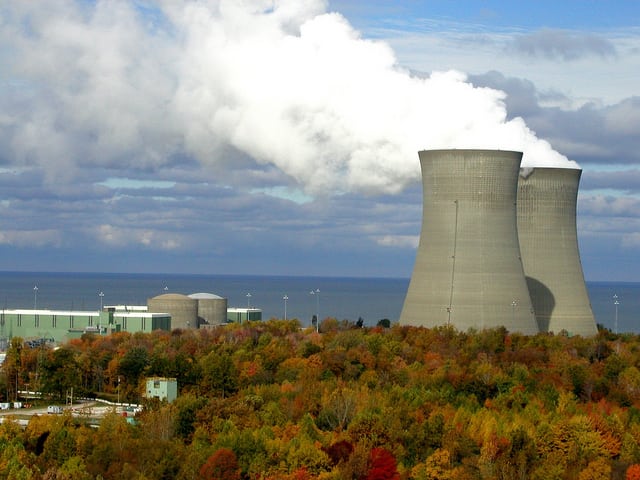
Bruce A and Bruce B each house four CANDU pressurized heavy water nuclear reactors (see sidebar “Inside the CANDU Reactor”). Bruce A reactors (Units 1 through 4) entered commercial service during 1977–79 and were followed by Bruce B reactors (Units 5 through 8) between 1984 and 1987 (Figure 1). All eight units featured a stellar operating record through the 1980s. In 1981, Unit 1 operated with a 97% capacity factor, garnering accolades as the number one reactor in the world. In 1982, Unit 3 set a new world record of 494 days of continuous operation. In addition, Bruce A was the most reliable multi-unit station in the world in 1984, with all four units finishing the year with capacity factors greater than 90%.
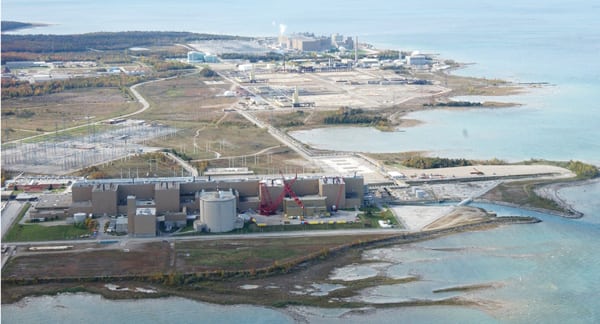 |
| 1. Eight is enough. A 2,300-acre site accommodates the Bruce A (foreground) and B (background) generating stations. Each station houses four CANDU reactors. All four units of Bruce B (Units 5 through 8) and Units 3 and 4 of Bruce A are in commercial service. When the Bruce A Unit 1 and 2 restart is completed in 2012, the entire site will produce 6,200 MW. Courtesy: Bruce Power |
These performance figures may seem average by today’s standards, but they were stellar 25 years ago. In contrast, the U.S. nuclear fleet’s average capacity factor was an embarrassing 56.3% in 1984. By 1987, Bruce Units 3, 4, 6, and 7 were on the global top 10 list of best-performing reactors. By the end of that decade, Ontario Hydro was recognized as owning one of the world’s largest and most reliable fleets of nuclear power plants. (For a more complete picture of Canada’s energy portfolio, see “Canada Moves to Rebalance Its Energy Portfolio” in our June 2009 issue.)
In the mid-1990s, Ontario Hydro, then-owner of the Bruce stations, was grappling with an unexpected situation: Overbuilding had produced the largest capacity surplus in its history. The business decision was made to temporarily lay up the Bruce A units in order to “concentrate resources on other initiatives.” Bruce A Unit 2 was prematurely mothballed in October 1995, in part because of damage to its steam generators from a lead blanket left inside during a 1986 outage. Unit 1 was subsequently shuttered in October 1997, Unit 4 in March 1998, and Unit 3 in April 1998.
Inside the CANDU Reactor
The heart of each Bruce unit is the CANada Deuterium Uranium (CANDU) pressurized heavy water reactor. Developed in Canada, the first CANDU reactor entered service in 1962. The last CANDU reactors to enter service were RPAS-3 and -4 and Kaiga-1 and -2 in India in 2000, followed by China’s Qinshan Unit 3-1 in 2002 and 3-2 in 2003. According to the CANDU Owners Group, there are 34 operating CANDU reactors in Canada and abroad, not including the two Bruce units currently being refurbished.
The CANDU design is quite different from U.S. light-water designs. Instead of enriching U-235 to 5% and using regular or “light water” as a moderator to slow down the neutrons for fission to occur and as a coolant, CANDU reactors are fueled with natural uranium (uranium with an isotopic composition found in nature, containing 99.3% U-238, 0.7% U-235, and a trace of U-234) and use deuterium (D2O) as a moderator and coolant. Deuterium (heavy water) is an isotope of hydrogen that contains an extra neutron not found in hydrogen. Deuterium occurs naturally in all bodies of water (1 part per 7,000 in the Great Lakes).
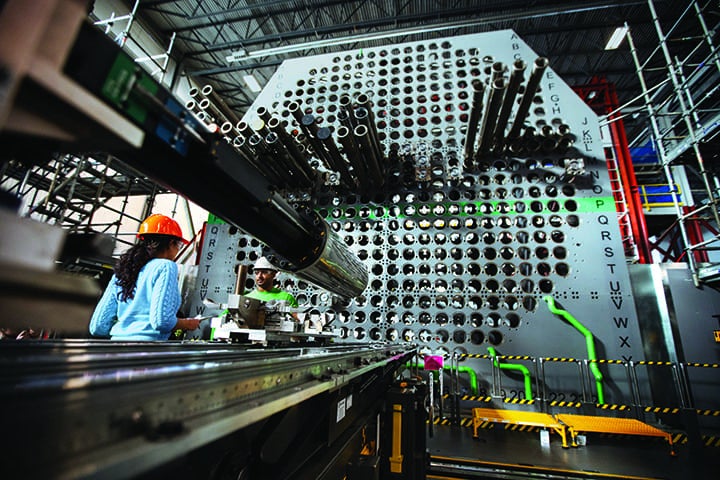
CANDU Reactor Core. Within a CANDU reactor core, the calandria (a large metal drum with flat end shields) is filled with the heavy water moderator and pierced by an array of horizontal tubes approximately 6.3 meters in length called “calandria tubes” (Figure 2). Each calandria tube, in turn, contains an inner “pressure tube,” in which natural uranium fuel bundles—the source of the heat that creates steam—are laid end-to-end. The pressure tubes and calandria tubes are made of a zirconium alloy that absorbs fewer neutrons than other metals. Collectively, the pressure and calandria tube systems are referred to as “fuel channels.” The calandria contains 480 fuel channels.
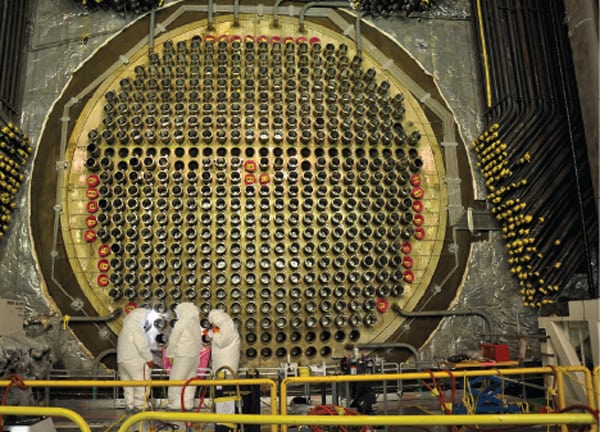 |
| 2. Down to the core. This photo shows the core of the CANDU reactor, including the calandria and shield tank assembly, during a fuel channel replacement. Courtesy: Bruce Power |
CANDU Fuel. Fuel for Bruce Nuclear Generating Station is in the form of compressed and sintered natural uranium dioxide pellets that are sheathed and sealed in Zircaloy-4 tubes. Thirty-seven tubes (elements) are assembled between two end plates to form one fuel bundle. Each of the 480 fuel channels contains 12 bundles, and each bundle weighs 22.5 kg. A small number of depleted uranium fuel bundles are inserted at specific locations to fine-tune reactivity in the core. Fresh fuel bundles are received at a fuel-receiving area, enclosed in protective palletized crates containing 36 bundles. Fuel storage areas have the capacity to store approximately 23,000 bundles.
CANDU Refueling. The CANDU system employs a unique, online, full-power refueling system (Figure 3). Two identical fueling machines rise from a fueling duct under the reactor and latch onto opposite ends of a designated fuel channel. Each machine is remotely operated from the control room. With both machines latched on and brought up to system pressure, the ends of the fuel channel are opened and new fuel is simultaneously exchanged for used fuel—one machine discharging and the other accepting. Each bundle stays in the reactor from 12 to 20 months, depending on its location in the core.
 |
| 3. Automated refueling. Specialty robotics automate the task of feeding fuel assemblies into one of the Bruce A reactors. Courtesy: Bruce Power |
Spent Fuel Processing. Once fuel is removed from a reactor, it is transferred by remote control to a water-filled storage bay or spent fuel pool. The bay is about 6 m deep and roughly the size of an Olympic swimming pool. Fuel bundles are stored in the cooling bays at the stations for at least 10 years to dissipate decay heat. Afterward, the bundles are transported to a dry fuel storage facility owned and operated by Ontario Power Generation (OPG) on the Bruce Power site. Used fuel from Bruce Power’s operations is owned by OPG, and as part of the lease agreement with OPG, Bruce Power pays a per-megawatt fee to OPG for storage of the used fuel.
Special Safety Systems. The CANDU reactor design has two independent and physically separated shutdown systems. Shutdown System No. 1 is the primary means of quickly shutting down the reactor. Neutron-absorbing rods made of stainless steel–sheathed cadmium are suspended vertically above the reactor and held in place by an electromagnetic clutch. The rods drop into the core within 2 to 3 seconds of a reactor trip signal by cutting off electricity to the clutch (Figure 4).
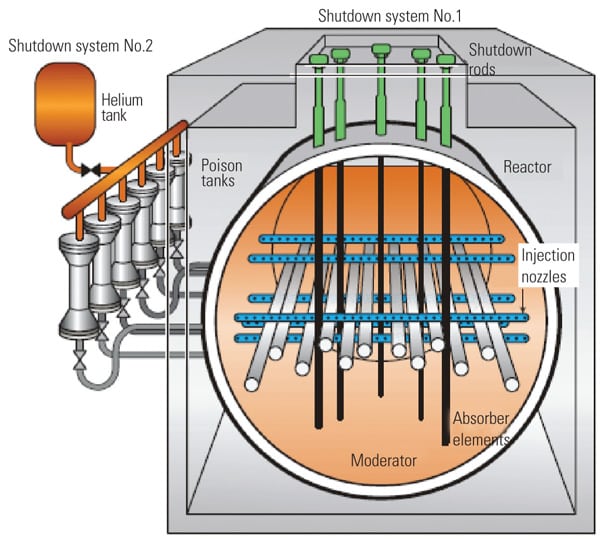 |
| 4. Double your safety. The CANDU reactor design has two independent fast shutdown systems that are physically separate and have their own power supplies and monitoring equipment. Courtesy: Bruce Power |
Shutdown System No. 2 is a fully independent system consisting of tanks containing gadolinium nitrate in heavy water connected to perforated tubes that run horizontally through the reactor. Opening the isolation valves at the top of the tanks activates the shutdown system. High-pressure helium injects the gadolinium nitrate into the moderator that absorbs neutrons and shuts down the reactor in about 2 seconds.
A New Beginning for Nuclear Power in Ontario
In 1999, as part of Canada’s establishment of a retail electricity market, Ontario Hydro (a crown corporation) was dissolved into five private successor companies, including Ontario Power Generation (OPG), which would retain the nuclear plant assets. In May 2001, Bruce Power LP (Bruce Power) became Canada’s first private nuclear generating company and the licensed operator of Bruce A and B through a long-term lease with OPG. At the time of the lease, all four units at Bruce A were mothballed.
Bruce Power is a business partnership consisting of Cameco Corp. (31.6%), Trans-Canada Corp. (31.6%), BPC Generation Infrastructure Trust (31.6%), the Power Workers Union (4%), and The Society of Energy Professionals (1.2%).
Setting the Stage for Bruce A’s Second Act
After assuming responsibility for Bruce A, Bruce Power invested C$720 million to return Units 3 and 4 to service. That project was successfully completed in January 2004 and October 2003, respectively.
In October 2005, Bruce Power reached an agreement with the Ontario Power Authority (OPA) and launched a C$4.25 billion program to refurbish and restart the other two units at Bruce A. At that time, the two units were in what is known as a defueled, guaranteed shutdown state. As with the earlier Units 3 and 4 restart project, Bruce Power required regulatory approval before the reactors could be loaded with fresh fuel and operated at power. The restart project cost estimate has risen to about C$6 billion, principally because of the decision to replace all 480 fuel channels in Unit 4 in 2007, difficulties with robotics in 2008, and other raw material cost increases. No federal funding was used on any of the Bruce A refurbishment projects.
When the final two units (Units 1 and 2) are completed, the eight Bruce units will supply more than 6,200 MW and provide about 25% of Ontario’s electricity (Figure 5).
 |
| 5. Big floor show. The turbine generator bay of Bruce A is common to all four units. Courtesy: Bruce Power |
The Canadian Nuclear Safety Commission (CNSC), equivalent to the U.S. Nuclear Regulatory Commission, regulates the use of nuclear energy and materials to protect the health, safety, and security of persons and the environment. CNSC’s RD360: Life Extension of Nuclear Power Plants defines Canada’s requirements for the replacement or refurbishment of major components or substantial modifications to a plant. Bottom line: Final plant condition must be comparable to the condition of a new system and adhere to the “modern standards” in effect for new plants built at the time a life extension project is initiated.
In addition to adhering to modern technical standards, as part of the licensing process, Bruce Power also successfully completed an 18-month environmental assessment not unlike what is required for an original licensing process, a series of public hearings, and in-depth consultations with local communities, stakeholders, and First Nations. In July 2006, Bruce Power received approval from the CNSC to begin the Unit 1 and 2 restart project.
Bruce Power’s return-to-service (RTS) plan for the refurbishment and restart project at Bruce A has three essential goals:
- Enhance the safety and reliability of the Bruce A station.
- Increase the combined plant’s (Bruce A and B) capacity to 6,200 MW.
- Ensure that the station remains fit for service through 2043, an additional 25 years of operation beyond the original plant’s 2018 lease.
To accomplish those goals, Bruce Power developed a comprehensive project plant that leveraged the expertise of many important equipment suppliers (see table) in order to repair or replace just about every key component on both units. Each component or system has an interesting story to tell about its refurbishment or replacement, but space precludes in-depth discussions of them all. Representative of the long list of components and systems being refurbished are the steam generators.
 |
| Contractors supporting the Bruce refurbishment/restart project. Source: Bruce Power |
A First: Replacing CANDU Steam Generators
The steam generators transfer heat from the hot pressurized heavy water coming from the reactor (known as the primary side) to raise the temperature and boil light water on the secondary side to produce the steam that supplies the turbine generator with the energy to generate electricity.
The steam generators at Bruce A were close to the end of their useful service life due to wear caused by erosion and corrosion when the units were prematurely retired in the late 1990s. Because the tubing was considered a life-limiting feature, a business decision was made to replace all of the steam generators, thus providing up to 30 years of additional life to match the remainder of the plant refurbishment standards.
Babcock & Wilcox (B&W) Canada, builder of the original Bruce A steam generators more than 30 years ago, was contracted to manufacture the replacement steam generators. In August 2006 the first of 16 steam generators were delivered, marking a major project milestone. Eight steam generators were installed in Unit 1 and another eight in Unit 2, arranged in two banks of four on either side of each reactor (Figures 8 and 9). This was the first CANDU steam generator replacement when the project was completed in January 2008.
 |
| 8. Can do. SNC-Lavalin Nuclear removed the old steam generators on Units 1 and 2 through access holes in the roof using a special crane sourced from Alberta. A total of 16 old steam generators were replaced. Courtesy: Bruce Power |
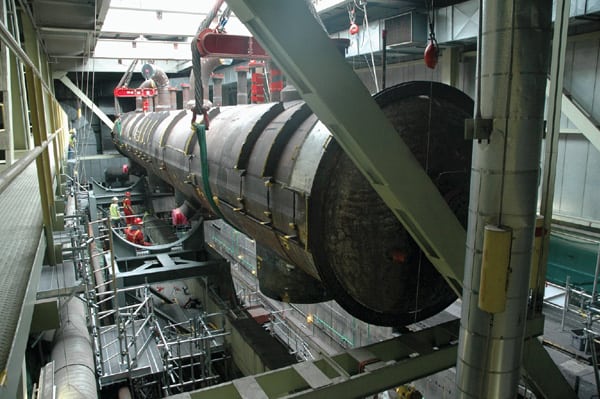 |
| 9. Up and out. A 250-ton steam drum is lifted up and set aside to provide access to the four steam generators below. The steam generators at Bruce A are arranged in two banks of four on each unit. After the steam generators are replaced, the steam drum is lifted back into position and reconnected to the tops of the new vessels. Courtesy: Bruce Power |
In August 2007, B&W Canada signed a contract in excess of C$90 million to manufacture eight additional replacement steam generators for Unit 3. Unit 3 and 4 steam generators were not replaced during their earlier restart project. A replacement schedule for those units is being developed with OPA.
Bruce Power is to be commended for its creative thinking about the problem of disposing of the old steam generators (see sidebar “A Comprehensive Waste Management Program”). Instead of placing them into long-term storage, the tubes will be recycled. Approximately 90% of the metal from the steam generators can be decontaminated, melted down, and sold back into the scrap metal market by Studsvik, a Swedish company that pioneered the treatment and recycling of steam generators from nuclear reactors. This method offers an economically attractive approach to nuclear clean-up that is also environmentally responsible.
A Comprehensive Waste Management Program
The Bruce A refurbishment and restart project and ongoing operations at Bruce B generate a variety of waste streams that will be managed by the Western Waste Management Facility (WWMF). Although the WWMF is located on the Bruce Power site, it is managed by Ontario Power Generation (OPG) and has maintained its ISO 14001 certification since 1999. The WWMF has been safely managing all the low- and intermediate-level nuclear waste generated from the operation of all of OPG’s CANDU reactors for more than 40 years. It also provides dry storage for spent nuclear fuel from the Bruce reactors.
Low-Level Waste
Low-level waste (LLW) generated by the CANDU plants is similar to LLW generated in the U.S. and consists of items such as mop heads, cloths, paper towels, floor sweepings, and protective clothing that have become radioactively contaminated during routine cleanup and maintenance operations. These items make up about 95% of the total nonfuel waste volume.
LLW from the Bruce, Pickering, and Darlington nuclear generating stations is received at the Waste Volume Reduction Building, where it may be stored as is or reduced in volume through either incineration or compaction. After processing, the LLW is placed into above-ground concrete warehouse-like structures called Low Level Storage Buildings. A storage building is built on the WWMF site about every two years. About 3,000 m3 of LLW are stored annually, including the Bruce refurbishment/restart wastes (including fuel channels and steam generator parts), yielding a total storage volume of approximately 70,000 m3 of LLW (based on 2009 records).
Intermediate-Level Waste
Intermediate-level waste (ILW), consisting primarily of used reactor core components, including reactor water resins and filters, is equivalent to Greater-Than-Class-C Waste in the U.S. ILW is more radioactive than LLW and requires shielding to protect workers during its handling. Because of its radiological and physical properties, ILW is not processed for volume reduction but is stored in subsurface steel-lined concrete containers. About 290 m3 of ILW are stored annually, totaling about 9,000 m3 as of 2009. ILW makes up about 5% of the total volume of nonfuel waste produced from the nuclear generating stations.
LLW and ILW stored at the WWMF is continually monitored to ensure the integrity of the storage containers, which can be retrieved at some future date for transfer to a long-term storage facility.
The WWMF will continue to add storage structures as required and is subject to applicable regulatory approvals. OPG is currently in the planning stages for developing a deep geologic repository for long-term storage of LLW and ILW at the Bruce site.
Used Nuclear Fuel
At the WWMF, only used fuel from the Bruce Power stations is stored at the interim used fuel dry storage facility. That facility consists of a processing building and storage buildings. It went into operation in 2002 and is designed to provide storage space for about 2000 dry storage containers (DSC) (Figure 6). The overall Western Used Fuel Dry Storage Facility design includes four DSC storage buildings, each having the capacity to store about 500 containers. Two buildings were commissioned in 2002 and 2007, and construction of future storage buildings will be staged as required, estimated at every four to seven years.
 |
| 6. Canadian cask. This drawing illustrates the dry storage container (DSC) used to hold CANDU used fuel bundles. The DSC is made of reinforced high-density concrete approximately 510 mm thick and is lined inside and outside with 12.7-mm-thick steel plate. Courtesy: WWMF |
Dry storage is a proven technology in use around the world. In Canada, dry storage is used by Hydro Quebec at Gentilly, New Brunswick Power at Point Lepreau, Atomic Energy of Canada at Chalk River, and Douglas Point, which is located at the Bruce site.
Dry Storage Process
The process of loading a dry storage container with used nuclear fuel begins by first submerging a 63–metric ton container into one of Bruce Power’s water-filled used fuel storage bays. (Used fuel bundles are stored in the water-filled bay for at least 10 years, allowing time for cooling and a reduction in radioactivity.) Once the container is in the storage bay, four modules, each containing 96 used fuel bundles, are loaded into it under water.
The container, now holding 384 used fuel bundles, is removed from the bay and drained, decontaminated, and vacuum dried. A transfer clamp secures the lid to the container, which is moved to the dry storage facility using a large transport vehicle (Figure 7). Once the DSC is received at WWMF, the lid is welded to the container’s base and the vent port is seal-welded closed. After the inside of the container has been vacuum dried, it is filled with helium gas. The remaining drain port is then seal-welded closed. The helium gas provides a means of leak detection for the sealed container and creates an inert atmosphere for the storage of used fuel.
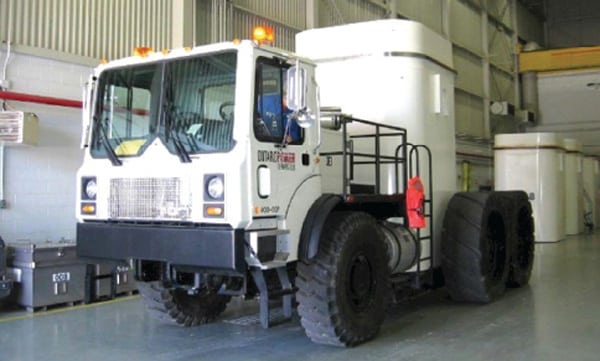 |
| 7. Precious cargo. A transport vehicle begins the move of a dry storage container to the storage pad. Courtesy: WWMF |
Before being placed into storage, the container undergoes rigorous testing to ensure that it is absolutely leak-tight. Finally, safeguard seals are applied by an inspector from the International Atomic Energy Agency.
Accuracy Counts; So Does Accomplishment
The Project Controls Team, in consultation with other project groups, establishes the project schedule and major milestones, such as the logical order of tasks and timelines for the various plant systems to return to service. This team works closely with work crews to identify and overcome obstacles encountered during construction and commissioning, training and turnover, and operations. Nevertheless, challenges are inevitable for a project of this scope. At Bruce A, one challenge is keeping up with the myriad accountability tasks.
One critical item on the RTS program plan is the required closeout of a long list of pending design change notices (DCNs) before start-up can begin. By September 2009 the rate at which contractors were closing out DCNs was unacceptable. The average time for closing out a DCN was approximately a thousand days, meaning that another 550 years would be required to finish the project. Instead of maintaining that status quo, a 90-day limit was placed on delinquent DCNs, and the pressure was on the RTS staff to pick up the pace. Through process streamlining, such as grouping like items together to achieve economies of scale, the staff was able to reduce DCN closeout time to about 75 days. There are still more than a thousand DCNs to finish before fuel can be loaded into the reactors.
The RTS process is driven by a staff of about 60 people who verify the DCNs by ensuring that all the supporting documentation, necessary training, on-site inspections and verifications, remedial re-work when required, and signoffs are complete before systems are declared safe and available for service. The transparency of the RTS program, and specifically the DCN process, is extremely important because the CNSC uses it as the basis for regulatory staff to determine whether fuel can be loaded in Unit 1 and 2 reactors.
The Project Controls Team reports that never in the 1,635-plus days of the project (at the time of POWER’ s plant visit in April) have so many deliverables and associated milestones been squeezed into three months as was the case in the first three months of 2010. For example, during those three months the project:
- Completed all delinquent DCNs older than 90 days. The lead time was then further ratcheted down to eliminate DCNs older than 45 days.
- Launched the New Safety Leadership and Human Performance Programs to empower field supervisors with more decision-making authority.
- Completed commissioning activities for 66 new motor control centers.
- Completed a record 350 work packages in a single week. One of those work packages alone required approximately 1,800 valves to be aligned, restored, or replaced.
- Exceeded the 1,000 project tasks–per-week barrier. A climb to 1,500 tasks per week is under way.
- Removed the legacy asbestos discovered under the turbine deck plates in both Units 1 and 2.
Milestone Countdown
The process of recommissioning Units 1 and 2 began in April 2010 when representatives from across the site spent the day with key members of the Restart Team (Figure 10). Using the successful restart of Units 3 and 4 as a guide, management stressed the importance of a smooth transition from reconstruction to operations for Units 1 and 2. Other management representatives recalled the “glory days” of the station’s operating record during the 1980s, when the units were among the top performers in the world, and reiterated that they strongly believe Bruce Power will soon establish new industry reliability records.
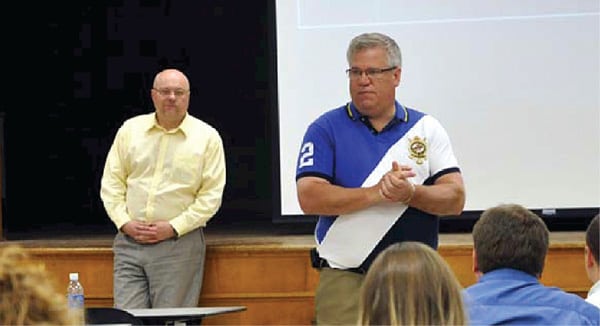 |
| 10. Motivating the team. Bruce A Executive Vice President and Chief Nuclear Officer Norm Sawyer watches as Executive Vice President, Project Management and Construction John Sauger addresses participants at the Bruce A’s Return to Operations workshop. Sauger directed his remarks to the operations staff: “It’s going to take a Herculean effort. We expect you guys to help us, to pull us across the finish line. You own the plant; you need to take it back from us.” Courtesy: Bruce Power |
“There has never been another project quite like this in the Canadian nuclear industry,” said John Sauger, Bruce Power’s executive vice president for project management and construction. “We’re proud to be blazing a path for others to follow, and I thank everyone who has brought us this far. But our work is far from over. Our job now is to put these reactors back together, to do it safely, and to deliver a first-class product.”
The RTS program is also designed to ensure orderly transfer of the plant from construction to operation. When all the equipment has been installed and successfully tested and all the DCNs have been processed as a precursor to CNSC approval, then the final commissioning steps begin for each unit:
- Load fuel (currently scheduled before year-end 2010 for Unit 2)
- Remove the “guaranteed shutdown state” designation
- Refill the primary heat transport system
- Turbine operation
- Turbine synchronization to the grid
- Full reactor power
- Specific commissioning tests
- Normal operation and follow-up to monitor plant performance and new or updated programs after return to service
At the end of May, the project team continued moving forward to meet the remaining milestones. Fuel loading and associated operations will precede synchronization to the power grid by approximately five months. Units 1 and 2 are scheduled to return to commercial service by early 2012. When they do, they and their fellow Bruce units will supply about one-quarter of Ontario’s power and will have a longer life expectancy than anyone anticipated two decades ago.
—James M. Hylko (jhylko1@msn.com) is a POWER contributing editor. Dr. Robert Peltier, PE is editor-in-chief.