Bring-Your-Own-Generation (BYOG) is emerging as a practical solution for power-hungry facilities that can’t wait on grid upgrades. Success hinges on a unified control architecture that coordinates diverse microgrid assets.
Fifty years ago, most businesses never questioned whether they would have enough power to operate. Today, large energy users, especially data centers, are discovering that securing the electricity they need is one of their most difficult challenges. Massive compute campuses requiring hundreds of megawatts have accelerated demand far beyond what utilities can quickly deliver, creating shortfalls that increasingly affect both commercial and residential customers.
The U.S. electric grid, often described as the largest and most complex machine ever built, was not designed to accommodate this sudden surge in load on the timelines required. The traditional model of centralized generation, long distance transmission, and local distribution is straining under the weight of these new loads. Connecting these loads often requires major upgrades to generation, transmission, and sometimes distribution, which can take up to seven years or more depending on complexity and supply chains. Even existing customers seeking to expand their operations are finding that utilities cannot commit additional capacity within the timelines their businesses require.
Solving this problem will require a mix of strategies. Some involve upgrading today’s infrastructure, including higher capacity transmission lines. Others involve rethinking how demand is managed, not just how electricity is produced.
When people talk about an “electricity shortfall,” they are usually referring to the grid’s ability to serve peak demand. This typically pertains to a handful of extremely hot afternoons and evenings each summer when air conditioning drives electricity usage to its highest point. However, most of the year there is sufficient generation available. Because utilities must ensure they can meet these peak conditions before approving new load, large new customers often trigger long and complex studies that lead to these infrastructure upgrades.
For large energy users, this timeline simply doesn’t align with their business needs. They cannot wait years for power. A new model has emerged as a result, and it is referred to as “Bring Your Own Generation” (BYOG). Under BYOG, customers are increasingly required to install, operate, and maintain their own onsite generation to power their operations until the utility can provide a permanent interconnection.

In This Issue
Full issueIs BYOG New?
The term BYOG may be new, but the concept is not. Industries with large, continuous power requirements have relied on self-generation for decades whenever the grid couldn’t deliver the capacity or reliability their operations demanded.
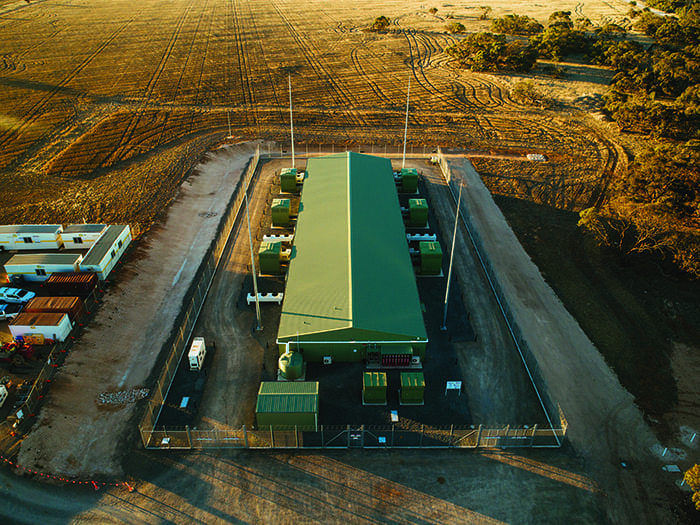
Mining operations in remote regions of Australia have long relied on onsite generation because grid access is limited or nonexistent. A similar challenge exists in the U.S., where energy producers in the Permian Basin of New Mexico and Texas have found that local utilities cannot supply enough power to maintain full production. In both cases, companies are increasingly turning to onsite generation that can be integrated into, or serve as the foundation for, a microgrid to bridge the gap between their operational needs and what the grid can provide.
A microgrid is a localized energy system that can combine onsite generation, energy storage, and controls to power a facility, campus, or defined geographic area. Unlike traditional backup systems, a microgrid can operate in parallel with the utility grid or independently in “islanded” mode. Its purpose is to improve reliability, resilience, and energy flexibility by allowing the customer to manage these power resources they are now bringing alongside, or in place of, utility supply.
Navigating BYOG Hurdles
Across industries, BYOG has emerged as the practical response whenever grid limitations threaten operational reliability or growth. More than ever before, modern industries, particularly data centers, now require BYOG for operational continuity.
While BYOG offers a path to securing timely and reliable power, the challenges associated with operating utility-scale generation cannot be understated. Utilities have spent decades building the expertise, processes, and institutional knowledge required to operate generation plants safely and reliably. Large energy users now must develop similar capabilities, often with much less time to do it in. Several hurdles stand out:
- Permitting and Regulatory Compliance. Onsite generation requires air permits, interconnection studies, fuel infrastructure approvals, and often public utility commission oversight. In New Mexico, for example, microgrids may be required to comply with the Energy Transition Act, which mandates 40% renewable generation by 2028, 50% by 2030, and 100% by 2040.
- Fuel Access and Reliability. Whether a microgrid uses reciprocating engines, gas turbines, or fuel cells, operators must secure a stable fuel supply with appropriate pressure, redundancy, and operational contingencies. These tasks have traditionally been handled by utilities.
- Integrating Renewables and Storage. If BYOG includes solar, wind, or battery energy storage, even at relatively low penetration, operators must manage variability, forecasting, and system stability. These functions typically require advanced control systems and operational expertise.
- Equipment Scarcity and Heterogeneous Generation Fleets. Global supply chain constraints have extended lead times for new generation assets. Because of this, many procure whatever is available, creating heterogeneous fleets with differing control schemes and performance characteristics.
Much more than just adding generators, BYOG requires standing up a miniature utility at unprecedented scale and speed, complete with planning, forecasting, dispatch, maintenance, and resiliency capabilities.
What Large Energy Users Need from Microgrids
Large energy users depend on uncompromising operational continuity. It doesn’t matter if the facility is an industrial plant, a manufacturing campus, a refinery, or something else, reliable power is essential. Beyond simply meeting nameplate megawatt requirements, these operations depend on precise control of frequency, voltage, and fault isolation to keep critical processes stable and safe.
A well-designed microgrid can deliver greater than 99.9% power reliability, minimizing nuisance trips and enabling rapid recovery when equipment or generators fail. These systems also support lower fuel consumption and reduced emissions. They optimize dispatch decisions, trimming unnecessary spinning reserve and improving the efficiency of both thermal and electrical resources. With more predictable maintenance planning supported by real-time diagnostics, predictive insights, and automated derate handling, operators improve performance and stay one step ahead of potential failures.
A Unified, Layered Control Architecture
Successfully managing a BYOG microgrid (Figure 1) requires a layered control architecture that coordinates assets from the device level to enterprise-level dispatch.
 |
|
1. Operators ensure power reliability by coordinating diverse assets into a cohesive, resilient microgrid system. Courtesy: Aspen Technology |
Modern microgrids increasingly rely on the structure defined in the IEEE 2030 control hierarchy, which organizes control functions across five layers:
- Level 0 – Device/Equipment Protection Control. Fast, protective control of individual devices: breakers, inverters, governors, excitation systems, and battery controllers.
- Level 1 – Local Control Schemes. Automated responses for load shedding, voltage/frequency regulation, and islanding sequences.
- Level 2 – Plant-Level Monitoring and Generation Control. Supervisory control and data acquisition (SCADA)/human-machine interface (HMI), plant optimization, and real-time performance management.
- Level 3 – Sitewide Power Optimization and Resource Scheduling. Asset dispatch, unit commitment, renewable/storage integration, and fuel optimization.
- Level 4 – Enterprise Energy Planning and Grid Interaction. Grid interface management, market participation (where applicable), and enterprise-level forecasting and operational planning.
This layered architecture matters because it ensures that each control decision happens at the right speed, in the right place, with the right context, from millisecond protection actions to hour-ahead forecasting and long-term economic scheduling.
Key Tenets of Success with Control Architecture
A unified control architecture begins with hardware-agnostic integration, enabling operators to bring together generation assets of any type or original equipment manufacturer (OEM). A microgrid could incorporate gas turbines, reciprocating engines, renewables, batteries, or new technologies. The control system must be able to support standard protocols and interfaces so that all assets function within a single, cohesive ecosystem.
Building on that foundation, unified control and optimization ensures that these diverse assets operate as a coordinated power system rather than a set of independent machines. Automatic generation control maintains system frequency, voltage, and reserve margins across mixed fleets. Meanwhile, intelligent dispatch prioritizes units based on real-time capability, efficiency, and availability.
To support this coordination, forecasting and real-time management play a critical role. Higher-level forecasting across the control hierarchy enables operators to plan for load, renewable variability, and fuel requirements, while lower-level controls respond instantly to disturbances. This combination allows the system to isolate faults, trip degrading assets, and prevent localized issues from cascading across the microgrid.
As these microgrids increasingly become mission critical infrastructure, cybersecurity and compliance must be embedded throughout the control stack. Adhering to rigorous frameworks, such as Department of Homeland Security Safety Act designations, North American Electric Reliability Corporation Critical Infrastructure Protection (NERC CIP) standards, and ISO27001, helps ensure that onsite generation assets do not become an attack vector. Operators must be able to maintain trust in both digital and physical layers of control.
As microgrids continue to scale, advanced control capabilities become increasingly important. Future operations may require enterprise-level energy planning, multisite distributed energy resource (DER) optimization, integration of new resources such as hydrogen or long-duration energy storage, and participation in emerging flexibility or ancillary service markets where regulations allow. Higher-level control layers provide the forecasting, economic optimization, and grid interactive functionality needed to support these evolutions. By establishing a unified, layered control architecture from the start, operators ensure that their microgrids can not only manage current complexity but also grow into more sophisticated energy systems without expensive redesigns.
A New Energy Paradigm
Microgrids are now mission critical for many large energy users, and mismanaging the control hierarchy can result in operational, financial, and reputational consequences. Organizations pursuing BYOG should select operational technology partners capable of delivering both the unified control layer and the layered architecture required to operate as a miniature utility.
BYOG doesn’t have to mean operational chaos. When supported by a coordinated, multilayered control architecture, microgrids can become the backbone of large-scale energy resilience.
—T.J. Surbella is a director at Emerson’s Aspen Technology business.