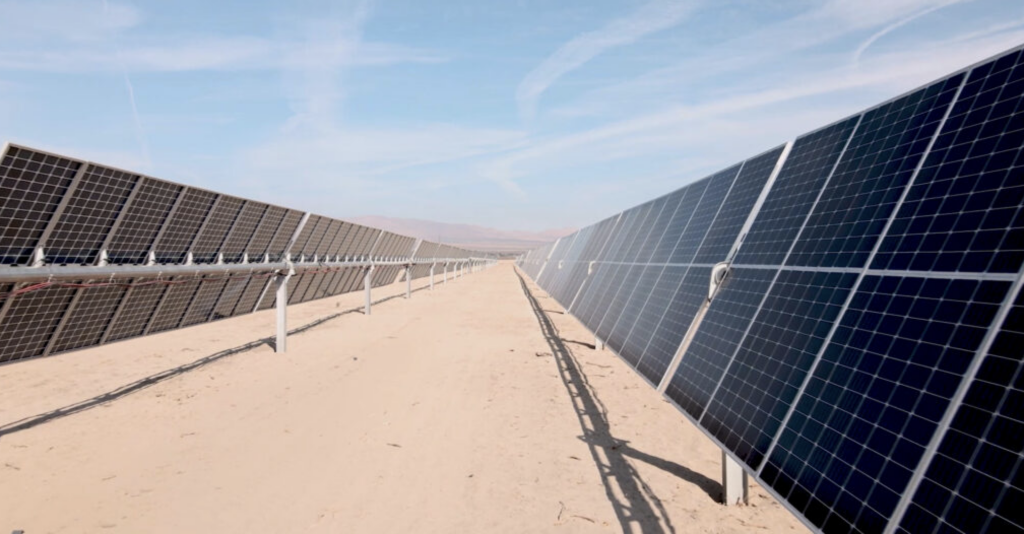
Leading corporations are advancing their sustainability goals by investing in renewable energy, particularly through community solar credits that support both environmental and social impact. This trend follows the ever-growing solar market, driven by new production contracted by these large companies and utilities, businesses, and residential solar panel users.
But to be sustainable, there’s more to consider than just purchasing and using solar energy; what happens when solar panels are damaged or reach the end of their usable lives? The sustainable option: recycling. As solar panels progress through their lifecycles, recycling programs and plans will be essential, especially to keep up with the push toward a more sustainable energy future. While we’re seeing an influx of solar panel production now, we’re already experiencing a high demand for solar panel disposal.
The Recent History of Solar Panels
The rise in solar panel usage in the early 2000s corresponded with an appetite for fossil fuel alternatives. With policy support and dramatic decreases in the cost of the energy it produces, solar power has grown at a historic pace over the last several decades.
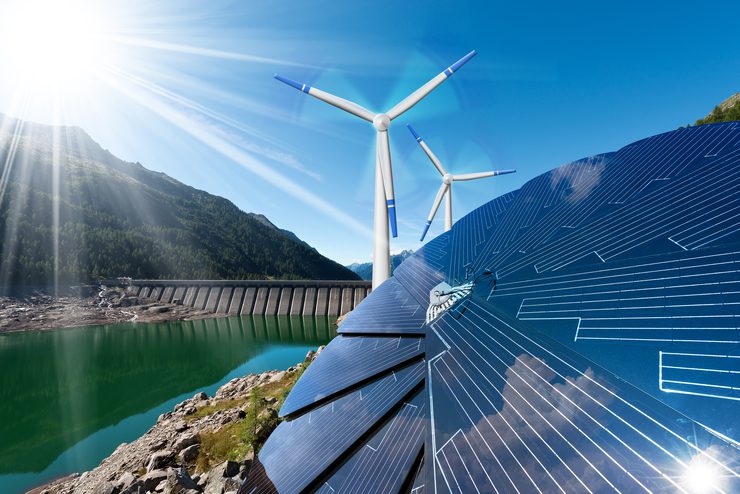
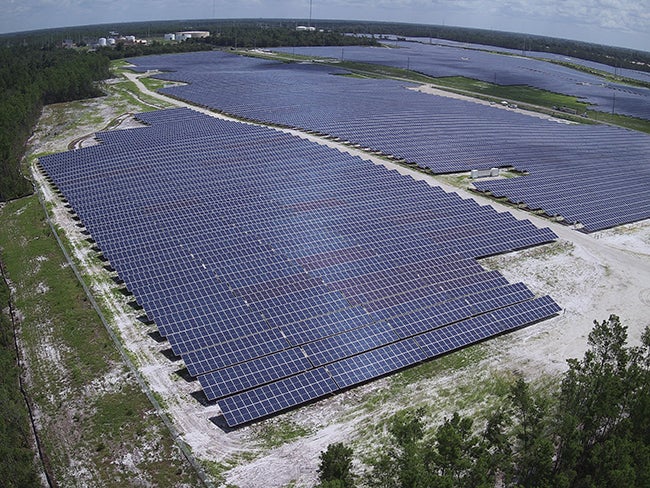
Now, we’re experiencing exponential growth in energy demand to account for increasing populations and importantly to power new technologies that require large data centers. This demand is a catalyst for record solar farm growth across the U.S. By 2030, solar photovoltaics (PV) is expected to account for 80% of the growth in global renewable capacity and is on track to become the largest renewable source, surpassing both wind and hydropower.
While we’re rapidly expanding solar energy, we must remember that these panels do not last forever. According to the U.S. Environmental Protection Agency (EPA), solar panels have a usable life of about 25 years. This means that in 2025, we’re seeing the largest wave of solar panels needing to be disposed of to date.
The International Renewable Energy Agency shares that by 2030, the cumulative end-of-life PV waste in the U.S. is projected to be between 0.17 and 1 million metric tons. By 2050, the U.S. could generate up to 10 million metric tons of end-of-life solar panels—the second highest globally—representing a significant opportunity for material recovery and circular economy leadership. With aluminum making up roughly 17% of a solar panel’s mass, this would translate to about 1.7 million metric tons of recoverable aluminum.
Recycled aluminum panel has the potential to be a meaningful domestic supply source, as the U.S. currently imports more aluminum than it creates. The takeaway: we must pay attention to how solar panel waste is managed and seize opportunities for material recovery.
Luckily, solar panel waste has potential for beneficial reuse. The PV cells are built from recyclable materials, and in some states and across the world, they are already being recycled. But in the U.S., there are some obstacles.
Solar Panel Waste Classification
Companies, such as those using community solar as part of their sustainability plans, utilities, businesses, and residential solar panel users have two primary options for disposal: landfilling or recycling. Currently in the U.S., there is no clear federal regulation on how solar panel waste is classified or what disposal method is required.
Solar panel waste can either be classified as hazardous or universal waste. Hazardous waste is subject to more stringent regulations at disposal, whereas universal waste, a specific type of hazardous waste that is widely produced, can be managed with less stringent regulations than other hazardous wastes, encouraging recycling as its proper disposal method.
According to the EPA, solar panels are safe when in use and maintained appropriately. At the end of their usable lives, some solar panels are classified as universal waste under the Resource Conservation and Recovery Act (RCRA). However, others contain enough metals, like lead, to meet the definition of hazardous waste under RCRA. In many states, solar panels must be inspected to determine if they contain these materials classified as hazardous, and disposal methods are determined from there. In other states, like California, all solar panels are classified as universal waste, and recycling is required.
Federally, the EPA is preparing to propose a new rule that would reclassify solar panels from hazardous to universal waste—a move that could streamline recycling efforts and reduce regulatory barriers. In anticipation of this rule or similar state-specific rules, it’s important for those currently using or planning to integrate solar panels to know what disposal options are available and what regulations apply to them.
Benefits of Solar Panel Recycling
PV cells are, at a high level, comprised of three components that can be recycled and reused as raw materials for other products. These are aluminum, glass, and silicone. The aluminum framing is easily recyclable and can be used in almost all new aluminum products, while the silicone solar cells can be melted and repurposed for various applications. During the recovery process, the glass sheet is typically broken, and the fragments are recovered and used in new solar panels or other applications. By first separating the components, recyclers can more easily process them for their next lives in industries like electronics manufacturing.
Solar panel recycling offers more than just sustainability. The parsed-out materials reenter the market, not only providing economic benefits but also contributing to the security of the supply of finite raw materials and saving landfill airspace. By 2030, it’s estimated that the raw materials recovered from all PV panels combined could have a value of $450 million (in 2016 terms). That is equivalent to the amount needed to produce 60 million new solar panels.
These materials are valuable to manufacturers beyond those in the solar industry. With fewer solar panel manufacturers in the U.S. than in other regions, American recyclers aim to sell these recovered materials to non-solar industries so that these resources remain in circulation and continue to deliver environmental and economic benefits. This versatility and value are why we must consider solar panel recycling as standard practice for current and new solar energy projects.
When to Recycle Solar Panels
At any stage of the solar panel lifecycle, solar panels may require disposal. From raw material mining to manufacturing, everyone has a stake in the game. During the installation of solar farms alone, an estimated 5%–10% of panels are tested and found to be defective, requiring proper disposal. As a purchaser, it’s best practice to have a disposal plan in place at the project’s inception, not just end-of-life disposal, but also if a solar panel breaks during transportation or installation, or a natural disaster destroys several units. In all cases, recycling can be a viable disposal method.
As we prepare for the influx of solar energy as the primary renewable energy source, we must also prepare for solar panel disposal. In the U.S., waste and recycling companies may begin offering their existing and new customers increased options for solar panel recycling. Experienced recycling partners like Clean Earth are uniquely positioned to help solar stakeholders navigate evolving regulations and implement scalable, compliant recycling solutions across the panel lifecycle.
—Sergio Nusimovich is vice president of Engineering and Technical Director at Clean Earth.