
Legal & Regulatory
-
Legal & Regulatory
Too Many Fingers in the Smart Grid Pie?
There has been much excitement about the advent of the "smart grid" recently, especially because of the strong push by the Obama administration. Despite the simple-sounding term, the smart grid is not a simple concept.
-
Legal & Regulatory
White House Announces Cyber Security Plan
The Obama administration has unveiled its long-awaited policy on cyber security of government and private-sector communication and distribution systems. Is it less than meets the eye, as some critics argue?
-
Legal & Regulatory
New Administration’s Energy Priorities: Hydrogen Is Out, Coal Is In
The Obama administration has pulled the plug on the Department of Energy’s attempts to develop hydrogen-powered fuel cell cars. (The Bush administration had been touting H-powered cars for many years, with nothing to show for the effort other than large expenditures and a General Motors concept car that cost in the millions to build.) At about the same time, the Obama administration announced it would resurrect the billion-dollar FutureGen coal-fired generating project, aimed for Mattoon, Ill.
-
 Legal & Regulatory
Obama Names Jaczko to Head NRC
As expected, President Obama has named Nuclear Regulatory Commissioner Gregory Jaczko, an ally of Sen. Harry Reid (D-Nev.), as chairman of the NRC, almost certainly dooming the Yucca Mountain, Nev., site for disposal of spent nuclear fuel.
-
Commentary
Learning from Past, Failed Energy Laws
It’s not easy writing energy legislation, as the experience of the past demonstrates. Nor are the results always in the public interest.
-
Legal & Regulatory
Cap-and-Trade or a Carbon Tax for Greenhouse Reductions?
What makes more sense to reduce greenhouse gas emissions from power plants—a cap-and-trade regime or a carbon tax? It’s a contentious issue among those who generate power and among academic economists and policy makers.
-
Commentary
Regulatory Effectiveness: Is It Measurable?
A [state utility regulatory] commissioner asked recently, “By what metrics can I assess my commission’s performance?” That’s a tough question.
-
Legal & Regulatory
Looking Downstream After the Cooling Water Case
In the wake of the recent U.S. Supreme Court ruling related to cooling water intake practices at large power plants, many utilities are relieved to be off the hook as far as implementing expensive control upgrades to protect fish and other aquatic organisms.
-
Legal & Regulatory
TREND: Coal Industry’s Future Faces Challenges
What role will coal play as the nation moves toward trying to reduce greenhouse gases? The picture is mixed, as these news stories from around the country demonstrate.
-
Legal & Regulatory
Supremes Back Cost Reviews on Cooling Water
The Supreme Court backs restrictions on “once-through” cooling for new plants, while giving a pass to existing plants.
-
 Legal & Regulatory
Coal Companies Peabody, CONSOL, and Arch Are Weathering the Economic Storm
Coal continues to demonstrate considerable financial muscle in the current economic downturn, despite anti-coal rhetoric and concerns about climate change.
-
 Legal & Regulatory
Will Plug-in Hybrids Cause Blackouts?
Could demand from plug-in hybrid cars crash the grid? A DOE national lab addresses the issue.
-
 Legal & Regulatory
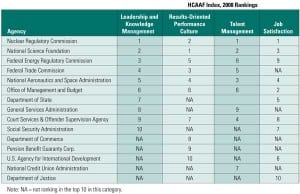
The Best and Worst of U.S. Government Employers
Working for Uncle Sam can be worthwhile or a life-sapping grind, depending on which agency employs you, according to a new survey by the U.S. Office of Personnel Management. Guess which agency ranked best. (Hint: It’s related to power.)
-
 Legal & Regulatory
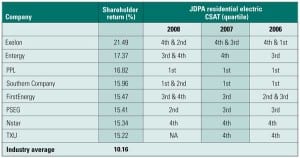
Utility Customer Satisfaction: A Faith-Based Initiative?
Does customer satisfaction play a meaningful role in guiding utility operations? Many utilities think it does, as do many regulators. The market apparently doesn’t. Data suggest that the jury is out on the question, and the intuitive answer may not match the empirical evidence.
-
Legal & Regulatory
Will Stars Align for Transmission Policy in 2009?
In the 1990s, alarm bells were sounded because the construction of electric transmission infrastructure was not keeping pace with the United States’ rapidly increasing electric demand. More than 10 years later, despite considerable debate and the passage of new legislation, we continue to search for ways to get transmission built. However, it now looks as if 2009 may the year in which the stars finally align to fix the transmission system.
-
Legal & Regulatory
Nuclear Loan Guarantees Have Failed
Nuclear loan guarantees in the 2005 Energy Policy Act have proven to be a failure: not just too little, but far too late.
-
Legal & Regulatory
Energy Earmarks in Spending Bill Hit $98M
North Dakota garnered most of the Department of Energy’s earmarks in March’s omnibus appropriations bill.
-
Legal & Regulatory
Regulators Face Worst of Times
It’s not easy being a regulator as the nation faces several daunting energy challenges—integrating renewables, carbon constraints, reliability, and security into an elderly grid that is barely able to keep up with its current mission of moving power from generator to load.
-
Legal & Regulatory
Transmission Superhighway or Interconnected Patchwork?
President Obama promoted "green energy" as a signature theme in his presidential campaign. During his first weeks, he reaffirmed his administration’s commitment to renewable resources. In a radio address, he promised to double the nation’s alternative energy capacity within three years and to construct a 3,000-mile transmission grid to "convey this new energy from coast to coast."
-
 Legal & Regulatory
SCR Coming to Diesel Vehicles
Power plant managers are familiar with selective catalytic reduction (SCR), a technology to reduce emissions of nitrogen oxides from fossil-fueled generating plants. Starting in 2010, SCR technology, using a urea reagent, will also be required on new diesel-powered vehicles in utility fleets, ranging from light-duty pickups to 18-wheelers.
-
Legal & Regulatory
Generators Propose a Plan for Carbon Pricing
With the U.S. economy currently in a free fall, some utility industry leaders and elected officials argue that carbon cap legislation should be put on hold while the country recovers financially. However, President Barack Obama has a different game plan.
-
Legal & Regulatory
Oil—Unsafe at Any Price
A confluence of circumstances promised to make 2008 a transformative year for renewable energy in the U.S. States enacted additional, and more demanding, renewable portfolio standards, promoting accelerated and sustained development of "green" energy resources. Increasing concerns about global warming and climate change prompted some of this activity. However, the unprecedented escalation of oil prices to almost $150 a barrel (translating into prices at the pump in excess of $4) was the largest impetus for demands that this nation end its addiction to fossil fuels.
-
Legal & Regulatory
Is a Green Future Realistic with an Economy in the Red?
California Governor Arnold Schwarzenegger recently signed an executive order expanding the state’s renewables portfolio standard (RPS) requirement to 33% by 2020. The executive order formalizes what has been generally assumed for some time: A 33% RPS requirement will be needed for California to achieve its ambitious greenhouse gas (GHG) emissions reduction goals.
-
Legal & Regulatory
Energy’s Articles of Confederation
An attendee at a recent industry conference made the cynical observation that the dysfunctionality of our national and state energy policies can be attributed to the fact that implementation of any program is subject to institutional limitations akin to those imposed by the "Articles of Confederation." Readers may recall that the Articles preceded the Constitution as the governing compact for the 13 original states.
-
Legal & Regulatory
California’s GHG plan gives power heaviest load
On Sept. 12, the California Public Utilities Commission (CPUC) and California Energy Commission (CEC) took the next step in the implementation of Assembly Bill (AB) 32, California’s ambitious greenhouse gas (GHG) emissions – reduction initiative, with the release of a 300-page proposed decision on GHG regulatory strategies.
-
 Legal & Regulatory
Texas loses “food vs. fuel” biofuel feud
How often do you get a clash between two great Lone Star icons?
-
 Legal & Regulatory
Prop 7: California’s illusory promotion of renewable power
This November, as part of California’s eclectic version of participatory democracy, its residents will vote on whether to amend the Solar and Clean Energy Act of 2008. Proposition No. 7 (Prop 7) promises to place the state on “the path to energy independence.” It would require all California electric utilities, including municipals, to procure 50% […]
-
 Legal & Regulatory
Reality bites California GHG plan
The California Air Resources Board (ARB) recently issued its long-awaited draft Climate Change Scoping Plan (Draft Plan) for implementing Assembly Bill (AB) 32, California’s ambitious greenhouse gas (GHG) emissions-reduction initiative. AB 32 requires California to reduce GHG emissions to 1990 levels by 2020—roughly a 30% reduction in projected “business-as-usual” emissions levels or 168 million metric […]
-
 Legal & Regulatory
Climate change: Policy via litigation?
By Steven F. Greenwald and Jeffrey P. Gray David Crane, the CEO of NRG Energy, was recently quoted in a widely disseminated publication as saying: “It is a moral imperative that we take steps to reduce CO2 concentration in the earth’s atmosphere.” One might expect those reacting to Crane’s comments (made in a February 2007 […]
-
 Legal & Regulatory
The green trade-off
By Steven F. Greenwald and Jeffrey P. Gray These should be good times for environmentalists who focus on “green” energy policy. More than half the U.S. states have adopted renewable portfolio standards (RPS) that require utilities to meet specific renewable generation targets, and many are considering additional actions to reduce greenhouse gas (GHG) emissions. Such […]