
Ten years ago, utilities could plan for new 100-megawatt (MW) load requests. That size of energy load fit inside existing forecasts: it could be absorbed, modeled and planned around.
Today, load requests have increased to one, two even three gigawatts (GW) at a time. This results in utilities fielding individual load requests that rival full generating stations.
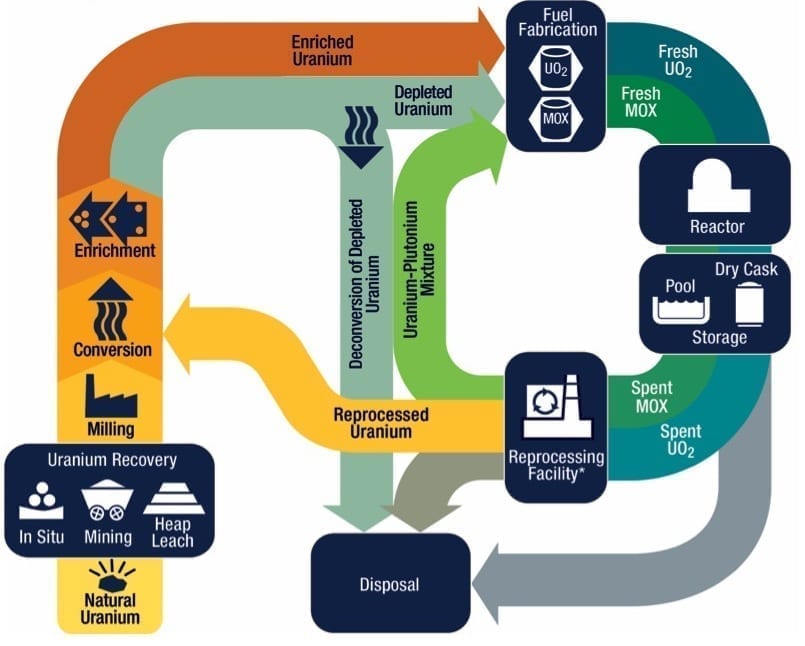
Enter nuclear; at gigawatt scale, it remains the only carbon-free source capable of providing continuous, round-the-clock baseload output.
COMMENTARY
The challenge? The build timeline for nuclear doesn’t meet the demand that’s now showing up.
An Outdated Planning Model
For decades, utilities successfully planned around incremental growth. In many regions, load forecasts moved predictably: generation, transmission and substations could be sequenced years in advance. That planning model has become obsolete.
Utilities now face growth expectations of 50% to 75% in regions that weren’t even part of their forecasts a few years ago. At the same time, data center development cycles have compressed. Projects can move from site selection to operation in roughly 18 months.
By contrast, utilities have historically planned three- to four-year timelines to bring a new power plant online. But due to current needs, that no longer holds. Turbine lead times have stretched. Electrical equipment is harder to procure. When data center developers and utilities are building simultaneously, competition for transformers and switchgear pushes delivery schedules out of alignment.
Forecasting has been complicated further by how projects enter the system. Developers often submit multiple interconnection requests across different locations, expecting to build only a subset. Utilities struggle to determine which requests represent real load. In a recent electric report survey conducted by Black & Veatch, only about 17% of utilities reported confidence in their load projections.
That uncertainty has begun to ease in recent months as coordination has improved. Utilities and developers are talking earlier, and more projects are now appearing with on-site generation or power supplied by independent producers rather than relying solely on traditional utility delivery.
Why Nuclear Enters the Discussion
As near-term options are evaluated, the tradeoffs between power sources become more visible.
When projects are tied to natural gas, offsets quickly enter the discussion. Renewables are also considered, but at this scale they have not been used to carry continuous, multi-gigawatt demand on their own. Land availability, storage requirements, and dispatchability limit how much they can contribute to always-on loads.
These constraints bring nuclear into planning conversations—not as a near-term solution, but as a way to place a large amount of firm capacity on a relatively small site over the long run. Small modular reactors (SMRs) are discussed as a viable way to build cleaner energy into future capacity needs.
In this new era of nuclear, hyperscalers and utilities are both participating, bringing both capital and demand.
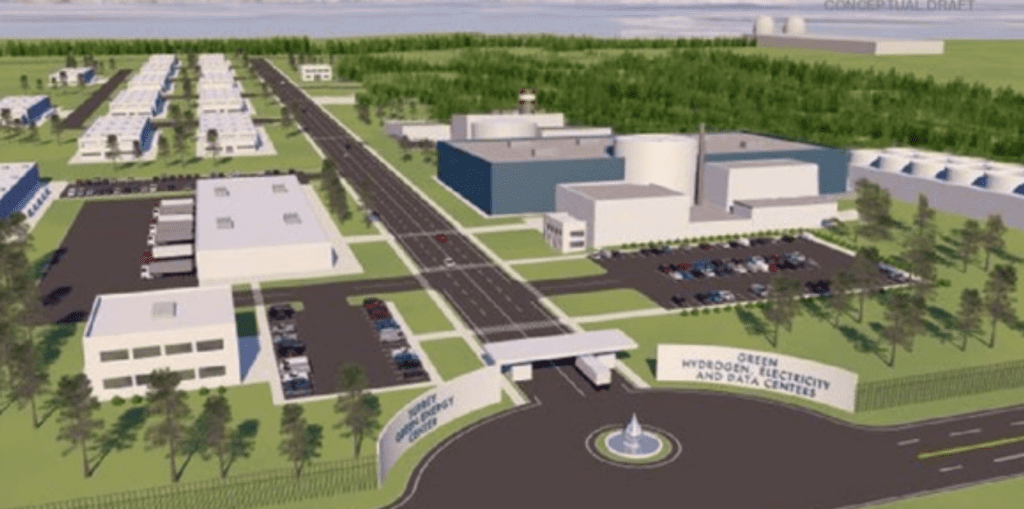
At Energy Northwest, Amazon has invested in X-energy and provided funding for early development work on the Cascade Advanced Energy Facility. Through Cascade Nuclear Partners, an equal joint venture among Black & Veatch, Kiewit and Aecon, the goal is to build multiple units.
Not long ago, nuclear development was dominated by utilities and original equipment manufactures. Today, hyperscalers, developers, private capital, and government funding all have a stake, representing levels of industry buy-in not formerly seen.
The Timeline Reality
Even with momentum around nuclear energy, it does not solve the near-term problem utilities are facing.
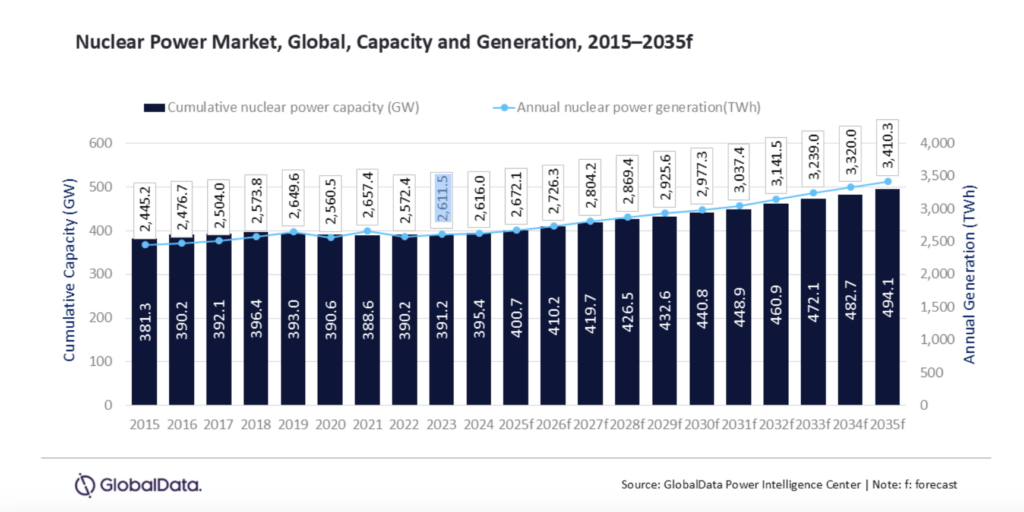
Any increase in nuclear output over the next several years is tied to existing plants. That includes restarts, extensions, and power uprates. New units will take longer to design and construct. SMRs targeted for the early 2030s are first-of-a-kind projects. Costs are being established and manufacturing has not yet scaled.
Large reactors extend the timeline further. A new AP1000 started today may take until the mid-2030s to complete. The AP1000 is a large, conventional nuclear reactor, producing about 1,100 megawatts, and taking many years to license, manufacture specialized components, and build on site. Key components rely on a limited number of overseas suppliers and fabrication spans multiple countries. That complexity adds time and uncertainty.
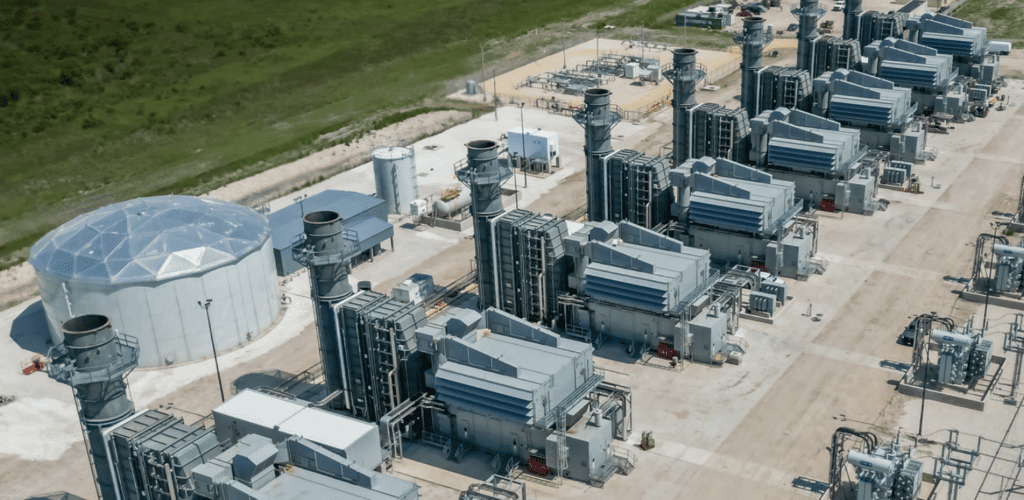
In the meantime, utilities are working with what can be built faster. As a transition fuel, natural gas appears in near-term plans because it can move through permitting more quickly, and utilities are familiar with integrating it into existing grid operations, even under current equipment constraints.
As data center development expands beyond a handful of established markets, these pressures are no longer regional. They are spreading across the broader U.S. grid and into more utility planning.
Sequencing, Not Salvation
The tension at the center of this moment is not just technological. It is temporal, too.
Data center projects move quickly. Utility planning follows longer cycles. Nuclear planning sits further out than both. These differences shape real decisions.
Utilities are working through what capacity is realistic, and when it can come online. At the same time, data center projects are encountering limits tied to generation availability, transmission capacity, and substation readiness earlier in development than expected.
Near-term needs are being addressed with the options that can move fastest. Longer-term goals are planned in parallel. Nuclear fits into this longer timeline, not as a substitute for what must happen now, but as part of what must follow.
Seen this way, nuclear’s return is not a pivot. It is an acknowledgment of where the grid is headed and how long it actually takes to get there.
—Kristen Braun is Associate Vice President, Nuclear Business Line Director, for Black & Veatch.