
Articles By

-
-
HR
Is the Future of Enterprise Computing in the Clouds?
“Cloud” computing has become the latest buzz in the information technology world. What does it mean? Is it real? And how can it affect your business world?
-
 O&M
O&MThe U.S. Gas Rebound
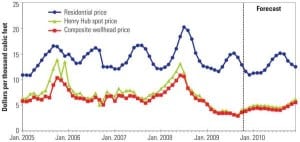
"It’s déjà vu all over again," said Yogi Berra. The Hall of Fame catcher could easily have been predicting the coming resurgence of natural gas – fired generation. Yes, a few more coal plants will be completed this year, but don’t expect any new plant announcements. A couple of nuclear plants may actually break ground, but don’t hold your breath. Many more wind turbines will dot the landscape as renewable portfolio standards dictate resource planning, but their peak generation contribution will be small. The dash for gas in the U.S. has begun, again.
-
 Nuclear
Japan Launches Commercial Operation of MOX-Fueled Reactor
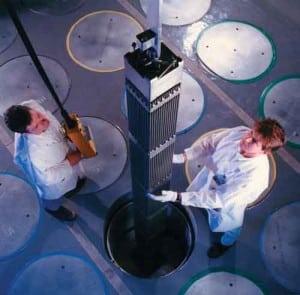
Japan began operating a nuclear power reactor using plutonium-uranium mixed oxide (MOX) as fuel for the first time last October. About 16 MOX-containing fuel assemblies were loaded during a scheduled outage to replace a portion of the 193 fuel assemblies at the No. 3 reactor at Kyushu Electric Power Co.’s Genkai nuclear power plant. The utility eventually plans to triple the number of fuel assemblies at the 1,180-MW reactor in Saga Prefecture to 48. The Ministry of Economy, Trade and Industry conducted its final inspection of the reactor and issued its certification on Dec. 2.
-
Legal & Regulatory
When It Comes to Nukes, Little Things Mean a Lot
It’s the little stuff that can lead to big stuff, the Nuclear Regulatory Commission tells FirstEnergy in relation to its Perry Nuclear Power Plant in Ohio.
-
 Environmental
A New Regulatory and Environmental Milieu
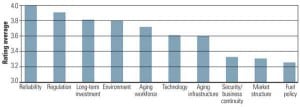
There will be no shortage of important issues to keep utility executives and their staffs busy throughout 2010. Few of these will be surprises, although a number will emerge quickly and assume larger-than-life significance. The confluence of the great recession and the sturm und drang of environmental legislation will create the liveliest of the debates, but more subtle trends will drive additional stressors. The results of Black & Veatch’s 2009 fourth annual industry strategic directions survey can offer guidance as to how these issues will affect the industry in the coming year.
-
 Solar
SolarChina’s Largest PV Maker to Set Up in Arizona
China’s largest solar panel maker, Suntech Power, in mid-November announced plans to open a photovoltaic (PV) manufacturing facility in Phoenix, Ariz., in the third quarter of 2010. Roger Efrid, Suntech’s managing director, was widely quoted as saying that the company — which holds 12% of U.S. market share and is looking to reach 20% by 2010 — chose to establish a plant nearer to customers. This was smart business, even though panels would be made from solar cells imported from China, because solar panels are heavy, he told The New York Times: "As the price of solar panels has reduced dramatically in the last 12 months, the shipping costs have become a larger and larger portion of the overall cost of getting these projects to market."
-
Legal & Regulatory
Addressing the Intraday Trading Position Conundrum
Power traders need to get faster, more accurate information on how markets are working and how they are swinging. They should look to telecommunications and manufacturing markets for solutions.
-
Smart Grid
U.S. Smart Grid Forecast: Flurries of Activity
A number of factors are coalescing to create the most hospitable climate for smart grid development activities that has yet been seen in the U.S. Here’s a look at those elements and at the different models and motivations for smart grid project development across the country.
-
 Coal
CoalThe Impact of Carbon Trading on Performance: What Europe’s Experience Can Teach North American Generators
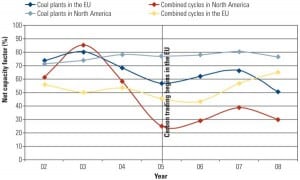
The European carbon trading system experience suggests that North American generators should expect severely altered coal-fired power plant operating profiles if cap-and-trade legislation becomes law. In a groundbreaking study, Solomon Associates predicts the reduction in mean run time that North American generators should expect. The trends outlined in this study provide an overview of some of the broad challenges facing generators in moving to a carbon-constrained market environment.
-
 Coal
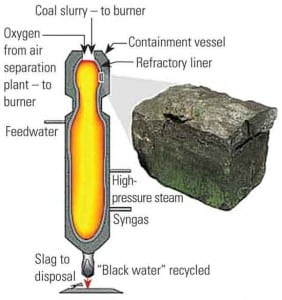
CoalAdvanced Refractory Lining Improves Gasifier Reliability
Successful testing of a new refractory lining material developed by the Office of Fossil Energy’s National Energy Technology Laboratory (NETL) could lead to higher reliability and improved economics of gasification technology.
-
Commentary
Interconnection Animus: Do Regulatory Procedures Create a “Tragedy of the Commons”?
What’s the real “tragedy of the commons?” It is legal, regulatory, cultural, or political? And is there is way out?
-
Smart Grid
What Do Customers Expect from the Smart Grid?
Xcel Energy’s SmartGridCity enterprise in Boulder, Colo., is one of the most talked-about smart grid projects. Here’s what some Boulder utility customers are saying about it.
-
 Solar
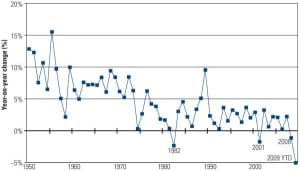
SolarA New Foundation for Future Growth
As the economy begins to grow again, the banking industry continues to stabilize, and lawmakers work on finalizing climate change legislation, the decisions made in 2010 will lay the foundation for the power industry for decades to come.
-
 Nuclear
High-Temperature Gas-Cooled Reactor Concept Moves Forward
Researchers from the Idaho National Laboratory (INL) say they have developed a new type of nuclear fuel for use in next-generation high-temperature gas reactors that produces less waste — a major step forward for the Next Generation Nuclear Plant (NGNP).
-
Commentary
For Utilities, Derivatives Is Not a Dirty Word
Financial derivatives make sense for the electricity business, providing protection against price swings, and don’t require additional regulation.
-
 Solar
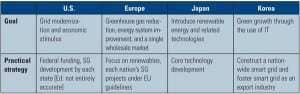
SolarWhich Country’s Grid Is the Smartest?
The U.S. isn’t the only country evaluating and implementing elements of smart grid technology. In fact, it could be argued that other nations are much farther along the path to a comprehensive, technically advanced system for integrating renewables, managing load, and creating a more flexible power grid.
-
 Business
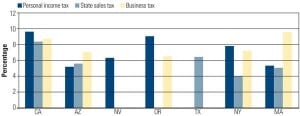
Dollars and Dirt: Investing in Infrastructure
The familiar saying "as goes California, so goes the nation" seems to apply to the many states that have been unable to invest in infrastructure improvements because they are crushed by debt and shrinking revenues. Will California and energy project developers continue to invest in energy infrastructure in 2010 given the limited availability of private capital, shaky state finances, and shifting regulatory climate?
-
News
Predicting Hurricane-Related Outages
Researchers from John Hopkins and Texas A&M universities say that they have found a way to accurately predict power outages in advance of a hurricane. Computer models developed using data from Hurricane Katrina and four other destructive storms could save utilities substantial amounts of money and help facilitate rapid restoration of power after a storm, they say.
-
 Commentary
For a Secure Energy Future, Obama Must Be Like Ike
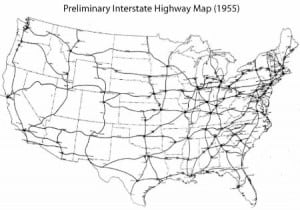
President Dwight David Eisenhower built the interstate highway system more than 50 years ago. Is it time for the U.S., when it comes to the electric power grid, to be like Ike?
-
Smart Grid
The Smart Grid Has a Growth Spurt
Which country has the smartest grid? Which U.S. state has the most smart meters? What’s Google got to do with the grid? Answers to these questions and more can be found in our web exclusives. Here’s a taste of what you’ll find online.
-
O&M
Sealing Transformer Oil and SF6 Leaks Quickly and Effectively
Transformers, which are prone to leaking, are an excellent example of where using the right materials and techniques can quickly reduce cleanup costs and potential environmental damage from a fluid leak. Transformer leaks are most commonly caused by degrading cork gaskets or holes in the radiator fins or the steel tank. Often these leaks are slow drips, but occasionally a catastrophic leak will occur, spilling hundreds of gallons of mineral oil into the environment and causing the transformer to short-circuit, causing further health and safety concerns. These dangers, coupled with transformers’ isolated locations, make inspection, repair, and maintenance a major challenge.
-
 Coal
CoalBrazil: Latin America’s Beacon
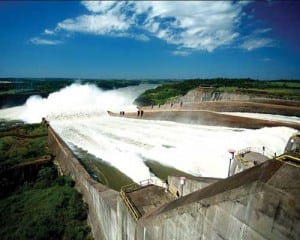
With the eighth-largest economy in the world, Brazil has a clear need for power, but balancing supply and demand has proven tricky in recent decades. Even in a country where over 80% of generation capacity comes from renewables, planning for future capacity additions isn’t straightforward or easy.
-
O&M
When to Use an Oil Skimmer
Oil skimmers are very effective in removing oil from wastewater before discharge but are also perhaps the most efficient and economical approach.
-
 Coal
CoalTuning Ammonia Flow to Optimize SCR Performance
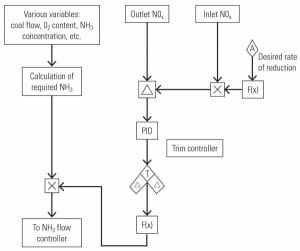
The selective catalytic reduction system has become ubiquitous throughout the world of power plants. Emission control requirements are ever-more stringent, and the cost of excursions is becoming increasingly high. The key to staying under the regulators’ radar is precisely controlling the ammonia injected into the boiler. A new control strategy does precisely that.
-
 News
NewsThin, Flange-Style Magnetic Encoders
Baumer introduced the new MOR 90 and MOR 105 magnetic incremental encoders for improved speed and position control on electric motors, drives, gearboxes, and conveyors. Measuring just 14 mm thick, these extremely thin, flange-style encoders are virtually imperceptible when positioned between the motor and the gearbox and have little effect on the overall size of […]
-
 News
NewsLow-Noise Remote Charge Converter
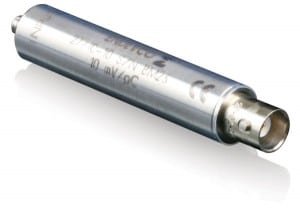
Endevco Corp. launched Model 2771C-XX, an ultra-low-noise remote charge converter (RCC) designed for use with charge output piezoelectric sensors within applications such as nuclear power plant/regenerative energy and environmental testing. The model offers a rugged two-wire (IEPE), single-ended design that operates from constant current power (4-20 mA). Both RCC signal output and current to the […]
-
 News
NewsMiniature Stainless Steel Pressure Switch
Ashcroft A-Series pressure switches are designed for tough OEM and industrial applications that require a durable, high-quality miniature switch. Available with explosion-proof and watertight enclosures, the pressure switch features a refined piston actuator that can be ranged up to 2,000 psi while enduring a working pressure of 5,000 psi. Small dimensions, a choice of connections, […]
-
Commentary
Carbon-Cutting Solution: Dynamic Demand Technology
Once upon a time, climate change felt like a distant threat on the horizon. Now it is happening in front of our very eyes. Across the world, global warming is sparking more intense heat waves, more flooding, and more droughts. If climate change continues at its current pace, the social, environmental, and economic costs don’t […]
-
 News
NewsFlowmeters for Steam Measurement
Racine Vortex released its RNS Series (Insertion) and RWS Series (Wafer) Vortex Steam Flow Meters to measure noncondensing steam and saturated process steam at pressures up to 150 psi for applications such as boiler monitoring. Both meters have no moving parts and are loop-powered devices with standard HART communication for ease of field programming and […]