The International Energy Agency (IEA) earlier this year reported that its analysis of recent data on geothermal power showed financing for the sector reached nearly $2.2 billion last year. The investment represents an 80% increase from the prior year, and IEA said it shows exponential growth from just $22 million of investment in 2018.
Industry analysts have said geothermal likely will continue to grow, in large part due to increased demand for energy worldwide, and drilling technology advancements supported by the oil and gas industry. The IEA recently said next-generation geothermal could meet up to 15% of worldwide demand for electricity by mid-century.
XGS Energy, with offices in Palo Alto, California, and Houston, Texas, is a geothermal energy company with a closed-loop system. The company said its “smallest modular unit is a single well, pipe-in-pipe heat exchanger, in which working fluid, typically water, is circulated inside a steel casing, warms up, and then is returned to the surface through an inner insulated tube.” The liquid can be used repeatedly to transfer heat to an above-ground power plant.
XGS earlier in April signed a deal with California Community Power (CC Power), a public authority established by CleanPowerSF and eight other local public energy providers, for development of 115 MW of geothermal power generation in the state. The deal means CleanPowerSF and the other CC Power members would have the first rights to electricity produced by XGS’s geothermal project.
Lucy Darago, chief commercial officer for XGS, said the company’s partnership with CC Power “sends a strong demand signal for next-generation geothermal, and XGS is ready to deliver—using a water-independent system designed to unlock California’s vast hot rock resources and provide reliable power for communities across the state.”

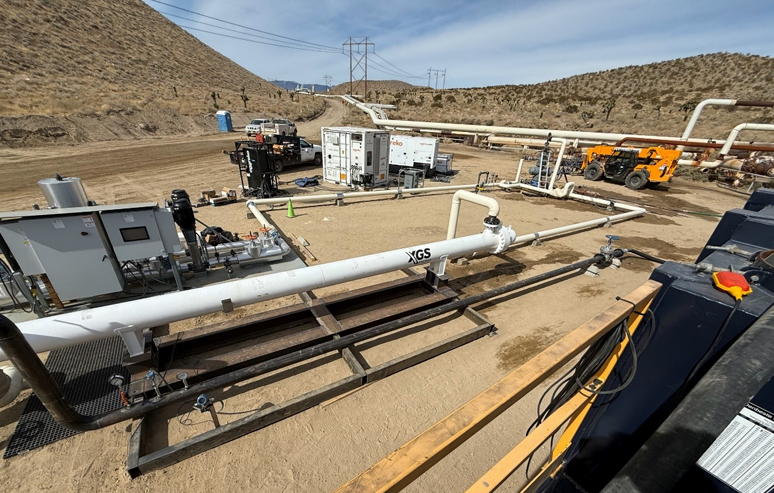
XGS has expanded its operations over the past year. The company in September 2025 announced it had successfully completed a commercial demonstration of its water-independent, closed-loop geothermal system, operating continuously for more than 3,000 hours at the Coso geothermal field (Figure 1) in California. This milestone marks the first time a water-independent geothermal system has been proven at commercial scale, validating both performance and economics, according to the company.
The Coso project included the workover of a long-idle well, and the incorporation of XGS’s Thermal Reach Enhancement, or TRE, technology. XGS said the project sustained a strong temperature differential between injection and production (power output from geothermal wells directly correlates to the temperature delta between injection and production fluid), and said the actual performance at the site aligned closely with model predictions. The company said the demonstration showed the reliability and predictability of XGS’s technology. It also is growing the company’s multi-gigawatt pipeline, and supporting the group’s move toward larger commercial deployments.
XGS in June of last year announced a 150-MW partnership with technology company Meta for a $1.2-billion capital project in New Mexico, which will power Meta’s data center operations through the PNM utility grid. XGS said New Mexico has just 15 MW of geothermal capacity operating today, so this project would greatly expand the state’s geothermal capacity as it supports Meta’s rapidly growing data center operations. The company said the project, currently under development, is a two-phased agreement that will include an initial smaller phase and a second, larger phase. Both segments are expected to be operational by 2030.
Darago, previously a principal at Boston Consulting Group and a strategic advisor to Fortune 500 energy companies and consumers in both the public and private sectors, shared her insight with POWER about the advancements in geothermal, including how new systems are being supported by technology from oil and gas exploration. XGS is utilizing those innovations to enhance its geothermal systems.
POWER: Geothermal energy is growing and XGS has acknowledged the technology advances from the oil and gas industry. How important is support (financial, technical, etc.) from the oil and gas sector to growth in geothermal deployment?
Darago: Support from the oil and gas sector is critical to accelerating geothermal deployment. Next-generation geothermal, like XGS’s closed-loop system, is built on decades of proven drilling, casing, and reservoir modeling technologies developed in the oil and gas industry. That foundation significantly reduces subsurface risk and shortens development timelines, helping geothermal move beyond the historical perception of being “hard to find” and “hard to finance.”
To learn more about geothermal energy, check out POWER’s coverage of the sector at powermag.com. And don’t forget to register to attend our annual Experience POWER event, which will be held this year in Washington, D.C., Sept. 28-30.
For XGS, that crossover is direct and practical. Our closed-loop, solid-state system relies on upstream tools like methods for optimizing drilling and established well construction practices. Our insulated return tube originated as an oil and gas innovation that we’ve enhanced for geothermal applications, and our team includes talent from companies such as Baker Hughes, Halliburton, ExxonMobil, SLB, BP, NOV and Shell. XGS is leveraging upstream operators’ decades of experience in utility-scale geothermal projects to minimize in-field learning curves and deliver projects on time and on budget.
Financial and strategic support from oil-and-gas-aligned investors is equally important. Capital that understands subsurface infrastructure helps bridge the gap between demonstration and commercialization. When oil and gas expertise, supply chains and financing mechanisms collaborate with geothermal, it accelerates deployment and positions next-generation systems as a scalable source of firm, reliable energy.
POWER: What are the various types of geothermal power plants, and what would make one type better than another?
Darago: There are two broad approaches to geothermal power production today: conventional geothermal and next-generation geothermal systems.
Traditional geothermal relies on a rare combination of hot rock, naturally porous and permeable geology, and abundant water. Because those conditions only exist in select locations, projects are limited to a handful of geothermal hot spots and can be difficult to finance due to subsurface resource risk.
Next-generation geothermal systems, such as XGS’s design, take a different approach to expand past the constraints of conventional geothermal systems. Instead of relying on natural underground permeability, next-generation systems engineer the subsurface to extract heat directly from hot rock. This dramatically expands the scope of where geothermal can be developed, unlocking a 42-TW development opportunity as recently sized by the IEA. Systems like XGS’s provide additional benefits: the solid-state system is fully water and geology-independent, delivering predictable, 24/7 baseload power with fewer siting constraints and lower subsurface risk.
POWER: In areas where geothermal can provide baseload power, why should it be considered instead of generation from fossil fuels?
Darago: In areas where geothermal can provide baseload power, it offers a compelling alternative to fossil fuel generation because it delivers the same 24/7 reliability without carbon emissions or fuel price volatility while remaining cost-competitive.
Next-generation geothermal, particularly closed-loop systems, has evolved from a promising concept into a commercially validated and financeable solution. By leveraging drilling technologies and workforce expertise developed over decades in the oil and gas sector, these systems can be deployed efficiently and at scale, including repowering or expanding existing infrastructure with a reliable, clean energy source.
Next-generation, water-independent geothermal systems like XGS’s also open up new opportunities in regions where water scarcity makes traditional power generation or other geothermal approaches difficult. Because they require no consumptive water use, they can bring dependable baseload power to water-constrained areas while supporting long-term environmental responsibility. XGS’s partnership with Meta, for example, demonstrates how closed-loop geothermal can enable energy-intensive development in places like New Mexico, where water conservation and land stewardship are essential.
POWER: What federal and state incentives are available for U.S. geothermal systems in 2026 and beyond?
Darago: At the federal level, geothermal projects qualify for clean energy tax credits that were recently maintained under the 2025 U.S. budget reconciliation bill, reflecting longstanding bipartisan support. These credits remain one of the most significant financial incentives available in 2026 and beyond. In addition, the Department of Energy supports geothermal through financial assistance and R&D initiatives, including the Enhanced Geothermal Shot, which aims to reduce the cost of geothermal energy per kilowatt hour and accelerate deployment. Ensuring that federal funding programs remain broadly inclusive of all geothermal technologies will be key to efficiently scaling the industry.
At the state level, incentives are more uneven. Many states, particularly those without a history of geothermal production, lack geothermal-specific policies despite rising load growth from AI, manufacturing, and electrification. New Mexico, which is home to XGS’s 150-MW project powering Meta’s data center operations, is a notable exception, offering a dedicated geothermal production tax credit.
Momentum is building in other regions as well. States such as Nevada, Utah, and California provide grants to support early-stage development, and clean energy procurement mandates are helping drive demand. For example, California’s Mid-Term Reliability procurement order requires load-serving entities to procure 1 GW of geothermal resources, creating a meaningful market signal for new projects.
This is meaningful progress, but broader and more consistent incentives at both the federal and state levels will be necessary to ensure geothermal can scale quickly and reliably as a core component of the U.S. energy mix.
POWER: What role should government play in supporting geothermal?
Darago: The government’s role in supporting geothermal should focus on accelerating deployment, reducing early-stage risk, and ensuring policy frameworks reflect the technology’s growing potential.
Historically, geothermal has not received the same level of visibility or political support as wind, solar or nuclear, largely because its development potential was viewed as geographically limited. With the emergence of next-generation technologies, that perception is changing. There is growing bipartisan interest in geothermal, driven by energy security, domestic manufacturing, and the need for reliable, firm, clean power. For example, in December 2025, the U.S. House Natural Resources Committee advanced nine geothermal-related bills aimed at speeding development on public lands, with several receiving bipartisan support. That marks meaningful progress in today’s political environment.
Beyond legislation, public-private partnerships are critical. By sharing capital costs and project risk, these partnerships help de-risk emerging technologies, support site development and drilling access, and accelerate early commercialization of large-scale projects.
Collaboration between the Department of Energy and the industry will be especially important in transmission-constrained regions and areas facing rapid load growth. Federal engagement can help unlock infrastructure development while ensuring a reliable power supply for expanding industrial demand. Proven performance and commercial validation will remain key, as agencies prioritize technologies with demonstrated, bankable operating histories.
—Darrell Proctor is a senior editor for POWER.