Operators are trying to coax more output from aging fleets, with fewer experienced people, under increasingly unforgiving reliability expectations. In that environment, preventive maintenance has become an essential function.
The U.S. power sector is attempting a generation buildout of postwar proportions in a fraction of the time, against a labor market that never recovered from decades of flat demand, aging assets running well past their design lives, and load profiles driven by artificial intelligence (AI) data centers that have no historical precedent on the grid. Each of those pressures converges on maintenance first—as a workforce problem, a knowledge problem, an equipment-stress problem, and a technology-adoption challenge. At the Innovation Agora at CERAWeek by S&P Global in March, industry experts laid out what operators are actually doing about it.
Labor Is the Binding Constraint
The scale of the demand has morphed into a throughput problem, suggested Matt Pistner, senior vice president of Generation at NRG Energy. “AI doesn’t run on hype and headlines. AI runs on steel, concrete, copper, and human beings that know how to develop, construct, commission, and operate power plants.” While the U.S. averaged one to two new natural gas plants per year for the past 10 to 15 years, it now needs 20 plants per year through 2030. While getting the new units built—at the pace required—is its own challenge, each new unit is effectively poised to become a multi-decade maintenance obligation.
At the same time, however, both craft and technical experience in the power sector “are basically aging out,” said Robert Patrick, vice president of development engineering and construction at NRG. Teams are doing “more and more what I call engineered lines into the field to help with the inexperience of craft and inexperience of supervision.” And, compounding the workforce concern, “the global supply chain is totally overstressed” and “our construction labor pool is shrinking.”
When the workforce cannot handle complexity, the answer is to reduce complexity, the experts suggested. Both Pistner and Patrick pointed to standardization as the primary lever. “Building unicorns or getting trapped in designing decisions is the recipe for failure,” Patrick said, suggesting that repeatable designs could reduce the burden on procurement, construction, and long-term maintenance alike. His approach to procurement follows the same logic—working with a small number of pre-qualified contractors and suppliers who already know NRG’s standards, rather than re-sourcing project by project.
Patrick also called operation and maintenance (O&M) readiness at handover “an overlooked but critical ingredient for long-term success in our power business,” and said his construction playbook is “shaped by a very clear expectation that I hand over facilities to my operating team that are safe to operate and reliable.” In practice, that means decisions about plant design, contractor selection, and standardization also determine which preventive maintenance program will be feasible over the life of the asset.
The Looming Retirement Wave
By the end of this decade, meanwhile, roughly 40% of plant operators will retire, according to Ahmed Wafi, director of Industrial Automation at Schneider Electric. “These operators have very strong asset knowledge that they are leaving with,” he said. That loss is especially acute in mission-critical assets that “cannot stop,” because even “one hour shut down is a lot of money,” Wafi said.
Wafi argued that AI can help capture that loss, but only through a disciplined, iterative process. In practice, that means deploying AI in an open-loop advisory role first—surfacing recommendations that engineers and operators review and validate—before gradually moving toward closed-loop autonomous control, one loop at a time. Over time, this creates what Wafi described as a “layer of trust” at the intersection of operator know-how, physics-based control models, and AI data models—the point at which teams are confident enough to let the next loop run on its own. “AI is not going to replace domain knowledge,” he noted. “Domain knowledge remains central, very important.”
One practical advantage the energy sector holds over other industries, Wafi noted, is that its digital infrastructure is already relatively mature. Sensors, control systems, and advanced process control software are already in place at most sites, which means the foundation for AI-enabled knowledge capture does not need to be built “from scratch.”
AI-enhanced asset management can be fruitful, Wafi noted. He pointed to a major national oil company that used Schneider Electric’s AI to reduce process trips in a multi-stage separation unit by 25%. He also made the case for software-defined automation, which he described as “disconnecting the software from the control hardware.” The practical consequence is that operators avoid a situation where all their programming “will be only working with one vendor of control system,” meaning if they want to change platforms, they face migrating all their code. Separating the layers protects that investment, he said.
AI Load Reshapes Maintenance
As data centers scale from megawatts to gigawatts, they are beginning to behave like power plants in reverse—massive, fast-changing loads rather than generation sources. The maintenance consequences are physical, as Jochen Kossmann, vice president of Technical Sales for Grid Technology Solutions at Siemens Energy, explained.
Because graphics processing unit (GPU)-heavy AI training workloads start and stop rapidly, they produce steep, irregular power swings across grid and microgrid infrastructure, he said. When a gigawatt-scale facility ramps or trips, the grid sees the equivalent of losing a large power plant—and the equipment absorbing that event pays the price. Left unmanaged, Kossmann warned, “we are causing oscillations … and we also endanger our on-site equipment due to an acceleration of degradation or even risk to damage our products on site.”
His prescription is to treat power quality and ramp-rate control as core preventive tools—combining longer-duration battery storage for peak shaving with ultra-fast supercapacitor-based systems capable of absorbing large power swings within milliseconds, protecting equipment before stress cycles begin.
Nuclear Turns to AI for Expertise
AI-enhanced preventive maintenance is evolving even in nuclear, a sector that has stayed mostly analog for safety and regulatory reasons. Efforts are burgeoning to link equipment monitoring, work order management, and outage planning into a single workflow, said Bradley Fox, CEO and co-founder of Nuclearn AI, a firm that builds domain-specific AI systems for nuclear power plants. Workforce scarcity, here, too, is a key driver, he noted.
 |
|
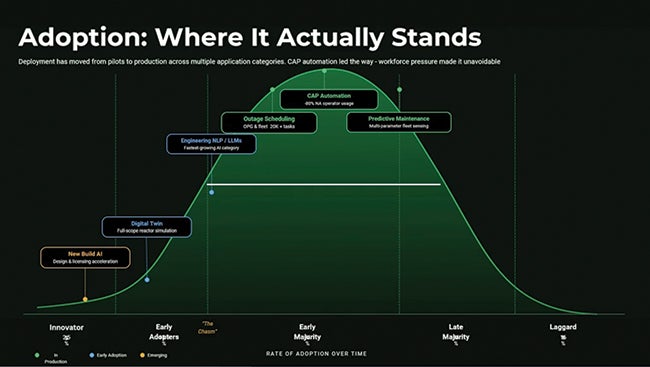
1. Artificial intelligence (AI) adoption in nuclear maintenance has moved past the chasm for corrective action program (CAP) automation, which has reached about 80% North American (NA) operator usage. Outage scheduling and predictive maintenance are in the early majority, while digital twins and new-build AI are in early adoption. Courtesy: Nuclearn AI / CERAWeek 2026 |
The first major wave of AI in nuclear focused on equipment prediction (Figure 1). “Primarily, what we’ve done as a company and what a lot of people are doing, we started with equipment predictions—when is equipment going to fail, how do we predict failure performance?” Fox said. “We call that automated pattern recognition, using statistics to predict equipment failures.” He noted that work has been underway for 20 to 25 years, progressing from simple statistical forecasts to machine learning systems and now to full AI that combines text and time-series data to generate maintenance recommendations and failure probability assessments.
The application that drove the most recent wave of adoption, however, was corrective action automation. Each reactor generates 5,000 to 7,000 equipment issue tickets per year, a volume that “overwhelms the staff that are responsible for correcting them,” Fox said. AI systems now handle intake, classification, and routing without requiring senior engineering time for triage. Almost every nuclear utility in the U.S. runs some form of automated corrective action AI, he noted, as does the entire Canadian fleet.
Preventive maintenance in nuclear has also extended into outage planning. A single refueling or maintenance outage involves 15,000 discrete activities, Fox said. “AI is pretty good at backfilling that—am I missing a task here, there?—especially as I turn over that scheduling stuff to younger folks that maybe don’t have the experience necessary,” he said. Robotics is also entering the picture. Spot robots equipped with radiation sensors are already crawling plants, generating 3D radiation maps to help maintenance teams plan work that minimizes dose exposure for specialized workers, such as nuclear welders, who operate under federally capped dose limits, Fox noted.
Autonomous Maintenance: A Trust and Technology Interplay
The barrier to autonomous plant operations is not technology readiness, according to Cody Falcon, Global Digital Portfolio and Technology leader for Energy Industries at ABB. “I think today, it’s trust,” he said. “Operators are slow to relinquish that trust, to let it move down towards closed-loop control.”
ABB’s six-level autonomy framework runs from full manual control at level zero to lights-out autonomous operation at level five. Roughly 80% of ABB’s global client base sits at levels one or two, Falcon noted, and “very, very few are taking it four and five.” His estimate for a fully autonomous facility is at least five years away—not because the technology is insufficient, but because operator validation moves “at its own pace,” he said. The approach that works is to integrate AI into existing control room workflows rather than asking operators to abandon them, Falcon said. That could start with how the control room actually functions, as opposed to how the technology prefers to be used. ABB has also developed a tool that surfaces historical precedents when an operator faces an unfamiliar alarm condition—showing what a comparable operator did in the same situation at another plant, and what the outcome was, Falcon said.
In a separate interview with POWER, Per Erik Holsten, president of ABB’s Energy Industries Division, addressed the infrastructure side. ABB’s equipment operates in 90 to 100 of the world’s roughly 400 nuclear reactors, many of which still run hardware from the 1970s and 1980s, he noted. “You can extend the lifetime of any facility that you’re running, even if it’s designed for 30 years, and you want to run it for 60 years, that’s how we operate,” Holsten said.
ABB’s newly unveiled Automation Extended architecture separates the digital innovation layer from core process control, he explained, which allows operators to test and improve analytics tools without interfering with the systems that keep the plant running. That is a crucial precondition for any maintenance modernization program in a brownfield environment, he suggested.
—Sonal C. Patel is a senior editor at POWER magazine.