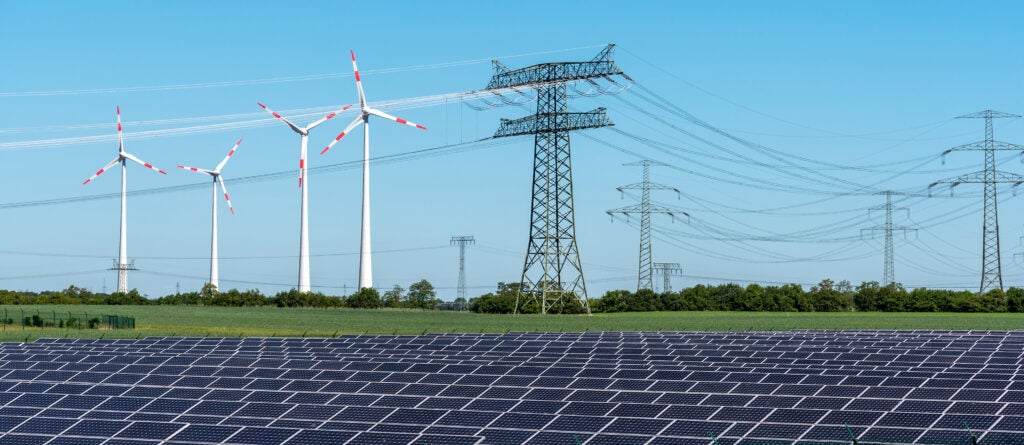
The tension between the growing number of renewable energy projects and limited transmission capacity is reflected in Washington’s legislative agenda of establishing a national renewable portfolio standard and new transmission lines dedicated to moving renewable energy coast-to-coast. Even if those ideas become law, hurdles to the happy marriage of renewables and transmission remain.
A total overhaul of the U.S. power delivery system, commercial practices, and regulatory oversight is required to accommodate the higher levels of renewable energy expected to be generated over the next decade. Specifically, transmission of the anticipated enormous quantities of renewable energy from coast to coast poses several key challenges and risks that must be mitigated as part of any comprehensive energy plan. The key question is, Can a growing body of renewable energy and a federal transmission plan be forced into what is surely a shotgun marriage?
The Federal Energy Regulatory Commission (FERC) recognizes the challenges posed by bringing electrons from new and disparately located renewable energy sources to population centers. In late May, FERC announced a series of transmission planning meetings that will focus on "wider integration of regional energy resources into the nation’s power grid." In essence, renewable energy generation, principally wind energy, is located where the transmission infrastructure does not exist, and other distributed energy resources are located in transmission-constrained regions.
According to FERC Chairman Jon Wellinghoff, "Planning is one of the three legs on the transmission policy stool — the others are siting and cost allocation — and all are crucial to meeting the goals of assimilating demand resources, renewable energy and distributed generation into the grid for the benefit of consumers."
We believe that the FERC review process currently under way will acknowledge that renewable energy development is changing the traditional energy source and transmission planning process in three principal ways:
-
Market push, not pull, is driving project development.
-
Longer distances are hindering new transmission capacity additions.
-
The intermittency of most renewable energy drags down new transmission line economics.
Together, these planning changes make it unlikely that evolutionary changes alone will enable the nation to reach its ambitious renewable goals. Rather, a more revolutionary approach that includes a proactive, regional approach to wind and other renewable energy generators will be required, as will electric system operation policies and procedures, and electricity market development, to keep access to transmission corridors open (Figure 1).
1. How the grid is managed. The U.S. electricity grid is divided into three separate management units or “interconnections.” Within each interconnection are further levels of grid operation involving states, utilities, regions, and a host of different regulators. The fractured nature of the grid impedes the efficient flow of energy between interconnections and complicates adding renewable energy to the mix. Source: National Renewable Energy Laboratory
Moving from Market Pull to Product Push
Historically, load-serving entities (LSEs) dictated when, where, and how much new generation would be added. Their integrated resource plans (IRPs) determined the timing of plant additions, the fuel sources, and the location of the new generation resources. Transmission planners followed the lead of LSEs to route the necessary transmission capacity while also seeking to lessen area congestion, if necessary. Traditionally, new power generation resources — and, by extension, new transmission — responded to a market pull: predicted load demand. The role of the state and local governments was oversight, providing access to transmission, and setting rates.
In contrast, renewable mandates have upended the traditional approach to developing an IRP. Rather than anticipated customer demand driving generation and transmission decisions, government mandates are now in the driver’s seat. Twenty-nine states and the District of Columbia have a renewable portfolio standard that requires utilities in those states to supply some percentage of renewable electricity by a date certain.
For instance, the California Public Utility Commission (PUC) requires that 33% of that state’s power originate from renewable energy sources by 2020. In order to achieve this extraordinary goal, all new power generation procured by the state’s utilities must come from renewable energy sources. In this new world, the "pull" of market demand has been supplanted by a government-mandated "technology push" that determines which renewable developers pushing new power into the system in response to state-mandated levels of renewable power have access to limited transmission infrastructure.
One of the other challenges to building new transmission capacity to move renewable energy long distances that was discussed by Wellinghoff is identifying acceptable siting locations for renewable energy facilities. One important initiative toward this goal in the Western Interconnection (Figure 2) is the Western Governor’s Association’s (WGA) Western Renewable Energy Zones (WREZ) study. In the WREZ study — which covers 11 western states, two Canadian provinces, and areas of Mexico that are part of the Western Interconnection — as many as 50 zones with substantial renewable resources are in the process of being identified so that renewable projects can be expedited and transmission projects can be planned in advance (Figure 3).
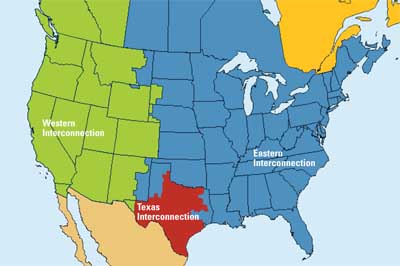
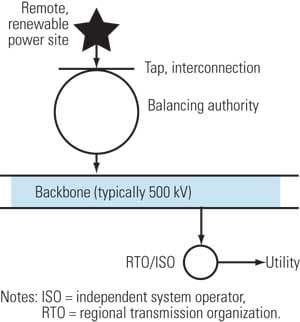
2. Power flow. Transmission of energy from renewable projects, from the plant to the load, should be invisible to grid users, regardless of which interconnection they are in. Source: U.S. Energy Information Administration
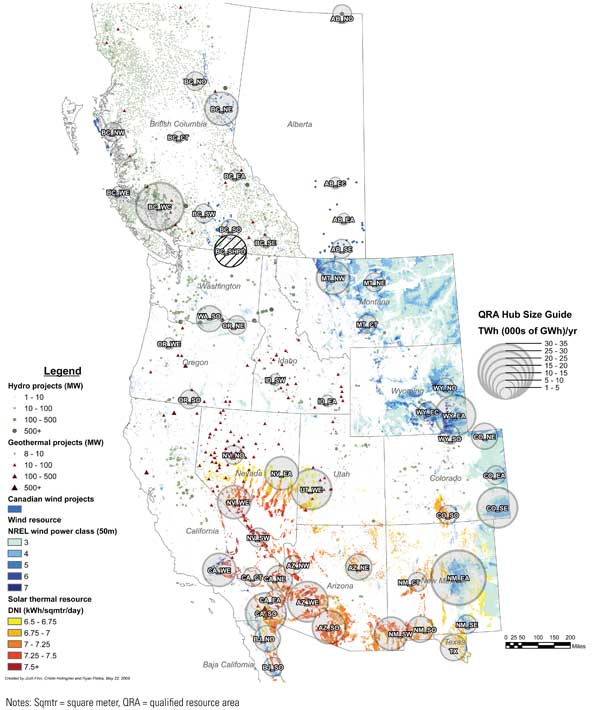
3. Mapping renewable hubs. The most recent draft map from the Western Governor’s Association illustrates Qualified Resource Areas (QRAs) as those areas with a high density of developable renewable energy resources after screening for known technical and environmental limitations for which data are available. These data will be used to determine Western Renewable Energy Zones (WREZ) in the Western Interconnection. When the WREZ are determined, then an overall transmission plan, much like ERCOT’s, can be developed. Source: Western Governor’s Association
The ultimate goal of the WGA is to "develop 30,000 MW of clean and diversified energy by 2015." This work is in turn driving transmission planning. For instance, in California’s Renewable Energy Transmission Initiative, competitive renewable energy zones are being developed in "the most cost effective and environmentally benign manner."
The state with the largest installed wind power capacity has already identified Competitive Renewable Energy Zones (CREZ) within the Electric Reliability Council of Texas (ERCOT) Interconnection. In March, the Texas PUC assigned approximately $5 billion of transmission projects to be constructed in these CREZ that will eventually transmit 18,456 MW of wind power over more than 2,300 miles of new transmission lines from power-heavy West Texas and the Panhandle to highly populated metropolitan areas of the state. The regulatory body expects that the new lines will be in service within four or five years. The Texas PUC took about three years to select the most productive wind zones in the state, designate them as CREZ, and devise a transmission plan to move power generated from those zones to various populated areas in the state. Many of these new transmission projects will begin construction later this year.
Longer-Distance Transmission
The principal renewable resources — wind, solar, geothermal, and hydroelectric — are usually great distances from load centers. Typically, the greater the length of the transmission lines, the more time, money, and regulatory hurdles there are to clear.
There are positive indications that a more regional transmission planning process is taking hold; however, the long period of time necessary to develop interstate transmission lines makes planning, siting, and permitting problematic — for the developer as well as the investor. We recommend several actions to shorten these too-long projects that delay bringing additional renewable energy to market.
Provide More Regulatory Oversight. We believe that more oversight needs to be provided by regulators who have the authority to resolve any impasse that occurs, especially when new transmission lines cross state lines and more regulatory agencies are involved. A super-regulator is needed both for master planning as well as for specific project approvals. Today, federal agencies such as FERC, the U.S. Forest Service, the Fish and Wildlife Service, the Bureau of Land Management, and others are involved in virtually every interstate transmission project, not to mention a host of state and local regulators, any one of which can bring a project to a standstill for a host of reasons.
More market oversight is also required so that even when transmission does exist, a renewable developer doesn’t have to negotiate with multiple companies to deliver power at a distance. For instance, Claude Mindorff of Mainstream Renewable Power said his company contracted with six transmission operators to move power from one Alberta, Canada, wind farm to one customer. There should be one authority for one-stop shopping to determine the costs of delivering electricity anywhere at any time.
Shorten Procedural Time. The surge in renewable power is stretching out project completion times. For instance, a necessary project step is acquiring a transmission interconnection agreement. The California Independent System Operator recently had 361 interconnection requests pending at one time, overloading its processing and planning capabilities. In a similar queue at the Southwest Power Pool, 61% of the requesters were from the wind industry alone.
Minimize the Extra Money Required. Greater transmission distances, in general, increase per-unit transmission costs. In particular, the more transmission operators that are involved in connecting a generation source to a single customer, the greater the potential for "pancaking" charges (multiple rate surcharges for electricity crossing service territory boundaries).
More insidious are unpredictable transmission costs. Power sellers, buyers, and investors adamantly want price certainty in the total delivered cost. However, congestion charges can make the delivered price vary, especially in locational marginal pricing.
For new transmission construction and upgrades, cost allocation and recovery remains contentious. The issue here is how to apportion costs. To the new generator? Across all users of the upgraded network? Ultimately, rate payers cover the cost of transmission.
Everyone wants to know the answer to the question, What is the added premium to deliver renewable energy? Many transmission networks have both fossil fuel and renewable generators sharing the same network. Certainly, intermittent renewable sources have higher system-integration costs. Load balancing is more involved as well.
A recent Lawrence Berkeley National Laboratory study may provide an early answer to the cost question. It indicates that transmission unit costs for wind are only about $15/MWh (see sidebar).
What Will New Transmission Cost?
Lawrence Berkeley National Laboratory (LBNL) recently issued a research report that examines the expected costs for new transmission infrastructure that would be needed to support an accelerated program for renewable energy projects, particularly wind energy. The report, "The Cost of Transmission for Wind Energy: A Review of Transmission Planning Studies" was released in February 2009. (A copy of the report can be downloaded at http://eetd.lbl.gov/ea/ems/reports/lbnl-1471e.pdf.)
The authors’ objectives in preparing this report were threefold: to define the transmission costs for a rapidly growing wind power industry, to discuss different transmission planning approaches, and to examine the models used to estimate future wind deployment. Our interest in this article is to focus on the transmission cost estimates prepared by LBNL.
The cost estimates are based on a review of 40 transmission planning studies completed between 2001 and 2008 by various developers, independent system operators/regional transmission operators, state agencies, and individual utilities. There is a wide range in transmission costs, although the costs are generally less than $500/kW. The cost of the median study scenario was $300/kW, or about 15% to 23% of the typical installed cost of a wind turbine plant.
The authors also concluded that variation in the study methodologies used in these 40 transmission siting studies and the characteristics of the specific grid may affect transmission installation costs (Table 1). Depending on the original purpose of the transmission line under study (whether it was congestion or deliverability focused), the authors concluded that the purpose affected the costs of adding wind energy to the mix.
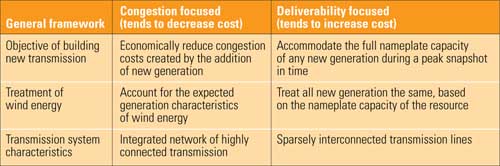
Table 1. Qualitative effects of grid study methodology and grid characteristics may affect estimated transmission costs. Source: LBNL
The study also reviewed three high-level wind transmission – only studies, as shown in Table 2. These costs are generally consistent with the median cost identified in the original study sample of $300/kW.
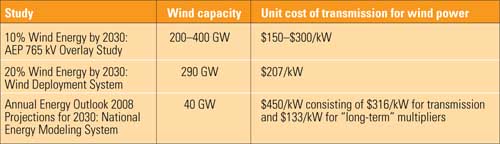
Table 2. Estimated installed cost of wind transmission based on three higher-level studies of wind transmission. Source: LBNL
What isn’t adequately discussed are the operating costs, in say $/kWh, for a transmission system installed solely for delivering wind energy to a load center. Given the high installed costs of transmission and the low capacity factor of wind compared to conventional forms of generation, perhaps a more appropriate figure of merit to compare the cost of any form of generation is its cost per unit of electricity delivered, rather than purely installed costs.
However, that cost varies, depending on the configuration. For instance, the lowest cost scenario is having a concentrated pool of new power (thousands of megawatts). In this case a very high voltage line (765 kV) can transport that power very economically, even over great distances.
Nevertheless, renewables do add additional costs to the whole system. For instance, speedy ramp-up of backup power is essential when a wind farm goes down with as little as one-hour warning. Reliability issues kick in as well.
Wind and Solar Generation Are Intermittent
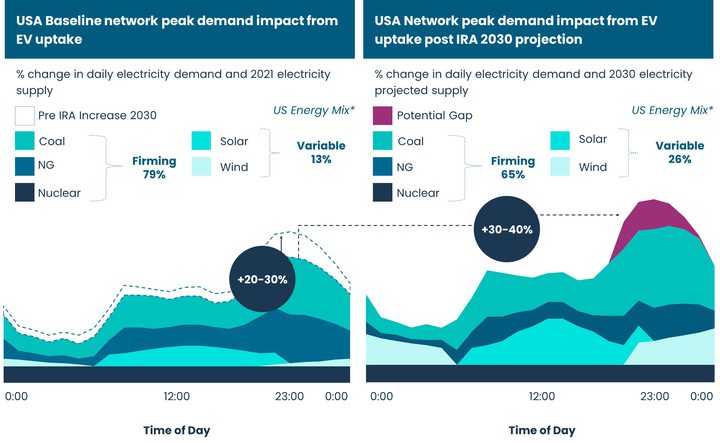
Wind and solar farms produce power intermittently due to weather changes and time of the day and season. For either technology, the nameplate power can be produced only over about one-third of the daily hours. Stated another way, a plant’s potential annual capacity factor is typically around 33%.
Some opponents of wind projects take an overly simplistic approach and state that any utility that has renewable energy sources must provision three times the number of wind/solar megawatts and claim that that overhead produces the equivalent baseload power. Unfortunately, simply scaling up wind or solar power in this manner does resolve the delivery mismatch to the baseload demand that is actually needed.
Someplace in the delivery chain this intermittency of energy production versus load demand must be smoothed out. LSEs traditionally have taken on this burden themselves. Typically, an LSE backfills wind/solar gaps with natural gas – fired plants to make up for any shortfall in energy production based on a number of factors, including the season, weather, and the region’s operating experience. Using the same approach with very remote wind and solar farms isn’t as straightforward. To do so would make the entire long-distance energy delivery chain, in effect, run intermittently — if the remediating, balancing measures are not applied.
A more recent procurement practice is for the LSE to insist that the renewable producer directly supply steady, baseload-style power. In particular the LSE expects the renewable power producer to have its own storage or natural gas backup. An example would be Xcel Energy’s April 2009 request for proposal for 600 MW of solar thermal that is "fortified" in this way.
It’s All About the Dispatch
Energy researchers have been seeking the holy grail: a technology that transforms intermittent forms of energy production into the same sort of firm, baseload capacity we now enjoy from coal-fired and nuclear power plants. Many have proposed the standard list of energy storage options, such as compressed air energy storage, pumped hydro, stored heat or ice storage, batteries, flywheels, and the like. None of these alternatives has been proven in a utility-scale energy storage facility, so their use remains hypothetical.
The ultimate grid would accept power generated from any type of plant, especially widely dispersed wind or solar farms that have complimentary operational patterns. This grid would also serve to "pool" the many disparate, nondispatchable renewable plants so that they would appear to the grid as a reasonably predictable, virtually dispatchable, baseload energy – generating "plant." Nature, in effect, would do the energy balancing. This approach assumes an extensible and far-reaching transmission grid that is all but invisible to the energy generator but that has sufficient capacity to absorb all projected future renewable power sources.
Developing this renewable energy transmission superhighway is sure to require a legislative "push" to mature the concept into steel, concrete, and wires. Such a radical transformation of the transmission grid would allow resources planners to move past the antiquated concept of a market "pull" for traditional baseload power, because supply and demand would be average over large numbers of plants, especially the predicted plethora of small renewable projects located in every corner of the country.
Today, building renewable plants is not the problem. The principal problem facing developers is economically connecting those plants with the grid to get the power to market. New transmission planning must encourage and sustain the renewable power renaissance rather than be the cause of project delay and deferral, as it is today. The transmission planning now under way in the Western Interconnection, and the new transmission lines recently awarded by ERCOT, are excellent examples of rigorous regional planning. The next step: Interconnect each of the regions to form the ultimate grid.
Questions Awaiting Answers
The electricity industry is now facing up to several very important decisions that demand answers now rather than later. Will it be necessary to have almost the entire fossil fuel fleet dispatchable to fill the gaps in renewable power production? Will the U.S. need to move to a French-style infrastructure: highly centralized operations that are regulated at the national level? Should the federal government assume complete responsibility for siting new transmission corridors?
Some have even questioned whether the federal government should be picking winners and losers by specifically allocating capacity on interstate transmission lines or whether the government should consider direct investment in what has been a market-driven business if private investors are not available.
Answers to these questions must be forthcoming, as they will direct the overhaul of the country’s power delivery system, change today’s commercial practices, and streamline regulatory oversight of future transmission infrastructure projects.
—Martin Piszczalski, PhD (martinp@ic.net) is an industry analyst with Sextant Research. He works with renewable power developers, governments, and multi-lateral agencies to develop renewable power markets, especially for geothermal energy. For the past year he was in the Western Renewable Energy Zones study group of the Western Governors’ Association.