American utility-scale solar split into two eras on July 4, 2026. Any project that began construction by that date retains its federal tax credits under the One Big Beautiful Bill Act’s transition rule, while any that missed it must be in service by December 31, 2027, or proceed without them. For tax equity, the financing method built on those credits, this is a real ending.
What replaces it is demand: developers now hold more projects than they can build by 2030. As such, the ones that proceed are the ones with a customer who has signed a long contract at a guaranteed minimum bill.
Lazard’s July 2026 numbers show what the credits were worth: unsubsidized utility-scale solar at $40 to $98 per megawatt-hour, with the production tax credit having pulled the low end down to $16. Because that value was written into statute and the money came from the U.S. Treasury, lenders treated it as the most dependable revenue in a project, which let sponsors get by with fewer signed sales contracts for everything else.
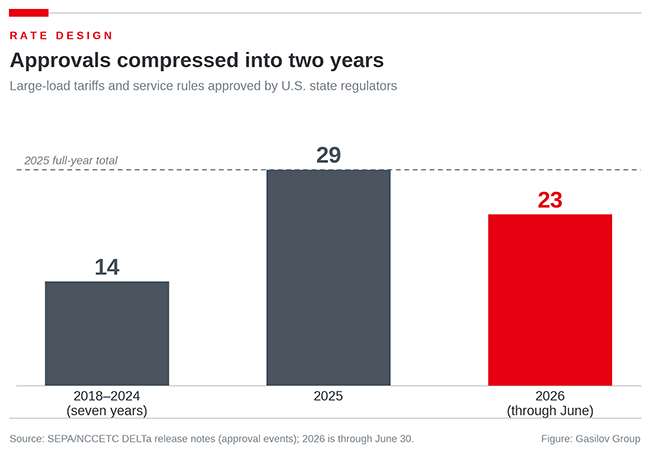
Regulators have created a framework for that at speed: DELTa (Database of Emerging Large-Load Tariffs), the quarterly-updated public tariff database maintained by the Smart Electric Power Alliance and the North Carolina (NC) Clean Energy Technology Center, counted 14 large-load tariff approvals across the entire 2018-2024 period.
The year 2025 on its own produced 29. The first half of 2026 produced 23 in only six months, nearly the 2025 full-year total (Figure 1). Thirty-seven states now have a large-load tariff approved or pending. In addition, eligibility thresholds have moved up, with around two-thirds of the 2025 class between 50 and 150 MW.
 |
|
1. Large-load tariffs and service rules approved by state regulators: 14 across 2018–2024, 29 in 2025, and 23 in the first half of 2026—eight in Q1, implied by the 51 cumulative approvals reported March 31, plus 15 in Q2. Source: SEPA/NCCETC DELTa release notes |
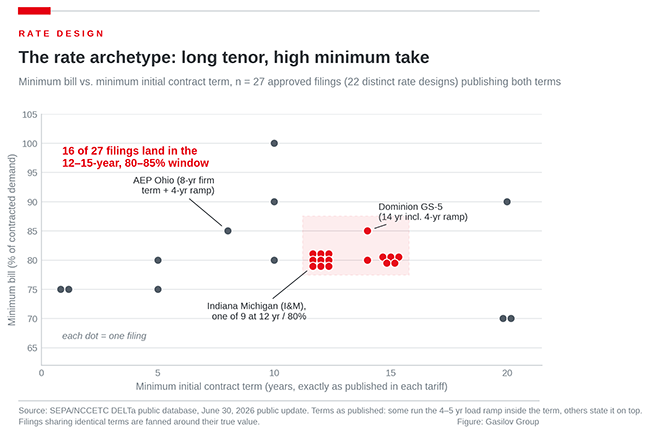
Put the approved tariffs side by side and a rate archetype appears (Figure 2). Among the 27 approved filings in DELTa that publish both terms—22 distinct rate designs—minimum bills cluster at 80 to 85 percent of contracted demand, and initial contract terms cluster at 12 to 15 years as written, with the four- or five-year load ramp counted inside the term in some tariffs and added on top of it in others.
 |
|
2. Minimum-bill ratchet versus minimum initial contract term for the 27 approved large-load tariff filings in DELTa publishing both—22 distinct rate designs—one dot per filing. Terms are exactly as published: some tariffs run the four- or five-year load ramp inside the term, others state it on top. Source: SEPA/NCCETC DELTa, June 30, 2026 public update (released July 7) |
AEP Ohio charges 85% across an eight-year firm term on top of a four-year ramp. Dominion’s GS-5 charges 85% for distribution and transmission—60% for generation—across 14 years, its four-year ramp counted inside. Indiana Michigan charges 80% over 12 years with a five-year ramp on top. A Tri-State Generation and Transmission analysis of 11 tariffs found security averaging seven years of minimum bills and exit fees averaging five.
These terms are similar to the contracted revenue line a lender asks for: take-or-pay, an investment-grade counterparty, collateral, with a regulator’s approval behind it. The obvious objection is that these commitments run to the utility, not to any particular solar project—which is quite precisely what the next generation of tariffs changes.
A second generation of tariffs converts that contracted demand directly into new clean supply. Google’s Clean Transition Tariff with NV Energy, for example, funds a 115-MW enhanced geothermal plant and credits Google the plant’s energy and capacity value. A similar Google tariff with Xcel in Minnesota covers wind, solar, and storage, and Georgia Power’s 2025 IRP settlement created a Customer-Identified Resource option inside its CARES program. RMI groups these under bring-your-own (BYO) tariffs: the customer pays the full incremental cost of a specific new resource, the resource gets built, and other ratepayers are insulated from the risk.
For solar developers, supply in this market is already set. Wood Mackenzie counts 216 to 240 GWdc of utility-scale solar safe-harbored—begun in time to keep the credits—most of it before year-end 2025, while its base case holds annual additions flat near 43 GWdc through 2031—about five years of building at that rate, so for the next five years, the question is: which of those projects will get built?
There are three ways large-load demand can support a project: the BYO route referenced above, minimum-bill revenue supporting what the utility buys through its resource plan, or, in ERCOT, which has no tariff of this kind, power purchase agreements (PPA) signed directly with developers. Q1 2026 offtake signings ran 6.3 GWdc, up 15% year over year, led by Texas projects with data and technology buyers.
The tariffs also tend to significantly filter out demand that wasn’t real: AEP Ohio’s data-center interconnection queue fell from 30 GW to 13 GW once its tariff required real financial commitments—Enverus puts the first-year cost to a 100-MW facility near $10 million, and as a result, more than half the queue decided it would rather not. This filtering out is useful, as a load that stays and agrees to those terms is one a utility can plan new generation around.
The ITC paid per megawatt-hour, with a project earning the credit whether it had a twelve-year buyer or a term sheet and a prayer. What a large-load tariff pays for, on the other hand, is a customer who has committed to a term and a minimum bill. Those commitments are approved by state commissions rather than written into federal law, so an election changes what is left of the tax credits and does not touch them. In sum, solar developers now have more safe-harbored projects than they can build by 2030, and what increasingly decides which ones go ahead is whether a buyer has signed.
—Arif Gasilov is a partner for Natural Resources & Built Environment at Gasilov Group, a U.S.-based environmental and energy consultancy covering energy regulatory analysis, water governance, and built environment assessment.