![POWER Digest [January 2026]](https://www.powermag.com/wp-content/uploads/2021/02/power_wordart_sp-300x108.jpg)
News briefs curated from December 2025 by the editors of POWER, highlighting key developments across global power markets, technology, finance, and energy infrastructure.
Vattenfall, Industrikraft Advance SMR Program at Ringhals in High-Stakes Deal
Swedish state utility Vattenfall and industrial consortium Industrikraft i Sverige AB signed an agreement, announced on Nov. 10, to co‑invest in new small modular reactors (SMRs) at the Ringhals site on Sweden’s Värö Peninsula. The effort moves the project into joint development and clears the way for state risk‑sharing. Industrikraft—formed in June 2024 by ABB, Alfa Laval, Boliden, Hitachi Energy, Höganäs AB, SSAB, Saab, Stora Enso, and Volvo Group—will take a 20% stake in project company Videberg Kraft AB and invest SEK 400 million ($42.2 million) to finance early‑stage development. In addition to co‑financing, industry will contribute project management expertise and technology selection support to ensure Swedish technology has a place in a competitive European supply chain. Vattenfall has shortlisted GE Vernova–Hitachi’s BWRX‑300 and the Rolls‑Royce SMR for a 1,500 MW project—either five BWRX‑300s or three Rolls‑Royce units—and will submit an application for state risk‑sharing before selecting a final supplier. The agreement follows Sweden’s state-aid act, which took force in August 2025 and limits loans to the equivalent of four large‑scale reactors (about 5,000 MWe), provided new units are sited at existing nuclear locations with at least 300 MWe total output. Vattenfall CEO Anna Borg called the partnership “a sign that there will be a demand for the new fossil‑free electricity production capacity,” while Industrikraft Chairman Tom Erixon said the companies “have reached consensus on the most important issues.”
World Nuclear Outlook: Global Nuclear Capacity Could Hit 1,428 GWe by 2050
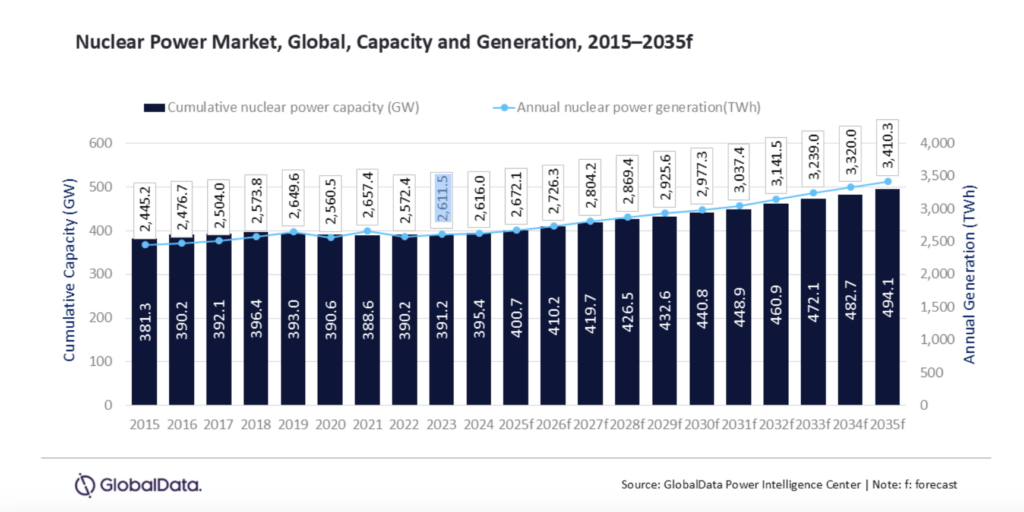
Global nuclear capacity could reach 1,428 GWe by 2050, exceeding the 1,200‑GWe “triple nuclear” target, if governments deliver on national plans, according to a preview of the World Nuclear Outlook Report 2025 released by the World Nuclear Association at COP30 on Nov. 13. The new assessment reflects extended operation of existing reactors, units under construction, and official targets, which total 1,363 GWe. Nuclear generation hit a record 2,667 TWh in 2024. The report identifies 50 countries with nuclear plans for 2050, including China, France, India, Russia, and the U.S., which account for nearly 1,000 GWe. The report, however, acknowledges that realizing the new figure will require accelerated licensing, expanded supply chains, and clear policy frameworks for large reactors and SMRs. It also notes that industrial giants including Amazon, Google, and Meta have pledged support, while the World Bank and 14 major financial institutions have affirmed backing for nuclear expansion. The full report is expected to be published later this year.
California’s Battery Storage Fleet Reaches Record 16,942 MW—One‑Third of 2045 Goal
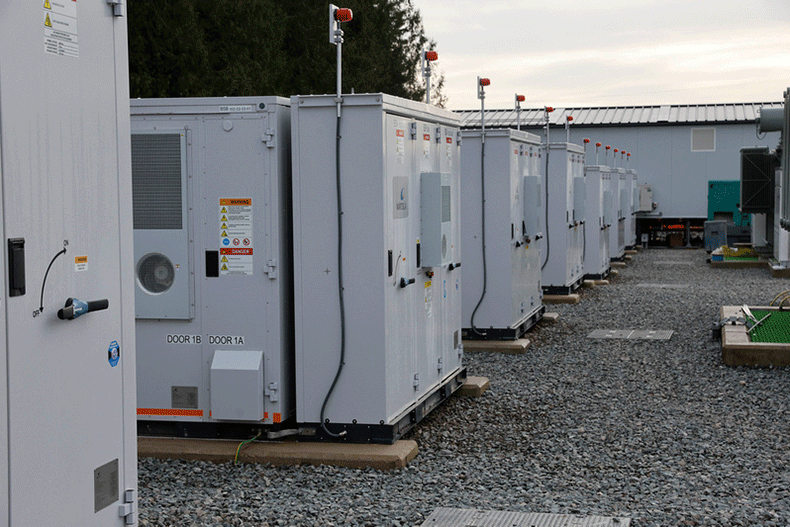
California’s battery storage capacity hit a record 16,942 MW—about one‑third of the state’s 2045 target—after adding 1,200 MW in six months, the California Energy Commission announced Nov. 13, 2025. The 2,100% surge since 2019 includes 13,880 MW from utility‑scale projects, 2,213 MW from batteries on more than 200,000 homes, and 849 MW at businesses, schools, and government facilities. By capturing excess solar and wind for peak demand, batteries have helped California avoid Flex Alerts for three straight years, even during 2024’s hottest summer on record, the commission noted. The release notes that California now has more battery capacity than any jurisdiction in the world except China, and leads all U.S. states, with Texas a distant second at roughly 9,000 MW. Gov. Gavin Newsom also announced that California will be the first subnational entity to join the Global Energy Storage and Grids Pledge, which targets 1,500 GW of storage, doubled global grid investment, and 25 million kilometers of new transmission by 2030. California’s rapid expansion of battery storage is central to its strategy to reach 100% clean electricity by 2045, and renewables already supply nearly 67% of in-state retail electricity sales. While the state plans to eliminate coal power from its electricity mix by the end of 2025, the California Independent System Operator (CAISO)—which serves roughly 80% of the state’s electricity consumers—has, on average, met demand with 100% clean energy for nearly six hours every day so far this year, the state said.
TotalEnergies Signs 15‑Year PPA to Supply Google’s Ohio Data Centers
TotalEnergies on Nov. 12 said that it has signed a 15‑year power purchase agreement (PPA) with Google to supply 1.5 TWh of certified renewable electricity from the company’s Montpelier solar farm in Ohio. The project, described as “nearing completion,” is connected to the PJM grid and will support Google’s data center operations in the state. The PPA aligns with Google’s strategy to add new, carbon‑free energy to the same grid regions where its facilities operate, and TotalEnergies’ push to offer “tailored energy solutions for data centers,” which the company notes accounted for almost 3% of global energy demand in 2024. TotalEnergies says the agreement showcases its ability to meet growing digital‑sector demand by leveraging an integrated portfolio of renewables and flexible assets, and contributes to its target of 12% profitability in the power sector. The company is currently deploying a 10‑GW U.S. portfolio of onshore solar, wind, and battery storage projects—1 GW in PJM and 4 GW in the Electric Reliability Council of Texas (ERCOT)—and reports that as of the end of October 2025 it had more than 32 GW of installed gross renewable capacity, aiming for 35 GW by the end of 2025 and more than 100 TWh of net electricity production by 2030.
China’s Zhangzhou Nuclear Unit 2 Connects to Grid, Making Both Hualong One Units Operational
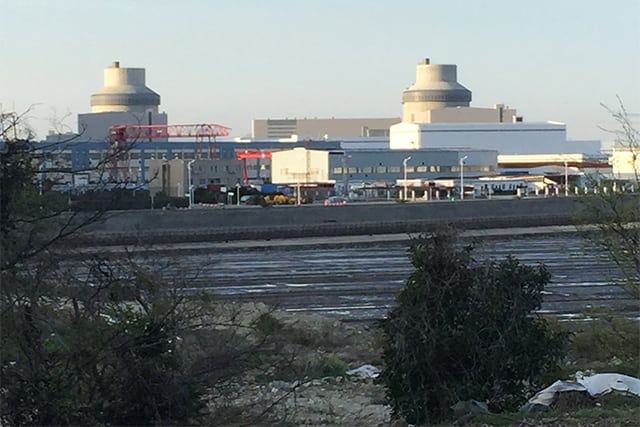
In a milestone for China’s indigenous reactor technology, Unit 2 of China National Nuclear Corp.’s Zhangzhou nuclear power project in Fujian province connected to the grid on Nov. 22, 2025, marking the first time both units of the Hualong One mass‑construction project are generating electricity simultaneously. Construction began Sept. 4, 2020; fuel was loaded Oct. 11, 2025; and first criticality was achieved Nov. 3, 2025. Unit 1 entered commercial operation Jan. 1, 2025. Zhangzhou represents the world’s largest Hualong One nuclear power base, with six units planned. Units 3 and 4 are under civil construction and installation, while preliminary work for Units 5 and 6 is progressing. Once fully operational, the six‑unit site will provide more than 60 TWh of clean electricity annually, meeting 75% of demand for Xiamen and Zhangzhou cities in southern Fujian. Units 1 and 2 will generate 20 TWh per year. Hualong One is China’s self‑developed third‑generation pressurized water reactor with fully independent intellectual property rights.
In This Issue
Full issue—Sonal Patel is a POWER senior editor (@sonalcpatel, @POWERmagazine).