
Articles By

-
News
The Modern CFL Light Bulb Turns 25
OSRAM SYLVANIA is marking the 25th birthday of the modern compact fluorescent (CFL) light bulb. Born on April 17, 1985 in Hannover, Germany, the CFL arrived a full eight inches tall, consuming 20 watts of energy. The stick-shaped CFL was the first screw-in, energy-saving replacement for a standard incandescent light bulb that featured an integrated electronic ballast.
-
News
2009 Saw Historic Power Demand Plunge, FERC Says
Demand for electricity in the U.S. dropped by 4.2% in 2009—the greatest decline in a single year in at least 60 years, the Federal Energy Regulatory Commission (FERC) found in its annual State of the Markets Report, released last week.
-
News
Duke Energy: Edwardsport IGCC Plant to Cost 23% More
The scale and complexity of Duke Energy’s Edwardsport coal gasification plant under construction in southwest Indiana has added about $530 million to project costs—a 23% increase—company officials told state regulators last week. The integrated gasification combined cycle (IGCC) plant slated to begin operation in 2012 is now estimated to cost $2.88 billion. The total project, […]
-
News
Nuclear Security Summit: Highly Enriched Uranium Headed to U.S.
Three nations participating in the Nuclear Security Summit hosted by the Obama Administration in Washington, D.C. this week have agreed to turn over highly enriched uranium (HEU), likely to the U.S. As a result, Ukraine and Mexico will be switching from power plants fueled by HEU to ones fueled by low-enriched uranium (LEU). These commitments follow a secret and at times challenging effort to convey HEU from Chile to the U.S. that was complicated by the earthquake there in February.
-
News
Significant Economic Benefits Possible from Electrified Transportation System
The Electrification Coalition (EC) released on Thursday a long-term macroeconomic analysis of the policy proposals put forward in its November 2009 Electrification Roadmap. The paper finds that the U.S. economy would benefit substantially over the long term from implementation of the EC policy package.
-
News
Nearly $100 Million for Smart Grid Workforce Training and Development
On Thursday, U.S. Secretary of Energy Steven Chu announced that the Department of Energy was awarding a total of nearly $100 million for 54 smart grid workforce training programs.
-
News
Groups Lobby for Passage of CHP-Friendly Bills in Congress
Nearly 90 business, labor, environmental, and government organizations urged Congress on Monday to adopt new tax policies to enhance industrial energy efficiency in order to simultaneously increase manufacturing competitiveness, create jobs, and reduce pollution.
-
News
National Academy of Sciences to Study Cancer Risk in Populations Living Near Nuclear Power Facilities
The Nuclear Regulatory Commission (NRC) announced last Wednesday that it has asked the National Academy of Sciences (NAS) to perform a state-of-the-art study on cancer risk for populations surrounding nuclear power facilities. The NRC and the NAS will finalize administrative details through the spring so that the study can begin this summer.
-
News
Georgia Issues Final Permits for Coal-Fired Plant
Power4Georgians LLC announced on Thursday that the Georgia Environmental Protection Division (EPD) has issued final permits for the operation of Plant Washington, an 850-MW coal-fired energy facility in Washington County, Georgia, in the eastern part of the state about halfway between Macon and Augusta, and approximately 125 miles southeast of Atlanta.
-
News
"Sand to Kilowatts" Solar Cell Company to Be Based in New Mexico
Green2V plans to manufacture solar cells and their frames as well as design, install, operate, and finance the systems, said company CEO Bill Sheppard last Wednesday. By controlling the entire value chain, the company expects to reduce the cost of solar energy.
-
General
Bye, Bye Blankenship
By Kennedy Maize Washington, April 7, 2010 — The coal mine disaster at Massey Energy’s Upper Big Branch mine in West Virginia rips at my heart. The 25 miners who died, and that’s likely to be 29, are the kind of folks I grew up with and lived with a major portion of my life. […]
-
News
Indian Point Nuclear Plant to Continue Operations Despite Denial of Water Permit
Entergy Corp. announced on Monday that it plans to continue operating its 2,000-MW Indian Point nuclear power plant in spite of the N.Y. Department of Environmental Conservation’s (DEC) rejection of the plant’s application for a water quality certification on Friday.
-
News
Texas PUC to Test Smart Meters in Wake of Oncor’s Meter Installation Errors
The Texas Public Utility Commission (PUC) announced on Thursday its plan to carry out a multi-pronged evaluation process for the independent testing of smart meters installed in the Texas competitive retail electric market. This action follows Oncor Electric Delivery’s announcement last week that it had incorrectly installed more than a thousand smart meters in central Texas.
-
News
Xcel Energy to Buy Two Calpine Plants Near Denver
Xcel Energy and Calpine Corp. announced on Monday that Public Service Company of Colorado, an Xcel Energy company, will purchase two of Calpine’s power plants near Denver that currently provide power to the utility under power purchase agreements.
-
News
Entergy Withdraws Nuclear Spin-off Plan
Entergy Corp., the second-largest operator of nuclear power plants in the U.S., announced on Monday it will cancel its proposed spin-off transaction that would have relocated six of its nuclear units into newly formed companies, Enexus Energy Corp. and EquaGen LLC. This decision occurred in the wake of the New York Public Service Commission’s (NYPSC) decision on Thursday to reject the company’s planned spin-off.
-
News
Suniva Receives DOE Loan Guarantee to Build Second Michigan Plant
Suniva, a U.S. manufacturer of high-efficiency monocrystalline silicon solar cells and modules, announced on Thursday that it has been selected for the U.S. Department of Energy (DOE) Loan Guarantee Program under the DOE’s Innovative Energy Efficiency, Renewable Energy and Advanced Transmission and Distribution Technologies Solicitation.
-
News
PGE Seeks Early Closure of Boardman Coal-Fired Plant
Portland General Electric (PGE) said on Friday it had submitted a proposal to Oregon’s Department of Environmental Quality (DEQ) to close its coal-fired Boardman Power Plant by 2020.
-
News
FPL Customers Could Pay Extra for Energy Conservation Programs
Florida Power & Light Co. (FPL) said on March 31 that meeting state-mandated energy conservation goals could cost the typical 1,000-kilowatt-hour customer an additional $2 to $3 a month.
-
News
Mine Disasters: 25 Dead in W.Va., More Than 50 Dead in China in Past Week
An explosion Monday at a coal mine owned by Massey Energy has left 25 confirmed dead and four missing as of Wednesday morning.
-
News
State Utility Regulators File Suit Against DOE over Nuclear Waste Fees
The National Association of Regulatory Utility Commissioners (NARUC) filed an appeal on Friday against the U.S. Department of Energy (DOE) over its decision last year to continue charging fees associated with moving and disposing of spent nuclear fuel. To date, ratepayers have paid approximately $17 billion into the fund over the last 27 years, according to NARUC. Further, the fund has earned an additional $13.5 billion in interest, bringing it to about $30 billion.
-
News
EPA Strengthens Rules to Prevent Harm from Appalachian Mountaintop Mining
The U.S. Environmental Protection Agency (EPA) announced on Thursday a set of actions to further clarify and strengthen environmental permitting requirements for Appalachian mountaintop removal and other surface coal mining projects, in coordination with federal and state regulatory agencies.
-
Coal
New Coal Ash Rules May Focus on Conversion to Dry Storage
While the Environmental Protection Agency appears to have initially proposed to regulate power plant coal ash as hazardous waste, there are indications the Obama administration is preparing new federal rules that will at a minimum require utilities to convert coal ash impoundments from wet to dry storage to prevent leaks—a change that would cost tens of millions of dollars but also potentially increase regulated utilities’ rate base and earnings, a Wall Street firm says.
-
 News
NewsStainless Triplex Plunger Pumps
CAT PUMPS recently introduced two new stainless steel triplex plunger pumps featuring a 316 stainless steel liquid-end for corrosion resistance. The 7CP6111 and 7CP6171 are designed for pumping liquids like seawater in small seawater reverse osmosis installations, demineralized water for misting, or hot water and sanitizers for sterile cleaning systems. The 7CP stainless steel pumps […]
-
Coal
Congress, APPA Divided on EPA Greenhouse Finding
Highlighting a sharp division within the public power community, two senior House Democrats blasted the American Public Power Association for endorsing Sen. Lisa Murkowski’s effort to strip the Environmental Protection Agency of its Clean Air Act authority to regulate greenhouse gas emissions, with the lawmakers saying they have been informed that “numerous” APPA members oppose the endorsement.
-
 News
NewsMicroprocessor-Based Vibration Amplifier
Sensing and monitoring systems supplier Meggitt PLC launched the Endevco model 6634C, a microprocessor-based vibration amplifier that has been designed to condition and display rotating machinery data in simultaneous outputs, such as broadband, acceleration, velocity, and displacement. Model 6634C is designed to accept inputs from a single-ended, differential piezoelectric or ISOTRON (IEPE-type) accelerometer, velocity coil, […]
-
Coal
New York Proposes Costly Retooling of Power Plant Cooling
In a move that could cost the state’s electricity generators an estimated $8.5 billion, New York regulators [have] issued a draft policy that would require the installment of closed-loop cooling systems at two dozen large power plants in the state, including oil, coal, nuclear and natural gas generators, to reduce fish kills and other harmful effects to wildlife in the water bodies that supply the plants’ cooling water.
-
 News
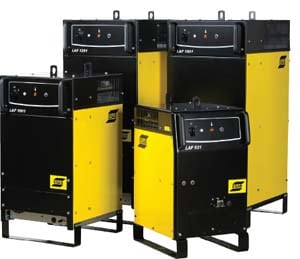
NewsDC Power Sources for High-Production Welding
ESAB Welding & Cutting Products’ LAF series of three-phase, fan-cooled DC welding power sources are designed for high-productivity mechanized submerged arc welding or high-productivity GMAW welding. Made for use in combination with ESAB’s A2-A6 equipment range and the A2-A6 Process Controllers (PEK or PEI), LAF welding power sources offer excellent welding characteristics throughout the entire […]
-
Commentary
I’ve Got a Secret
Why did the Environmental Protection Agency (EPA) drop the Cone of Silence around the good news about the continuing trend of improved air quality? The agency’s annual report of air quality trends was released in mid-March with barely a whisper. Even the major media outlets failed to report on the excellent results.
-
 News
NewsUniversal Input/Output Transmitters
Honeywell has added universal input/output (I/O) transmitters to its family of XYR 6000 wireless products. The transmitters allow manufacturers to wirelessly monitor more plant points with fewer devices. The company says that by transmitting signals from up to three different types of inputs — including measurement devices with a high-level analog, temperature or milli-volt, or […]
-
O&M
The Unique Challenge of Controlling Biomass-Fired Boilers
Biomass has many advantages as a fuel for boilers: It’s inexpensive, readily available in many regions, CO2 neutral, and its use warrants government subsidies. The fuel also presents unique concerns to the designers, owners, and operators of biomass plants, especially in the design of the control system.