
Articles By

-
News
STP Unit 2 Offline Following Circuit Breaker Malfunction
The STP Nuclear Operating Co. declared an "Unusual Event" at 10:38 a.m. this morning when a circuit breaker malfunctioned, which caused Unit 2 to go offline.
-
Commentary
Good Habit—Questionable Motive
Sometimes we do things for the wrong reason . . . that turns out to be exactly right.
-
 Coal
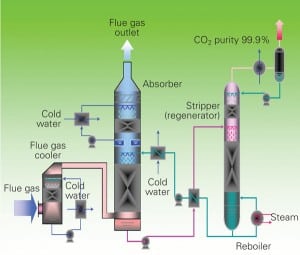
CoalSouthern Co. Captures Carbon Dioxide at Plant Yates Pilot
The pilot-scale project at Georgia Power’s Plant Yates near Newnan, Ga.—the first step in one of the industry’s largest demonstrations of a start-to-finish coal-fired power plant carbon capture and storage system—reached a significant milestone this September, capturing the greenhouse gas for the first time.
-
Business
Turkey Joins European Grid
Turkey, a country that has long vied to become part of the European Union, is finally part of its grid, at least. The nation’s power system was synchronized with Continental Europe’s interconnected grid this September, marking the beginning of a year-long trial period in which security and performance will be monitored.
-
 Coal
CoalFrog-Inspired Artificial Foam Could Help Trap CO2
In August, researchers from the University of Cincinnati who are working on creating an artificial foam that could absorb carbon dioxide (CO2) from the flue gas at power plants and convert it into biofuel won the grand prize at the 2010 Earth Awards in London.
-
Business
POWER Digest (November 2010)
TVA’s 550-MW Combined-Cycle Plant Starts Operations. The Tennessee Valley Authority (TVA) on Sept. 30 officially began operating the Lagoon Creek Combined Cycle Plant, a 550-MW natural gas–fired plant, near Brownsville, Tenn. The federal utility said that the new plant, the first new power generation source built by TVA since 2002, would provide power during days […]
-
 Nuclear
NRC Confident in Long-Term Dry Cask Storage
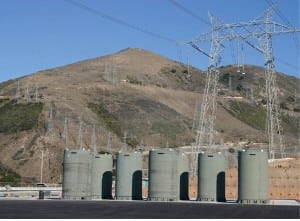
The U.S. Nuclear Regulatory Commission (NRC) approved an updated “waste confidence” rule in mid-September that reflects the agency’s confidence that spent nuclear fuel (SNF) can be safely stored for at least 60 years beyond the closing date of any U.S. nuclear plant. Approval of this rule was required before the NRC can license any new reactors that will be required to store SNF on site indefinitely.
-
Nuclear
EPRI Updates Spent Nuclear Fuel Storage Handbook
EPRI recently issued a handbook on nuclear spent fuel storage that examines regulatory trends affecting used fuel storage, describes available dry storage technologies, reviews planning considerations for spent fuel storage installations, and discusses technical issues affecting dry storage.
-
 O&M
O&MCSB Releases Hot Work Safety Notice
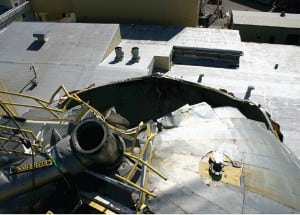
The Chemical Safety Board (CSB)—an independent federal agency charged with investigating serious chemical accidents such as equipment failure, as well as inadequacies in regulations, industry standards, and safety management systems—recently released multiple reports that should be made part of every power plant’s safety training program.
-
 Nuclear
Are Smaller Reactors Better?
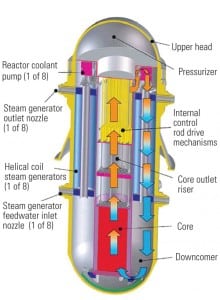
Is a paradigm shift—an economic and engineering earthquake—in nuclear power plant design on the horizon? For most of the past 50 years, the mantra in planning new nuclear plants has been “bigger is better.” But a growing number of nuclear power engineers and designers are contemplating a world where small is beautiful.
-
Commentary
Elner Shimfissle and Old Tom: In Praise of Electricity
Fannie Flagg’s fictional Aunt Elner Shimfissle reminds us of the power and the glory of electricity, a lesson we shall not forget.
-
O&M
NFPA Gas Purging Rules Updated
The CSB has made urgent recommendations to the NFPA and the International Code Council to prohibit indoor purging and require companies and installers to purge flammable fuel gases to safe locations outdoors, away from workers and ignition sources.
-
 Nuclear
Benchmarking Nuclear Plant Capital Requirements
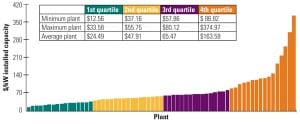
The EUCG Nuclear Committee’s primary goal is to optimize the costs and reliability performance of participating plants by publishing for its members a comprehensive database of performance metrics and best practices derived through surveys of its membership. Earlier reports examined staffing and performance data. In this exclusive EUCG report, we examine nuclear plant capital requirements.
-
 Distributed Energy
Matching Load and Generation at UCSD
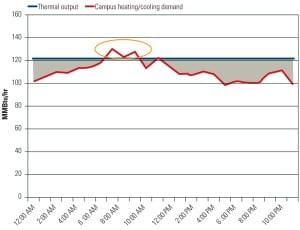
“Smart Power Generation at UCSD” explains how the University of California, San Diego (UCSD) is maximizing the value of combined heat and power. However, like any other grid-controlling entity large or small, the campus has to match generation and load. Its two Solar Turbines gas turbines operate in baseload mode 24/7 while the cogeneration side of the plant maximizes the value of “waste” heat and electricity that isn’t needed to serve immediate load by generating steam and chilled water for campus heating and cooling.
-
Legal & Regulatory
TREND: Smart Grid Complications
Despite a trendy moniker and lots of hype and interest, the smart grid has been facing some major setbacks of late, as regulators and customers begin challenging some of the claims for what interconnected smart meters will deliver in the way of tangible benefits.
-
 O&M
O&MAbrasion-Resistant Pipe Handles Ash Slurry
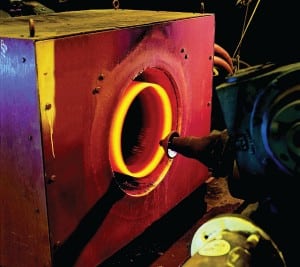
Steel piping systems are widely used at coal-fired power plants for a variety of purposes, including the conveying of coal ash slurry to nearby settling ponds, the transfer of limestone slurry to absorber spray towers for removal of SO2 and dilute hydrochloric acid from flue gases, and for transporting away the calcium sulfate by-product of the flue gas desulfurization process.
-
 Nuclear
The Best of U.S. Nuclear Developments 2010: Uprates and Loan Guarantees
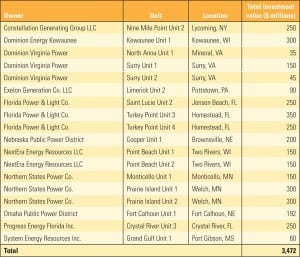
Utilities are spending billions of dollars on nuclear plant uprate projects, and Southern Company has been offered $8.3 billion in federal loan guarantees to build Vogtle Units 3 and 4 (although the final deal has yet to be signed). Meanwhile, other nuclear developers have slashed preconstruction spending as the cost of the “nuclear renaissance” becomes evident.
-
Smart Grid
Combined Heat and Power Across the U.S.
The University of California, San Diego (see “Smart Power Generation at UCSD”) is just one of many combined heat and power (CHP), or cogeneration, systems in the U.S. A 2008 report by Oak Ridge National Laboratory (ORNL), “Combined Heat and Power: Effective Energy Solutions for a Sustainable Future,” notes that Texas has the most CHP capacity—much of it used by the petrochemical and petroleum refining industries. California ranks second, largely a result of “industrial demands, stringent air quality requirements, and effective policies that encourage adoption of CHP.”
-
Legal & Regulatory
Uranium Enrichment: Boom or Bust?
The prospects of a worldwide nuclear power renaissance have spawned many plans for increasing uranium enrichment capacity. Could those plans swamp the world in SWUs?
-
 O&M
O&MAir Casters Speed Equipment Moves
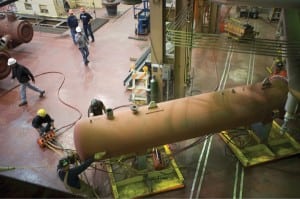
When it comes to moving megaton items like feedwater heaters or recirculating pumps, conventional moving tools such as wheel rollers, cranes, hoists, and come-alongs may be virtually useless. In some cases, moving large components is dangerous in a space-constrained location surrounded by delicate process control equipment. Feedwater heater and recirculating pump removal and replacement are […]
-
 O&M
O&MRetrofitting BWR Recirculation Pumps with Adjustable-Speed Drives
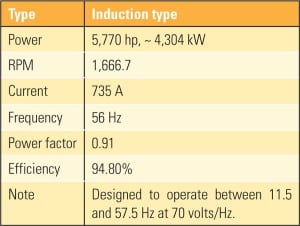
Exelon Nuclear recently replaced the original motor-generator sets for its boiling water reactor (BWR) recirculation pumps at its Quad Cities Generating Station Unit 1 with adjustable-speed drives. We examine the actual energy savings, motor-starting characteristics, control accuracy and stability, and motor and cable thermal behavior of this retrofit project.
-
Legal & Regulatory
NRC Chairman Floats Plan for Long-Term Spent Fuel Storage
A sea change in thinking about how to deal with spent nuclear fuel in the U.S. appears to be on the policy and political horizon, rekindling battles last fought in the 1980s about how to pay for the disposal of nuclear waste and where to put it. Holes in the ground look increasingly unlikely.
-
Legal & Regulatory
EPA’s Mercury Rule: Another Incarnation Coming
Much like the shape-shifting substance it regulates, the mercurial enforcement rule that governs mercury emissions from coal-fired power plants has changed unpredictably several times in recent years.
-
Commentary
Biomass Power Under Attack
Biomass energy has been an up-and-down industry for decades. As public awareness grows, it inevitably influences new tax legislation and environmental regulations. Two recent events have made the climate for development of this renewable resource even more volatile.
-
Legal & Regulatory
Dodd-Frank: Legislation and Magical Misdirection
Here’s how, with almost no attention, recent financial reform legislation changes how business must deal with whistleblower employees and affects other seemingly nongermane issues.
-
 Nuclear
Collaborative Team Investigates Long-Term Nuclear Operations
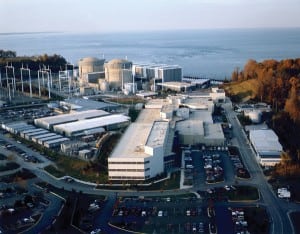
The Atomic Energy Act originally established the length of a U.S. commercial nuclear reactor license as 40 years and made it renewable for another 20 years. The U.S. Nuclear Regulatory Commission has stated that it bases the length of these licenses (and the 50+ renewed licenses granted to date) not on any particular technical limitation but on whether the plant meets current safety requirements. Does this mean there could be reactor life after 60?
-
 News
NewsSemi-Automated Tube Bundle Cleaner
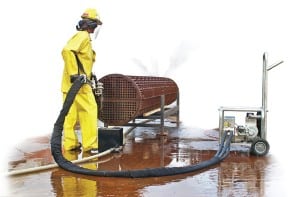
Part of a family of automated and semi-automated tube-cleaning accessories, the new Saflex 2000 makes tube bundle cleaning more productive because it can clean four times as many tubes in a given period as manual water jetting, says NLB Corp. Operating at pressures up to 40,000 psi, the semi-automated accessory cleans two tubes (ranging from […]
-
HR
Social Media: Watch Your Words and Fingers
Letting loose on Facebook, Twitter, and email, no matter how tempting and satisfying, can be a prescription for big trouble for you and your organization. Watch out for the dangers of social media on the job.
-
News
Follow the Leader
Another year has passed and the promised U.S. nuclear renaissance is still in the Dark Ages. Blame for slow progress is usually cast on the pedestrian pace of finalizing loan guarantees, the economy and slow load growth, or the rising cost of construction. The excuses end when competition increases. Two years have elapsed since the […]
-
 Nuclear
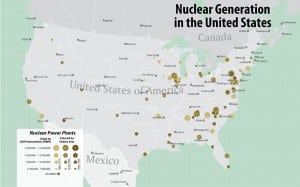
Map of Nuclear Generation in the United States
Courtesy: Platts Data source: POWERmap All rights reserved. No reproduction allowed. For full-sized maps, contact Platts.