
Articles By

-
News
FERC, NERC: February Blackouts in the Southwest Could Have Been Avoided
The rolling blackouts that affected nearly 4.4 million electric customers in the Southwest during the bitter cold snap from Feb. 2 to Feb. 4 this year could have been prevented by measures such as winterizing power plants and increasing natural gas storage capacity, the Federal Energy Regulatory Commission (FERC) and North American Electric Reliability Corporation (NERC) said after concluding a six-month inquiry into the outages.
-
General
What Polar Bear Decline?
By Kennedy Maize Washington, D.C., August 15, 2011 — It’s about those polar bears. You know, the ones endangered by global warming turning the Arctic into Florida, the poster predators of man’s inhumanity to the Earth. Those cute figures who have graced Coca-Cola ads and memorabilia for decades. Well, maybe they aren’t that endangered after […]
-
General
Ex-CIA chief Slams Smart Grid
By Kennedy Maize Washington, D.C., August 14, 2011 — I don’t often agree with former CIA director James Woolsey. In fact, I can’t think of a time that I have ever agreed with him. Until this week, that is, when Woolsey offered a short, sharp elbow to the policy ribs of the smart grid during […]
-
News
Crucial NRC Safety Backing for New Vogtle Reactors Clears Way for COL Hearing
Two new AP1000 reactors proposed for the expansion of Plant Vogtle near Waynesboro, Ga., on Tuesday received a Final Safety Evaluation Report (FSER) from the Nuclear Regulatory Commission (NRC). In a major milestone for the project—the first two reactors that will be built in the U.S. in 25 years—the federal regulatory agency concluded there are no safety aspects that would preclude it from issuing a limited work authorization and combined construction and operating license (COL) for the project.
-
News
Grid Operators to EPA: Strict Compliance Deadlines Could Jeopardize Reliability
Five U.S. grid operators last week jointly urged the U.S. Environmental Protection Agency (EPA) to reconsider strict compliance deadlines proposed for a suite of rules because they feared "accelerated" generation retirements as owners assessed the costs of complying with them. The grid operators also asked the EPA to consider keeping some plants online if they met certain conditions, because taking them out of service would affect system reliability.
-
News
ERCOT Cuts Power to Industrial Users to Avoid Blackouts
Power demand for the Electric Reliability Council of Texas (ERCOT) control area hit three consecutive records in the past week—reaching 68,294 MW on Aug. 3—forcing the grid operator to cut power to large industrial users to avoid rolling blackouts. It was the second time this year and only the fourth in more than two decades that the grid operator has been forced to implement such measures.
-
News
China Begins Operation of Second CPR-1000 Reactor
Eight days ahead of schedule, China on Sunday put into commercial operation Ling Ao Unit 4, the second facility of the Ling Ao Phase II nuclear power plant. Unit 4, owned by the state-owned China Guangdong Nuclear Power Co. (CGNPC), brings the number of reactors at the Ling Ao/Daya Bay Nuclear Power Base to six—making it China’s largest nuclear complex to date.
-
News
TVA to Delay Watts Bar 2 Startup until 2013
The Tennessee Valley Authority (TVA) on Monday said it would delay construction at Watts Bar Unit 2 and delay commercial operation of the facility from the previously anticipated late 2012 timeframe into 2013, owing to a licensing delay, safety and environmental issues, and a transition in the leadership of its nuclear generation development and construction (NGDC) group.
-
News
DOE Finalizes $967M Loan Guarantee, Funds Fuel Cell, Hydrogen Storage Development
The Department of Energy (DOE) on Thursday finalized a $967 million loan guarantee for a solar photovoltaic facility in Arizona. On Tuesday, it also awarded $7 million for independent cost analyses supporting research and development for fuel cells and hydrogen storage systems.
-
News
Dynegy Restructures in Recovery Attempt
Dynegy has restructured to create separate coal-fired and gas-fired power generation units.
-
News
Chicago’s Proposed Clean Air Ordinance Could Shut Down Two Coal Plants
The city of Chicago on Thursday reintroduced an ordinance that could shut down two coal-burning power plants in the city owned by Midwest Generation, an Edison International subsidiary.
-
News
UK to Close Sellafield MOX Plant on Fukushima Concerns
The UK plans to shutter its Sellafield Mixed Oxide (MOX) plant (SMP) as soon as it is practically feasible because the March 2011 Japanese quake and subsequent nuclear crisis at Fukushima have changed the facility’s commercial risk profile, the Nuclear Decommissioning Authority (NDA) said today.
-
News
Smart Grid Panel Approves First Six Standards
The Smart Grid Interoperability Panel (SGIP)—a consensus-based group of more than 675 public and private organizations created by the National Institute of Standards (NIST)—has made the first six entries into its new Catalog of Standards, a technical document that is expected to serve as a guide for smart grid–related technology.
-
News
NARUC, States Ask Court to Force NRC Action on Yucca Mountain Application
The Yucca Mountain fracas last week became more intense as the National Association of Regulatory Utility Commissioners (NARUC) joined a coalition of state and local governments in a suit against the Nuclear Regulatory Commission (NRC). The petitioners claim the agency is “unreasonably delaying” a decision on the proposed—and now-defunct—permanent spent nuclear fuel repository in Nevada.
-
News
EIA: Coal Power Plunged to Lowest Level in 30 Years in Q1 2011
The share of electricity generated from coal in the U.S. during the first three months of this year was at its lowest first-quarter level in more than three decades—even though the overall total level of generation in the U.S. increased by a little less than 1%, the Energy Information Administration (EIA) reported last week.
-
News
Alberta to Fund In-Situ Coal Gasification Project
Alberta’s provincial government last week signed a final funding agreement for a unique carbon capture and storage (CCS) project that seeks to tap a deep unmineable coalbed and turn the coal into power-generating synthetic gas—or “syngas”—while underground.
-
News
GE-UW Coal Gasification Research Facility Shelved on Federal Energy Policy Uncertainty
Plans have been delayed to build a small-scale coal gasification facility that would have enabled researchers from the University of Wyoming (UW) and GE Energy to understand the conversion of feedstock by gasification into syngas for use in power generation. The delay of at least 18 to 24 months stems from a lack of federal energy policy, Wyoming’s Governor Matt Mead said on Friday.
-
News
DOE to Invest $50M to Boost Domestic Solar Manufacturing
The Department of Energy on Tuesday announced a $50 million investment over two years for the SUNPATH program, an initiative that seeks to help the U.S. reclaim a competitive edge in solar technology manufacturing.
-
News
Blue Ribbon Commission: Nuclear Waste Program at an Impasse
On Friday, the Blue Ribbon Commission—Energy Secretary Steven Chu’s 15-member panel assigned to recommend a new plan for managing the back end of the nuclear fuel cycle—released a draft report for public comment. The public comment period is due to end Oct. 31, 2011, and a final report is due to Secretary Chu before Jan. 29, 2012.
-
 General
New Spencer Research Challenges Climate Models
By Kennedy Maize Washington, D.C., August 1, 2011 — A recent article in the peer-reviewed journal Remote Sensing raises a profound challenge to the conventional wisdom about global warming predictions based on global circulation computer models. The paper by Roy W. Spencer and William D. Braswell of the University of Alabama at Huntsville shows that […]
-
News
Fracking Problems
By most estimates, natural gas is likely to become the dominant power generation fuel in the U.S. within perhaps a decade. The rapid growth in natural gas supplies follows advanced drilling techniques that can economically tap large shale gas reserves located deep beneath Earth’s crust. Unfortunately, it only takes one outlaw drilling company to frack it up for the rest of us.
-
 O&M
O&MMake Your Plant Ready for Cycling Operations
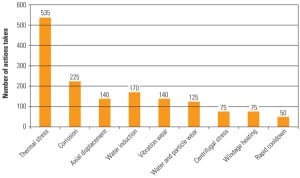
Cycling your steam power plant is inevitable, so now is the time to learn how to minimize equipment damage and assess the true costs of cycling. Whether cycling is required by the grid operator because of renewable integration or other factors, you must be proactive about updating operating processes and upgrade equipment so the transition to cycling operation goes smoothly.
-
Coal
Dominion to Convert Three Coal Plants to Biomass
Dominion Virginia Power has asked the Virginia Corporation Commission for approval to convert three aging and relatively small coal-fired plants to biomass, saying the move would provide substantial long-term savings to customers while cutting air emissions and creating hundreds of forest-related and trucking jobs in the state.
-
 Nuclear
THE BIG PICTURE: Underground Nuclear Waste Disposal
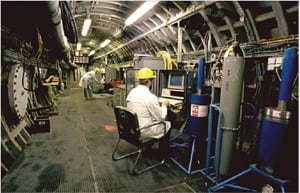
According to the International Atomic Energy Commission, deep disposal in stable geological formations is the only sustainable way to safely manage spent fuel and high-level waste (HLW) from nuclear power reactors. No permanent geological repository has yet been built, but some countries have found a location for a future repository. Others are researching the option…
-
 O&M
O&MMitigating the Effects of Flexible Operation on Coal-Fired Power Plants
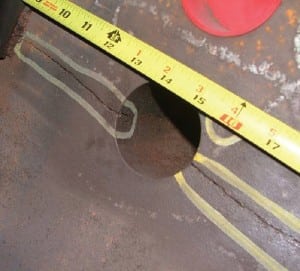
As coal-fired power plants increasingly operate in cycling modes, many plants are confronting the potential for higher levels of component damage and degraded performance of environmental control equipment. Generators and EPRI are working together to find ways to mitigate the effects of cycling operation and to manage the transition of formerly baseload plants to flexible operation.
-
Commentary
Water Issues, Carbon, and Price of Power Top Utility Concerns
In a clear sign of growing industry unease about the availability of water for power plant operations, utility officials recently surveyed by Black & Veatch on a host of policy and business issues ranked water supply as their second-highest environmental concern and identified water management as the business issue that could have the greatest impact on the utility industry in the near future.
-
 Smart Grid
Milestones for Flywheel, Lithium Battery Grid-Scale Projects
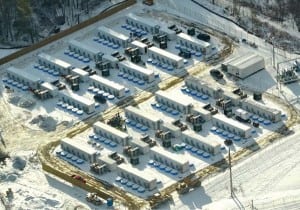
Energy storage developments got a boost as Beacon Power Corp. in June announced that its first flywheel energy storage plant in Stephentown, N.Y., achieved its full 20-MW capacity, and AES Energy Storage said its Los Andes battery storage system in Chile had performed continuously for more than 18 months as a critical reserve unit for the nation’s northern grid.
-
 Smart Grid
Accelerating the Pace of EV Deployment
A number of automotive manufacturers, electric utilities, electric power associations, and research groups are working to develop and evaluate technical approaches to integrating plug-in electric vehicles (PEVs) into the U.S. electrical grid system. This is a key requirement of facilitating widespread, near-term adoption of PEVs by the American public.
-
Commentary
Carbon Markets Take Flight (in Europe)
The European Union has adopted a greenhouse gas cap-and-trade system as part of its Emissions Trading Scheme (ETS). Beginning January 2012, aircraft flight engines will be added to the emissions sources regulated by the ETS. A Solutions Fellow at the Pew Center on Global Climate Change believes these regulations are an important step in regulating carbon emissions. You be the judge.
-
 Gas
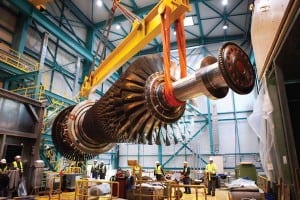
GasAlstom Launches Upgraded GT26
Just as GE Energy, Siemens, and Mitsubishi Heavy Industries (MHI) in May announced gas combustion technology developments—each seeking to push the 60% barrier with new gas turbine designs—Alstom has quietly been upgrading its KA26 combined cycle power plant. (See the July 2011 “Global Monitor” for more information on the GE, Siemens, and MHI turbines.) The firm says that the next generation of the 500-MW power plant, based on the advanced class GT26 gas turbine, features “achievable” efficiencies of over 61%, increased flexibility, and more than 350 MW, which can be delivered in less than 15 minutes to help integrate renewable energy sources (Figure 3).