
Articles By
-
News
NRC Splits on Yucca License Withdrawal, But Orders Work Close-Out
The Nuclear Regulatory Commission (NRC) on Friday split 2–2, neither upholding nor rejecting a decision by the Atomic Safety and Licensing Board (ASLB) last year that had ruled the Energy Department could not withdraw its license application for the Yucca Mountain permanent nuclear waste repository in Nevada. In a written decision, however, the NRC directed its licensing board to close out work on the project by Sept. 30, citing funding constraints.
-
News
N.H. Senate Fails to Override Veto, Keeps State Participating in RGGI
New Hampshire’s State Senate last week fell one vote short of overriding Gov. John Lynch’s veto of a bill that would have withdrawn the state from the Regional Greenhouse Gas Initiative (RGGI), a greenhouse gas cap-and-trade program whose participants include 10 states and provinces in the northeastern U.S. and Canada.
-
General
Reports: France Suffers Nuclear Explosion
By Kennedy Maize Washington, D.C., September 12, 2011, 9:30 a.m. — There are multiple reports this morning of an explosion at the French nuclear site at Marcoule. According to the BBC, one person has been killed and four injured. Few details are available. This morning’s New York Times said French nuclear regulators had confirmed the […]
-
General
The Lessons of Solyndra
By Kennedy Maize Washington D.C., September 9, 2011 — Pondering the collapse of solar PV manufacturer Solyndra and the earlier business failures of Evergreen Solar and SpectraWatt, all recipients of Department of Energy loan guarantees, several points seem clear to me. The first is that the Obama administration has made a mistake by investing economic […]
-
News
Obama Shelves Smog Rule on Concerns About Regulatory Burdens, Uncertainty
President Obama on Friday scuttled the Environmental Protection Agency’s (EPA’s) smog rule, saying that he had underscored the importance of reducing regulatory burdens and uncertainty. The decision has dealt a blow to environmental groups—which are contemplating legal action—and won the Democratic president praise from Republicans and industry groups.
-
News
Third Solar Panel Maker in the U.S. Files for Bankruptcy This Summer
Solyndra, the manufacturer of cylindrical solar photovoltaic panels, which had been granted the Department of Energy’s (DOE’s) first ever loan guarantee funded by the American Recovery and Reinvestment Act, on Tuesday filed for bankruptcy protection. The move follows the California company’s decision last week to shut down its Fremont factory and lay off 1,100 employees and contractors because it could not compete with low-cost manufacturers from other countries.
-
News
Shaw Group to Sell 20% Stake in Westinghouse to Partner Toshiba
Louisiana-based engineering firm the Shaw Group on Tuesday said it would sell its 20% stake in nuclear plant company Westinghouse back to partner Toshiba—forcing the Japanese company to raise its holding to 87%. Shaw said it would continue to work as a consortium team member with Westinghouse in the deployment and commercialization of the third-generation AP1000 reactor currently under construction in China and the state of Georgia.
-
News
European Steam and Gas Market Revenues Expected to Quadruple in Five Years
Analysis from research and consulting firm Frost & Sullivan shows that the steam and gas turbines market in Europe—which has seen an all-time low in the past two years—is expected to pick up in the medium-to-long term, even though the sector has been hard-hit by uncertainties concerning carbon trading, power industry legislation, and commodity price surges.
-
News
Mid-Cycle Assessment Shows All U.S. Nuclear Plants Operating Safely, NRC Says
All nuclear plants in the U.S. continued to operate safely, the Nuclear Regulatory Commission (NRC) said as it announced it had issued mid-cycle assessment letters to the nation’s 104 operating commercial nuclear plants.
-
News
DOE Awards Millions for Advanced Solar and Advanced Hydropower Technologies
The Department of Energy (DOE) on Thursday awarded more than $145 million for 69 projects in 24 states to help shape the next generation of solar energy technologies as part of its SunShot Initiative. That announcement was followed yesterday by one concerning funding for a more established renewable power generation technology. The DOE and Department of the Interior announced nearly $17 million in funding over the next three years for research and development projects to advance hydropower technology.
-
News
New California Law Expedites Permitting for Wind, Geothermal in Deserts
California Gov. Jerry Brown (D) last week signed into law a bill that extends an expedited permitting process previously limited to large-scale solar projects to wind and geothermal projects planned for installation in California’s Mojave and Colorado Deserts.
-
General
Guest Blog: How NOT to Communicate with Utility Customers During Outages
By John Egan Lafayette, Colo., September 5, 2011 — “A live electric wire just fell on a bus full of senior citizens—what do you do?” No, that wasn’t a line from Dennis Hopper in the movie Speed. In fact, it was an interview question I was asked when I was being interviewed to become a […]
-
Instrumentation & Controls
NERC CIPS Update: The Advantages of an Integrated Factory Acceptance Test
When adding, modifying, or upgrading a system, many critical infrastructures conduct a factory acceptance test (FAT). A FAT includes a customized testing procedure for systems and is completed before the final installation at the critical facility. Because it is difficult to predict the correct operation of the safety instrumented system or consequences due to failures in some parts of the system, a FAT provides a valuable check of these safety issues. Similarly, because cyber security can also impact the safety of critical systems if a system is compromised, it makes sense to integrate cyber security with the FAT.
-
Legal & Regulatory
WTO China Ruling Could Impact Rare Earths
Uncertainty about China’s role in world trade and its current monopoly over critical rare earth minerals continues to roil supply chains in energy technology markets. Will the World Trade Organization bring China into the fold, or will China ignore the international forum that it lobbied hard to join several years ago?
-
Legal & Regulatory
Critics Get Crossways with New Cross-State Air Rule
From the East Coast to the Lone Star State, a number of elected officials and power industry representatives are bashing the new aggressive regulation aimed at controlling specific power plant emissions. Complying with a federal court mandate, the U.S. Environmental Protection Agency (EPA) finalized the Cross-State Air Pollution Rule (CSAPR) on July 6. The new […]
-
HR
How to Screw Up an Employee Complaint Investigation
The process of handling employee complaints of workplace discrimination or harassment is filled with potentially disastrous pitfalls. Here are some things to avoid.
-
 Gas
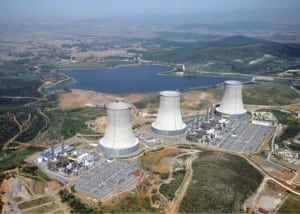
GasTop Plant: Adapazari Power Plant, Adapazari, Sakarya Province, Turkey
In 2010, the 2,310-MW Adapazari Power Plant achieved 99.8% availability, which is nearly 7% higher than the industry average and a global record in F-class gas turbine technology. The new turbine upgrade is helping ENKA Power bolster Turkey’s evolving economy by improving its energy sector’s efficiency and productivity.
-
HR
Getting Employees to Apply Training on the Job: How to Turn Hope into Reality
Employee training is one of the most important human resource functions, and one of the most difficult to manage. But there are some proven ideas to help guide training programs in the work environment.
-
 Gas
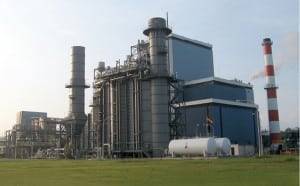
GasTop Plant: Arvah B. Hopkins Generating Station, Unit 2, Tallahassee, Florida
Known for its progressive, pro-sustainability policies, the City of Tallahassee recently repowered a 30-year-old conventional steam plant unit, turning it into a new 300-MW facility. The utility redesigned the Arvah B. Hopkins Generating Station, Unit 2 as a 1 × 1 combined cycle plant in order to improve efficiency, switched the primary fuel from oil to natural gas, and thereby reduced fuel costs and emissions. The plant’s flexible design even will enable expansion to a 2 × 1 configuration when additional capacity is needed in the future.
-
Business
How to Break Down the Barriers Between Information and Operations Data
"Asset health" offers a conceptual path to integrating information technology with operations technology, thereby overcoming the common management problem of "siloed data," according to a recent study by The McDonnell Group.
-
 Gas
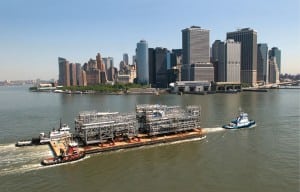
GasTop Plant: Astoria II Combined Cycle Plant, Queens, New York
Managing construction of the 550-MW Astoria II Combined Cycle Plant in the midst of Queens, a densely packed New York City borough, required extensive off-site modular construction and a high level of logistical organization. Now the new Astoria II plant is operating successfully in conjunction with the Astoria Energy I plant as the largest natural gas–fired power plant in the Big Apple.
-
 Commentary
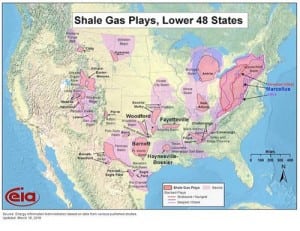
The Development of U.S. Shale Gas Resources: Regulation and Litigation
The rise of shale gas in U.S. energy markets has profound economic implications. It has the potential to transform the existing market and bring opportunities for new markets. But shale gas also raises regulatory challenges and the likelihood of litigation. Here’s an introduction to the issue and a primer on the regulatory and legal ramifications of the shale revolution.
-
 Gas
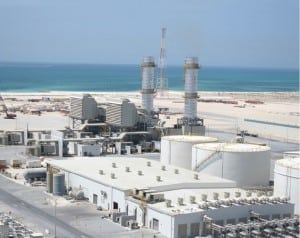
GasTop Plant: Emirates Aluminum Smelter Complex (EMAL), Al-Taweelah, Abu Dhabi, United Arab Emirates
The new 2,100-MW Phase 1 EMAL combined cycle power plant provides dedicated power with a high level of reliability to the Emirates Aluminum Smelter Complex, which is designed to be the world’s largest aluminum smelter upon completion. Located on the Persian Gulf, the gas-fired combined cycle plant uses seawater cooling towers to eliminate thermal stress on local marine life.
-
Commentary
Climate Pragmatism: Introduction
Last summer, an international group of scientists and policy analysts under the auspices of the London School of Economics launched an ambitious effort to reshape the debate over global warming policy in a document known as The Hartwell Paper. This July, a similar group followed up with a new report, titled "Climate Pragmatism: Innovation, Resilience and No Regrets," which puts the earlier work into a North American context.
-
 Hydro
HydroChart a New Course
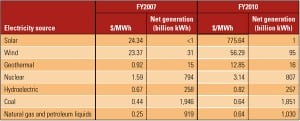
I examined the magnitude of electricity subsidies for renewables compared with conventional generation technologies in my May 2011 editorial, based on data from a 2008 report prepared by the U.S. Energy Information Administration (EIA). An updated EIA report released in July determined that federal government subsidies have risen substantially during the past three years. In fact, overall renewable energy subsidies have almost tripled, increasing from $5.1 billion to $14.7 billion. In my opinion, we aren’t getting value for the money spent.
-
 Gas
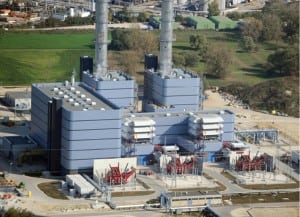
GasTop Plant: Irsching 4 Combined Cycle Power Plant, Irsching, Bavaria, Germany
The Irsching 4 Combined Cycle Power Plant has set a new world record in power plant efficiency with its new SGT5-8000H gas turbine. With an output of more than 578 MW and efficiency of 60.75% (net) achieved at a world record test run in May 2011, the plant demonstrates that climate protection, low-cost power generation, and flexible operation using fossil fuels can be attained simultaneously through technical advances. Due to its high efficiency, the gas-fired plant uses significantly less fuel and produces lower carbon dioxide emissions than traditional combined cycle plants.
-
Commentary
Get Creative, Skip the Path of Least Resistance
In training for a sport, the common wisdom is "no pain, no gain." The same is true when it comes to fostering creativity in the workplace. Force yourself and your organization out of the easy path, break out of the rut, and gain as a result.
-
 Coal
CoalTHE BIG PICTURE: Lights Out
Heat waves, droughts, and other weather and climate phenomena; economic woes; aging or inadequate infrastructure; fuel shortages. These are some of the most obvious causes that have led to record peaks in power demand or sudden drops in available capacity. The results have been sometimes debilitating load-shedding, brownouts, and blackouts around the globe this summer (and, in some cases, for much longer). Here’s an overview of which countries are affected by which difficulties. For a more detailed look at the extent of shortages and what’s causing them, visit Web Exclusives at https://www.powermag.com
-
 Gas
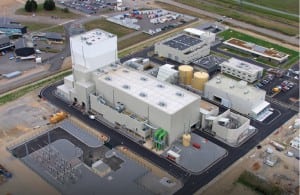
GasTop Plant: Montoir-de-Bretagne Combined Cycle Plant, Montoir-de-Bretagne, France
The 435-MW Montoir-de-Bretagne gas-fired power plant is ramping up Gallic generation in the Loire-Atlantique region of western France. The plant’s innovative natural gas combined cycle technology offers high efficiency and low emissions.
-
O&M
BIG PICTURE: Lights Out (Web Supplement)
A web supplement to the September issue with details of global power shortages.