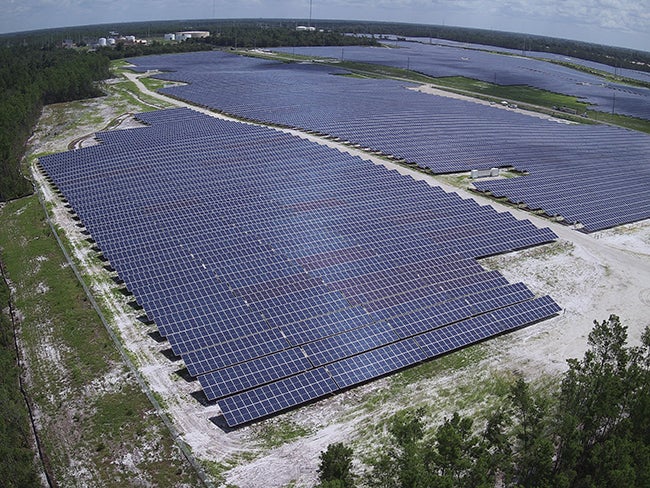
Speaking yesterday at the opening of Florida Power and Light’s (FPL) DeSoto Next Generation Solar Energy Center in Arcadia, Fla.—the largest of its kind in the U.S.—President Barack Obama announced the largest single energy grid modernization investment in U.S. history.
The $3.4 billion in grant awards are part of the American Reinvestment and Recovery Act (ARRA) and will be matched by industry funding for a total public-private investment worth over $8 billion. The 100 awards announced on Tuesday represent the largest group of ARRA awards ever made in a single day and the largest batch of ARRA clean energy grant awards to date.
Applicants for the awards stated that the projects will create tens of thousands of jobs, and consumers in 49 states will benefit from these investments in a stronger, more reliable grid. (Alaska is not included, and it’s not clear if any of its utilities even applied.) The DOE provided listings of the grant awards by category (PDF) and state (PDF). A map of the awards (PDF) shows virtually the entire nation covered by some sort of project.
What’s Being Funded
Awards were made in five categories:
• Category 1: Awards for advanced metering infrastructure went primarily to utilities.
• Category 2: Grants for customer service projects went to just five applicants, including municipal utilities and equipment vendors.
• Category 3: Funds for electric distribution systems went to utilities, including Hawaiian Electric Co. Inc.
• Category 4: Electric transmission systems dollars will go mostly to independent system operators.
• Category 5: Two awards, totaling $27,786,501 go to Whirlpool Corp. and Georgia System Operations Corp. Inc. for equipment manufacturing projects.
• Category 6: Money for integrated and/or crosscutting systems goes to utilities.
In his remarks, the president noted that “most of the projects that are receiving grants involve the installation of what are known as smart meters.”
Obama explained that “Smart meters will allow you to actually monitor how much energy your family is using by the month, by the week, by the day, or even by the hour. So coupled with other technologies, this is going to help you manage your electricity use and your budget at the same time, allowing you to conserve electricity during times when prices are highest, like hot summer days. Through these investments in a variety of smart grid technologies, utilities like Florida Power & Light will also be able to monitor the performance of its electricity grid in real time, which means they’ll be able to identify and correct service interruptions more quickly and effectively. And all this information will help increase renewable energy generation, provide support for plug-in electric vehicles, and reduce the carbon pollution that causes climate change.”
The DOE press release sliced the awards into the following benefit categories:
• Empowering Consumers to Save Energy and Cut Utility Bills—$1 billion. These investments will create the infrastructure and expand access to smart meters and customer systems so that consumers will be able to access dynamic pricing information and have the ability to save money by programming smart appliances and equipment to run when rates are lowest. This will help reduce energy bills for everyone by helping drive down “peak demand” and limiting the need for “stand-by” power plants—the most expensive power generation there is.
• Making Electricity Distribution and Transmission More Efficient—$400 million. The administration is funding several grid modernization projects across the country that will significantly reduce the amount of power that is wasted from the time it is produced at a power plant to the time it gets to your house. By deploying digital monitoring devices and increasing grid automation, these awards will increase the efficiency, reliability, and security of the system, and will help link up renewable energy resources with the electric grid. This will make it easier for a wind farm in Montana to instantaneously pick up the slack when the wind stops blowing in Missouri or a cloud rolls over a solar array in Arizona.
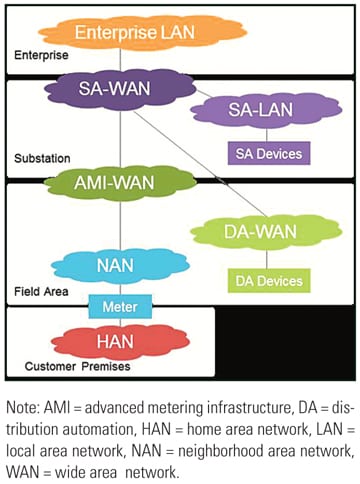
• Integrating and Crosscutting Across Different “Smart” Components of a Smart Grid—$2 billion. Much like electronic banking, the Smart Grid is not the sum total of its components but how those components work together. The administration is funding a range of projects that will incorporate these various components into one system or cut across various project areas—including smart meters, smart thermostats and appliances, syncrophasors, automated substations, plug in hybrid electric vehicles, renewable energy sources, etc.
• Building a Smart Grid Manufacturing Industry—$25 million. These investments will help expand our manufacturing base of companies that can produce the smart meters, smart appliances, synchrophasors, smart transformers, and other components for smart grid systems in the United States and around the world—representing a significant and growing export opportunity for our country and new jobs for American workers.
Biggest Winners
The biggest winners of an even $200 million each were:
• Baltimore Gas and Electric Co.—$200,000,000: Deploy a smart meter network and advanced customer control system for 1.1 million residential customers that will enable dynamic electricity pricing. Expand the utility’s direct load control program, which will enhance grid reliability and reduce congestion.
• Centerpoint Energy—$200,000,000: Complete the installation of 2.2 million smart meters and further strengthen the reliability and self-healing properties of the grid by installing more than 550 sensors and automated switches that will help protect against system disturbances like natural disasters.
• Duke Energy Business Services LLC—$200,000,000: Comprehensive grid modernization for Duke Energy’s Midwest electric system encompassing Ohio, Indiana, and Kentucky. Includes installing open, interoperable, two-way communications networks, deploying smart meters for 1.4 million customers, automating advanced distribution applications, developing dynamic pricing programs, and supporting the deployment of plug-in electric vehicles.
• Florida Power & Light Co.—$200,000,000: Energy Smart Florida is a comprehensive project to advance implementation of the Smart Grid, including installing over 2.6 million smart meters, 9,000 intelligent distribution devices, 45 phasors, and advanced monitoring equipment in over 270 substations. By incorporating intelligence into the transmission, distribution and customer systems, the utility will be able to anticipate and respond to grid disturbances, empower customers through alternative rate programs, and enable the integration of renewable and on-site energy sources.
• Progress Energy Service Co. LLC—$200,000,000: Build a green Smart Grid virtual power plant through conservation, efficiency and advanced load shaping technologies, including installation of over 160,000 meters across its multi-state service area.
• PECO Energy Co.—$200,000,000: Deploy smart meters to all 600,000 customers, upgrade communication infrastructure to support a smart meter network, install 7 “intelligent” substations, and accelerate deployment of more reliable and secure smart grid technologies that will reduce peak energy load and increase cost savings.
The fine print on the full list of awards lists notes that “The above projects have been selected for negotiation of an award.”
Expected Economic and Electric System Results
When the projects announced today are fully implemented, they will, according to the DOE:
• Create tens of thousands of jobs across the country. These jobs include high paying career opportunities for smart meter manufacturing workers; engineering technicians, electricians and equipment installers; IT system designers and cyber security specialists; data entry clerks and database administrators; business and power system analysts; and others.
• Leverage more than $4.7 billion in private investment to match the federal investment.
• Make the grid more reliable, reducing power outages that cost American consumers $150 billion a year—about $500 for every man, woman and child in the U.S.
• Install more than 850 sensors—called ‘Phasor Measurement Units’—that will cover 100 percent of the U.S. electric grid and make it possible for grid operators to better monitor grid conditions and prevent minor disturbances in the electrical system from cascading into local or regional power outages or blackouts. This monitoring ability will also help the grid to incorporate large blocks of intermittent renewable energy, like wind and solar power, to take advantage of clean energy resources when they are available and make adjustments when they’re not.
• Install more than 200,000 smart transformers that will make it possible for power companies to replace units before they fail thus saving money and reducing power outages.
• Install almost 700 automated substations, representing about 5 percent of the nation’s total that will make it possible for power companies to respond faster and more effectively to restore service when bad weather knocks down power lines or causes electricity disruptions.
• Power companies today typically do not know there has been a power outage until a customer calls to report it. With these smart grid devices, power companies will have the tools they need for better outage prevention and faster response to make repairs when outages do occur.
• Empower consumers to cut their electricity bills. The Recovery Act combined with private investment will put us on pace to deploy more than 40 million smart meters in American homes and businesses over the next few years that will help consumers cut their utility bills.
• Install more than 1 million in-home displays, 170,000 smart thermostats, and 175,000 other load control devices to enable consumers to reduce their energy use. Funding will also help expand the market for smart washers, dryers, and dishwashers, so that American consumers can further control their energy use and lower their electricity bills.
• Put us on a path to get 20% or more of our energy from renewable sources by 2020.
• Reduce peak electricity demand by more than 1400 MW, which is the equivalent of several larger power plants and can save ratepayers more than $1.5 billion in capital costs and help lower utility bills. Because peak electricity is the most expensive energy—and requires the use of standby power generation plants—the economic and environmental savings for even a small reduction are significant. In fact, some of the power plants for meeting peak demand operate for only a few hundred hours a year, which means the power they generate can be 5–10 times more expensive than the average price per kilowatt hour paid by most consumers.
More Money to Come
The $3.4 billion is part of a total $4.5 billion Department of Energy ARRA allocation for smart grid and transmission and distribution projects. The second-largest portion of that total will be allocated next month when the winners of $615 million for smart grid demonstration and energy storage projects are announced.
Sources: DOE, POWERnews