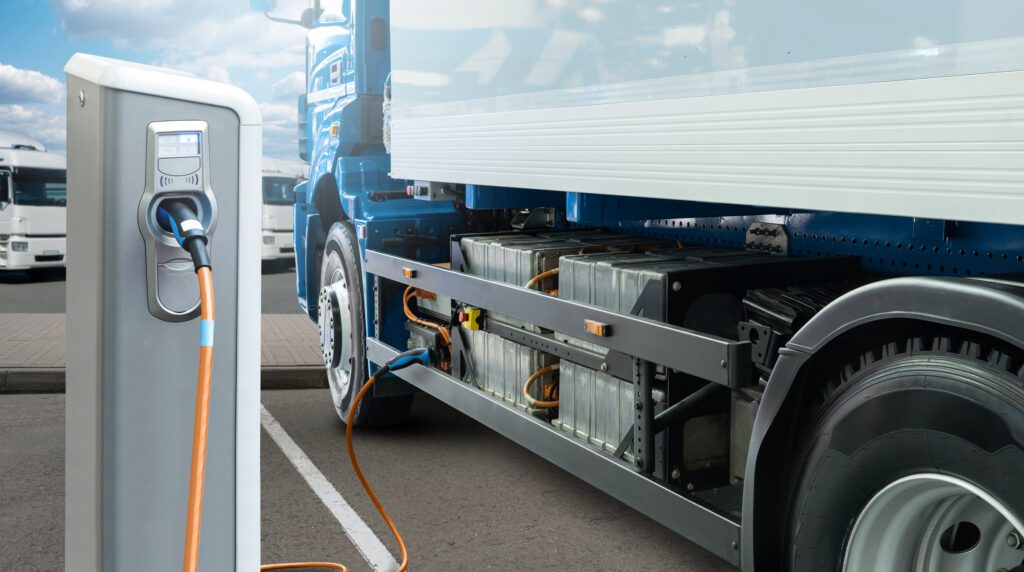
The dawn of electric semitrucks and other medium- and heavy-duty commercial vehicles has arrived, and if the technology is going to be widely adopted, we have to come to grips with what this means for our electrical infrastructure.
High-speed charging for heavy-duty electric vehicles (EVs) isn’t like charging a car. The power demand is multiples higher and requires thoughtful grid planning and careful management of peak power and power fluctuations to avoid voltage drops, frequency deviations, and potential blackouts. Grid stability will need real-time balancing of supply and demand.
COMMENTARY
Truck developers, utility companies, and technology companies are working to overcome these challenges. There’s a lot riding on getting the charging infrastructure right to help make transportation more sustainable. Medium- and heavy-duty vehicles are large sources of greenhouse gas emissions in both the U.S. and Europe.
More Electric Trucks on the Road
Electric truck sales are gaining momentum around the world. Last year, Europe saw more than 10,000 units sold for the second year in a row. Ambitious policies, such as the European Union’s carbon dioxide standards for heavy-duty vehicles, which target a 90% emissions reduction by 2040, are helping drive sales. U.S. sales are slowly gaining momentum. More than 1,700 trucks were sold in each of the past two years..
Building the charging infrastructure to accommodate more electric trucks on the roads is a complex process. Fleet owners are installing charging stations at their own facilities. These tend to be low-power chargers, anywhere from 50 to 150 kilowatts, for charging trucks overnight. This method is sufficient for short-range or local-delivery trucks with predictable routes and ample downtime.
There’s also a great need for a powerful and reliable public charging network to accommodate long-haul trucking and independent owner-operators who have small fleets or don’t have the capital to build their own charging infrastructure. Long-haul trucks require fast-charging on the road to minimize downtime. These chargers have to deliver high power output, from 350 kW to as much as one megawatt. SAE International introduced a new standard for megawatt charging of EVs, J3271, earlier this year.
“Megawatt charging really is the holy grail of what we’re trying to achieve,” said Patrick Macdonald-King, CEO of Greenlane Infrastructure. “It will make refueling time comparable with diesel.”
A Framework for Freight Electrification
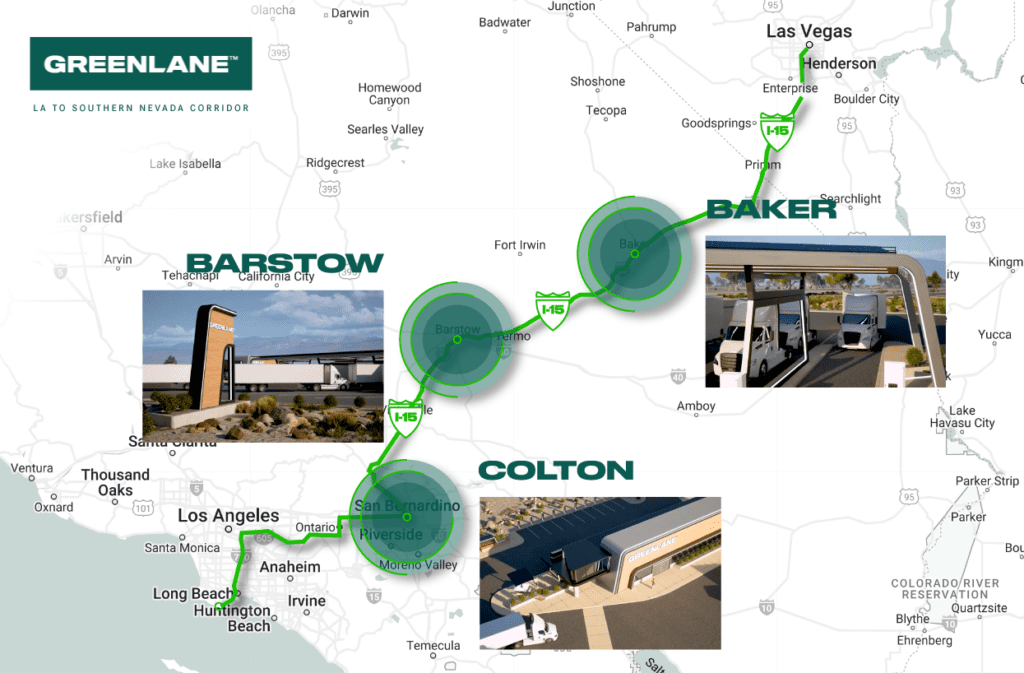
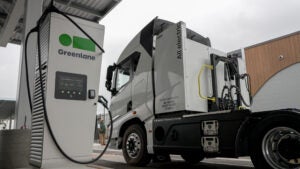
Greenlane Infrastructure LLC, a public charging network for commercial zero-emission vehicles, opened its first high-speed charging station for electric trucks in April in Colton, California. The company is working to build additional sites along the I-10 and I-15 freeways to serve major freight routes, and eventually throughout the rest of the U.S.
In developing the Colton station, Greenlane, with support from ABB, created a model for charging infrastructure and energy management built on three core principles:
- 1. Start with limits: Design for today’s grid and future-proof for tomorrow’s upgrades. The site currently has 41 EV chargers and plans to scale up to 60, for a combined nameplate charging capacity of nearly 12 MW—enough to charge 200 electric trucks per day.Colton features 12 pull-through lanes with 400 kW dual-port chargers and liquid-cooled cables designed to accommodate large Class 8 electric trucks. In addition, 29 bobtail lanes feature 180-kW chargers, offering longer-term parking and charging convenience for drivers while reducing deadhead miles. The site is also engineered with precast cable trenching, allowing for future equipment expansion and upgrades to megawatt charging as fleet demand grows.The site’s chargers are organized into four groups—each powered by separate 2.5 MVA medium-voltage (MV) to low-voltage (LV) transformers. Each transformer feeds a dedicated LV switchboard, which distributes power to each charger in its group. At least two of the switchboards distribute power to charger groups with an aggregate nameplate charging capacity over 2.5 MVA. This increases the utilization potential of the site because chargers rarely operate at maximum capacity, and seldom all at the same time.
- 2. Built-in flexibility: Use modular systems that support solar, battery storage, and megawatt charging as needs evolve. One of Colton’s key challenges is carefully managing the energy it receives from the grid. It must stay within a power limit set by the local utility.The site features multiple levels of load control, including ABB’s Supervisory Control and Data Acquisition (SCADA) platform, which acts as a backup to the Charger Management System (CMS). Combining them will help manage peak loads more effectively and provide energy resiliency.If the CMS can’t maintain charging within the given power limit, the SCADA system initiates a prioritized load shedding scheme when the site hits 95% of its budget. First, the 180-kW chargers are disconnected; if that doesn’t resolve the overload, the 400-kW quick-charge stations are next to go. If the site reaches 97.5% of capacity, the SCADA begins load-shedding the medium-voltage switchgear, cutting power to the entire site to prevent a full blackout from being triggered by the utility.The Colton site’s electrical infrastructure will also enable Greenlane to maximize the use of power generated from the future integration of an on-site solar and energy storage microgrid and participate in the utility’s demand response programs. This includes switchgear that allows Greenlane to add another switch to the cabinet in the field to support utility power additions or to segregate downstream chargers to be powered by different energy sources.
- 3. Operate smart and safe: Enable remote visibility and control to reduce downtime and support future growth. The electrical infrastructure, with the right hardware, controls and monitors a series of LV and MV circuit breakers remotely via a cloud platform. This feature improves safety and reduces maintenance costs. Greenlane can perform hard resets on EV chargers, which can address most software update issues, without dispatching a service truck. The technology solution will also allow control of breakers and other equipment across all future Greenlane sites.With the cloud platform, Greenlane can integrate third-party data, such as truck telematics, into its technology ecosystem. With telematics data, Greenlane can help fleet managers identify charge time or energy requirements for each route.
The Colton charging station is more than just a truck stop. It’s a prototype for how the freight industry might finally go electric. By tackling complex grid challenges, implementing cutting-edge energy management solutions, and designing for future scalability, Greenlane is demonstrating what’s possible when innovation and collaboration converge.
—Amber Putignano is Market Development Leader—EV ecosystem at ABB U.S.