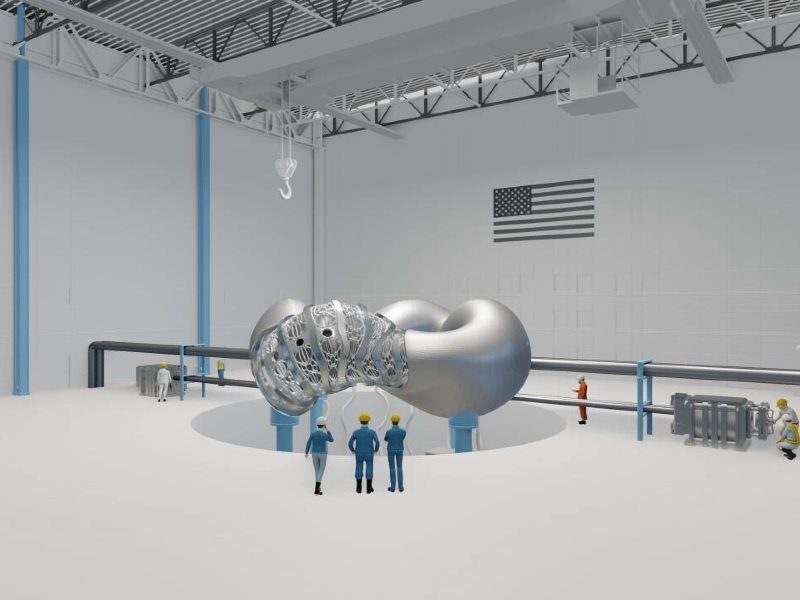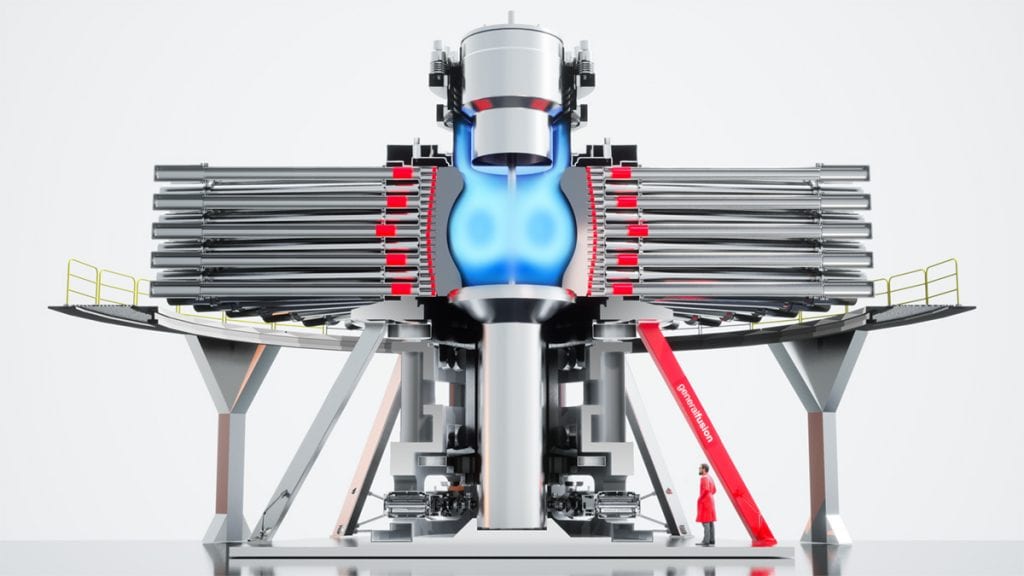
Fusion technology company Thea Energy said it has completed its preconceptual fusion power plant design. The company, founded in 2022 as a spin-out of the Princeton Plasma Physics Laboratory and Princeton University, is advancing the stellarator as part of its Helios system.
Thea Energy on December 15 said the milestone is part of an integrated, comprehensive preconceptual design study that was submitted to the U.S. Department of Energy (DOE) as part of the Milestone-Based Fusion Development Program. An initial paper on the system—“Overview of the Helios Design: A Practical Planar Coil Stellarator Fusion Power Plant”—details a system that combines software-controlled magnet coils that are adaptable to real-world conditions. It also outlines the world’s first stellarator “divertor” exhaust system capable of fusion power operations, and a sector-based maintenance scheme enabling long-term plant viability.
This paper is available as a preprint on the company’s website under “Presentations & Publications” and via arXiv. The company has submitted the paper to a peer-reviewed journal alongside additional manuscripts detailing specific power plant subsystems. As part of the DOE Milestone Program, selected companies work to demonstrate critical technologies and design power plants in preparation for commercialization. This report marks the completion of the last major milestone for Thea Energy in the initial phase of the program.
Interested in fusion technology? POWER will publish a Special Report in February on groundbreaking power generation projects, including details about nuclear fusion projects currently in development. Learn more about the “Groundbreakers” project, and other POWER Special Reports planned in 2026, here.
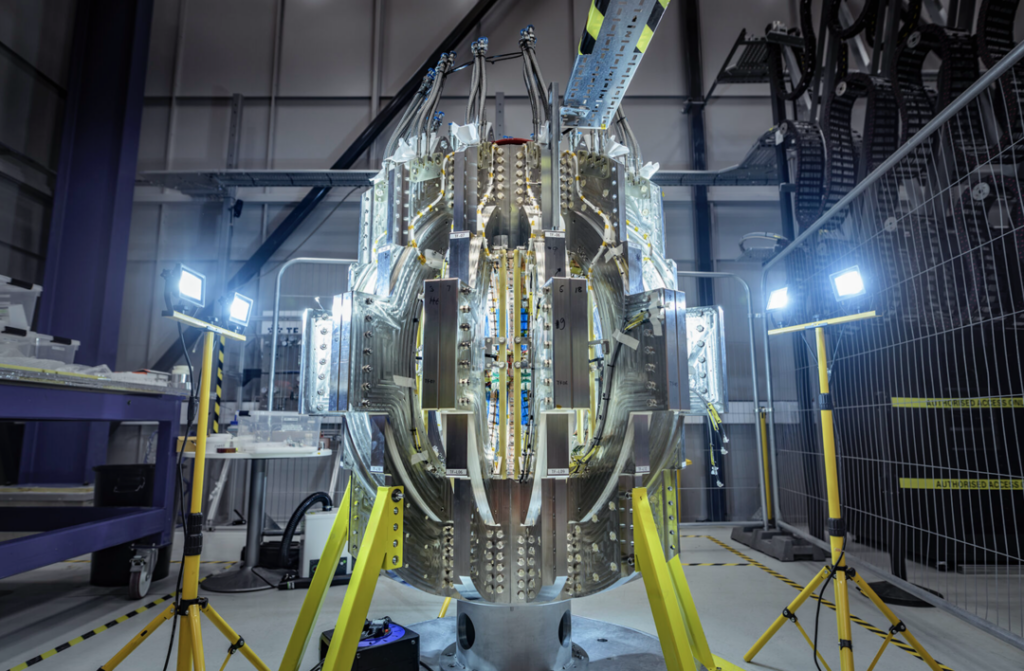
Thea Energy has said it is leveraging breakthroughs in computation and controls to reinvent the stellarator, a form of magnetic fusion technology. The company was selected as an inaugural awardee of the U.S. DOE’s Milestone-Based Fusion Development Program after a detailed merit review process. Thea Energy is currently designing its first integrated fusion system, Eos, based on its planar coil stellarator architecture that will produce fusion neutrons at scale and in steady state.
Helios is designed to operate continuously and provide about 400 MW net electricity to the grid, with a total thermal output of 1.1 GW. Helios has a major radius of 8 meters, making it the most compact optimized stellarator power plant architecture. All normalized plasma parameters utilized in the Helios power plant architecture have been previously achieved in existing large-scale stellarator systems.
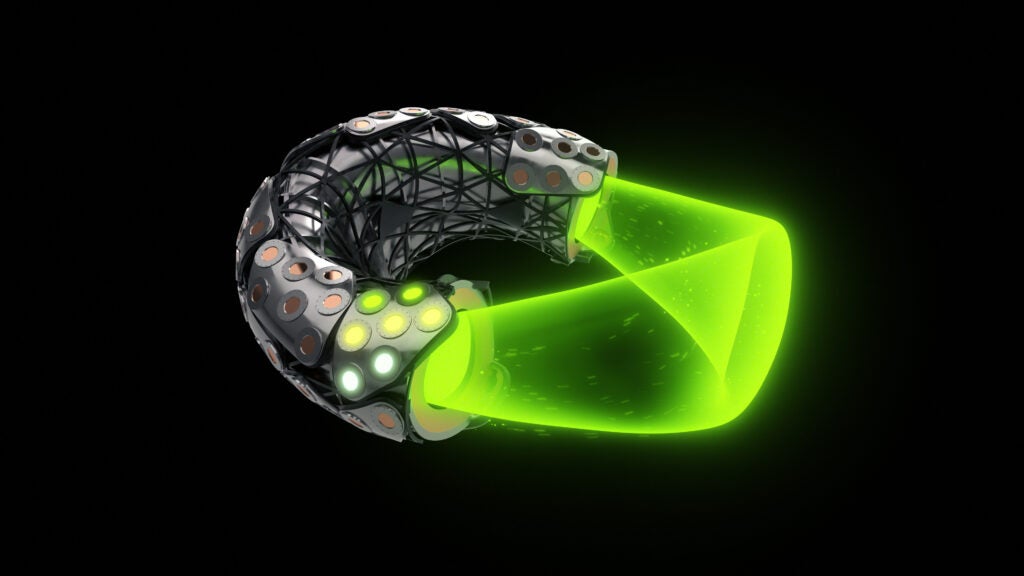
“Helios does not rely on future scientific breakthroughs,” said David Gates, Ph.D., co-founder and chief technology officer of Thea Energy. “Helios is designed to combine the inherent benefits of the stellarator— steady-state operation, no risk of damaging disruptions, and high efficiency—with programmable, planar magnets. This is the evolution of the stellarator for commercialization. Our proprietary architecture can individually control hundreds of magnets using a software stack to configure stellarator magnetic fields, while accounting for manufacturing and assembly errors as well as system wear and tear over its operational lifetime. This also uniquely enables our power plant architecture to utilize AI to increase performance and apply long-term software level system updates.”
Highlights of Thea Energy’s power plant include:
- Quasi-axisymmetric (QA) stellarators have the lowest plasma shaping requirements, which means they can use the simplest system hardware, including magnets, and have a smaller footprint and cost.
- Helios has a high capacity factor of more than 85%. The planar coil architecture allows for a practical commercial maintenance scheme, a primary design motivator. Entire toroidal sectors can be more easily removed from the system with a low number of unique parts, minimizing downtime, and enabling a 40-plus-year system lifetime.
- Implementing known and developed materials, the fusion-facing first wall is expected to have an average lifetime of 15 years before needing replacement, which also contributes to the system’s overall high capacity factor.
- Helios utilizes the world’s first tokamak-like “X-point” divertor in a stellarator architecture. This divertor has a simpler geometry and is designed to exhaust gas 10 times more effectively than prior stellarator divertors. Heat exhaust from the plasma was an unsolved challenge for the stellarator, compounded by complex magnet geometry. Thea Energy’s solution is significant and also allows the company to take advantage of decades of tokamak experience.
- Helios has a maximum magnetic field on the superconducting coils of 20 T, which is within realistic engineering parameters and performance levels previously achieved by large-bore HTS magnets.
- Helios has a practical radial build compared to competing power plant architectures, with more than a meter of space for energy conversion blankets and shielding. This larger plasma offset enables the lifetime of all magnets to be estimated at more than 40 years, decreasing required maintenance and increasing overall economic viability.
- High-fidelity simulations with state-of-the-art codes indicate low turbulent energy leakage (transport), meaning less heat leaks from the plasma, the fuel of fusion. This results in a more compact system with less heating power required compared to other proposed stellarator designs.
Brian Berzin, co-founder and CEO of Thea Energy, said, “Fusion will change humanity forever, but mass-manufacturable, cost-competitive systems that operate continuously are critical for deploying this abundant form of energy at scale. The Helios preconceptual design is accelerating the formation of commercial partnerships and first customers for Thea Energy power plants, a result of the work from nearly every member of our organization. Now 80+ skilled engineers, scientists, and commercialization experts, this team is championing the leading approach to a maintainable and dynamically controllable stellarator fusion system.”
Thea Energy is on track to operate Helios in the 2030s following Eos, its large-scale demonstration system that will create power-plant-relevant, steady-state fusion using the company’s simplified architecture. The company said Eos would directly benefit from the breakthroughs from Thea’s Helios design, and is scheduled to be online by 2030. Thea Energy is currently in conversations with five states for the siting of Eos; it expects to announce a location for the integrated system in 2026.
Carlos Paz-Soldan, Ph.D., associate professor of Applied Physics and Applied Mathematics at Columbia University, said, “Thea Energy’s design presents several significant innovations on the conventional approach to build stellarators. The planar coils are easier to manufacture and promise to reduce overall system complexity. They also provide new flexibility to the concept and facilitate plant maintenance. Other innovations include the power handling scheme, where a topology closely related to the conventional tokamak solution has been found for the first time in a stellarator power plant design. I congratulate the team on a job well done. My colleagues and I look forward to further collaborations with Thea Energy’s team on this design, enabling continued improvements to the stellarator.”
“Thea Energy is the kind of innovative opportunity that is difficult to overlook,” said Scott C. Hsu, Ph.D., Fusion Partner at Lowercarbon Capital. “The company’s architecture is modular, programmable, and cost-effective—a trifecta that puts them on a scalable path to commercial fusion. Thea Energy’s design makes its first plant, Helios, cheaper to build and the next ones cheaper to replicate. We appreciate the Company’s capital efficiency paired with its scientific transparency. Notably, Thea Energy is one of the DOE Milestone Program awardees who are seriously tackling an integrated preconceptual design, and we are proud to have invested in them to help bring this architecture to market.”
Jonathan Menard, Ph.D., deputy director for Research at the DOE’s Princeton Plasma Physics Laboratory (PPPL), said, “Thea Energy has modeled the Helios plasma using high-fidelity codes run on supercomputers here at PPPL and DOE’s NERSC. The company has simulated the most important performance indicators of stellarator fusion power plants, including turbulent transport, fusion-product confinement, magnetohydrodynamic (MHD) stability, and plasma exhaust.
“These simulations included truly novel contributions to the field; the first tokamak-like X-point divertor in a high-performance stellarator, and the first proposed stellarator power plant system design to use the M3D-C1 MHD evolution code to project access to the required conditions,” said Menard. “Thea Energy benefits from decades of foundational research and simulation tool development from institutions like PPPL, to push forward the state of the art, and we look forward to our continued partnership across power plant design, engineering, and manufacturing as the company progresses.”
—Darrell Proctor is a senior editor for POWER.