A chief information security officer (CISO) may have visibility into authentication events, network traffic, endpoint behavior, alerts and control failures, yet still lack the evidence needed to understand what is happening inside the physical process.
Plant operators and engineers monitor alarms, equipment states, interlocks, maintenance activity and production constraints, but they may interpret the same event as an operational fault. Each group has visibility into a different part of the picture. Until security and operational evidence are brought together, the organization cannot build a reliable view of an operational technology (OT) incident or make timely decisions about plant safety and continuity.
This is one of the CISO’s central OT challenges. A process event that leaves no conventional security trace may never reach the security team. Conversely, an adversary who bypasses or disables security controls may manipulate the operational environment before the Security Operations Center (SOC) detects a recognizable indicator. The result is more than a visibility gap. It is a decision gap.
The CISO Visibility Gap in OT
Traditional security monitoring explains activity in digital systems—who authenticated, which asset communicated, what command executed and which control produced an alert. It rarely explains whether a turbine slowed, a pump stopped, a valve changed position or a protection relay entered an unexpected state. Those facts sit with operations and engineering, often in separate systems and expressed in a different professional language.
This separation creates two problems. Significant operational events may never be escalated because they appear to be equipment faults, process deviations or maintenance errors. At the same time, security events may be detected without enough process context to judge their consequence. An alert involving a controller has a very different meaning when the controller is idle than when it is actively governing a safety-critical process.
The CISO therefore needs to connect digital activity with physical effect, operational dependency and potential consequence.
When an Operational Fault Conceals a Cyberattack
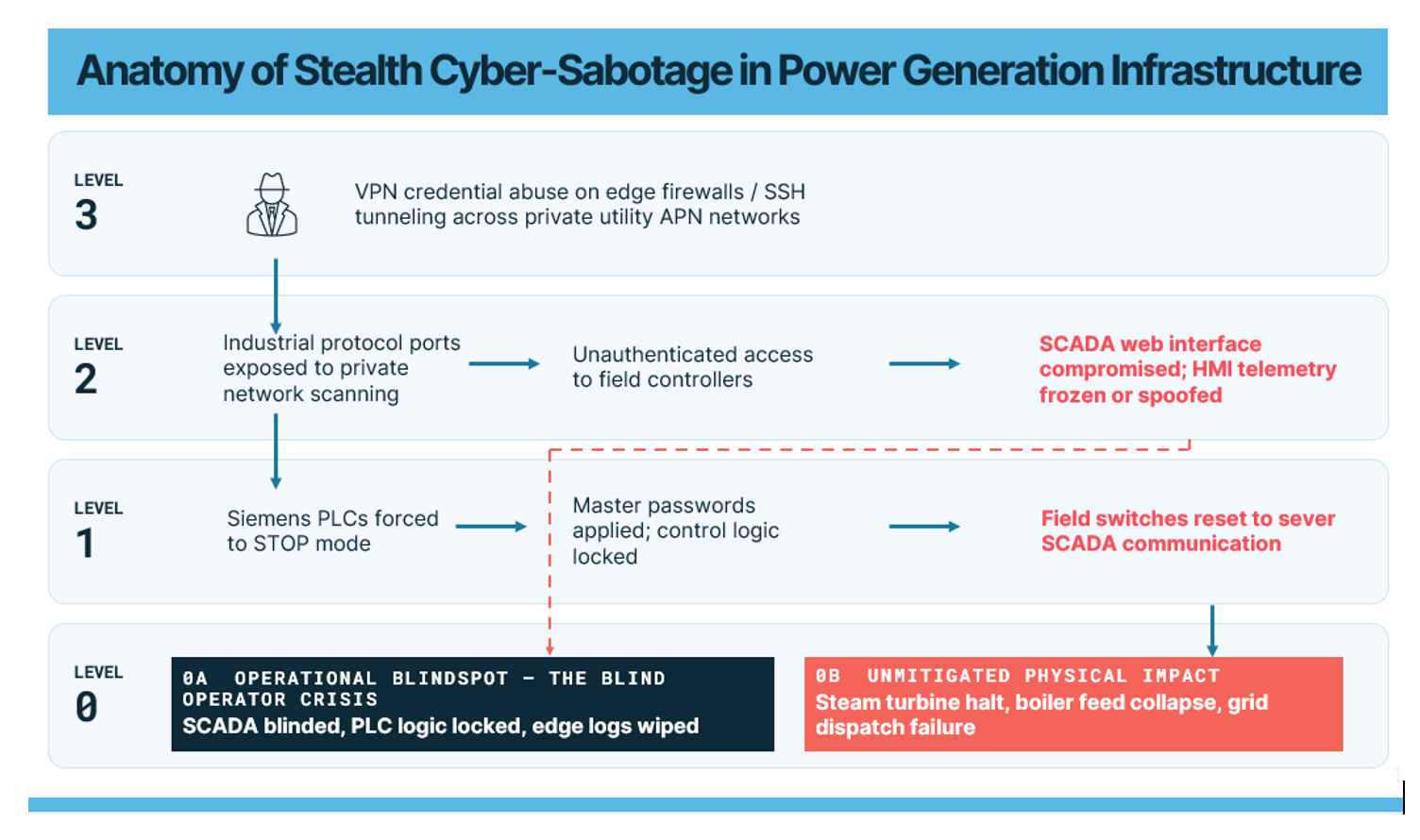
The December 2025 attacks on Poland’s energy sector illustrate the problem. According to CERT Polska, a computer emergency response team, coordinated destructive activity affected more than 30 renewable energy installations and combined heat and power (CHP) infrastructure. A later investigation described a CHP plant serving about 50,000 residents where attackers stopped a steam turbine and disrupted the process-water treatment system.
The physical symptoms could initially be interpreted as an engineering or maintenance problem. The lesson is not that every equipment failure should be treated as malicious. It is that cyber and operational hypotheses sometimes have to be tested together.
If operators see a trip while the SOC sees unusual remote access, controller changes, suspicious credential use or loss of field communications, the combined evidence changes the response. What first appeared to be a maintenance problem may instead be part of a broader attack.
Detection is Only the First Decision
Even when an attack is detected before physical damage occurs, difficult decisions remain. Should the plant isolate a network segment, disable remote access, move to manual control, reduce output or stop a process? Each option can carry safety, operational, financial and regulatory consequences.
A decision made from cybersecurity telemetry alone may contain the attacker but introduce avoidable operational risk. A decision based only on apparent process stability may allow the attacker to retain access. Containment therefore requires a shared view of the attack and the physical process.
Incident response teams need to know which systems the adversary reached, what commands or logic may have changed, which process units depend on those systems and whether the values shown on the control network can still be trusted.
The same requirement continues through eradication, where the organization removes the attacker’s access and persistence, and recovery, where systems and operations are restored safely. The organization cannot confidently remove an attacker until it understands how far the intrusion progressed and whether persistence remains in accounts, remote-access paths, engineering workstations, controllers or field devices. Restoring connectivity is equally insufficient if the physical process has not been validated.
Operational Intelligence Across the Incident Lifecycle
Operational information has a role throughout incident response. During detection and analysis, process trends, alarm sequences, controller states, maintenance records and physical measurements can help distinguish an equipment fault from malicious manipulation.
During containment, process dependencies and safe operating limits influence what can be isolated and whether the facility can continue operating. During eradication, security and engineering teams need to confirm that malicious logic, unauthorized changes and persistence mechanisms have been removed. During recovery, the plant needs confidence that control paths, telemetry and the process itself are behaving as expected.
That creates another problem: much of the information available to both security and operations travels through the same infrastructure that an attacker may be trying to compromise (Figure 1).
Decoupling Process Visibility from Network Integrity
Conventional OT monitoring depends heavily on controllers, switches, protocols and network paths. If an attacker spoofs telemetry, changes controller logic, disables a field switch or erases logs, both the control room and the security team can lose visibility at the same time. A duplicated supervisory control and data acquisition, or SCADA, view does not necessarily solve the problem if both views depend on the same underlying sources.
The organization therefore needs a way to validate what the control network reports against evidence that does not depend on the same network path. At least part of the process view needs to remain available when the integrity of network-derived information is uncertain.
Process Oriented OT Cybersecurity is an approach to cybersecurity that applies this principle at the process layer. Rather than relying exclusively on network traffic, controller data or software polling, selected physical signals are collected through an independent, out-of-band path. Voltage, current, frequency, actuator states and analog instrument outputs can provide a separate reference for validating what the control network reports.
The objective is not to replace SCADA, network monitoring or existing security controls. It is to add an independent source of process evidence.
If the Human-Machine Interface, or HMI, reports normal operation while a process-level signal shows that equipment has stopped, the discrepancy itself becomes relevant to the investigation. It may indicate telemetry spoofing, controller manipulation or a communications failure. Conversely, if a process change corresponds with authorized maintenance and is confirmed independently, the same evidence may prevent an unnecessary cyber escalation.
Turning Process Data into Security Intelligence
Raw operational data alone is not enough. The security team needs to understand what a process condition means in context: which asset is affected, what its expected operating state is, what recently changed and whether the behavior is consistent with known adversary activity.
This also addresses the language gap between the SOC and the control room. Engineers should not have to translate every abnormal process condition into cybersecurity terminology, and analysts should not have to infer physical consequence from an IP address. Operational evidence needs to be presented in a form that can be incorporated directly into security analysis and incident response.
MITRE ATT&CK, a globally-accessible knowledge base of adversary tactics and techniques based on real-world observations, for ICS (Industrial Control Systems) provides a useful framework for doing this. Its tactics describe what an adversary is trying to achieve, while its techniques describe how those objectives may be pursued. Operational evidence can therefore be considered alongside cybersecurity evidence as part of an attack sequence rather than remaining an isolated process alarm.
For example, loss of field communications may initially appear to be a network outage. If it occurs alongside unauthorized controller changes and abnormal process behavior, the combination may indicate an effort to inhibit response functions or impair process control.
MITRE ATT&CK does not replace engineering analysis or process-safety models. Its value is that it gives security, operations, incident response, Red Teams and Blue Teams (specialized groups of cybersecurity professionals who act as attackers and defenders to test and improve an organization’s security posture) a common vocabulary for discussing adversary behavior and understanding where detection or response gaps may exist.
Giving the CISO a Defensible Basis for Action
During a serious OT incident, the CISO may need to recommend actions that reduce production, interrupt service or create financial, regulatory and reputational consequences. A collection of security alerts is not enough to support that decision.
Executives need to understand what the adversary may control, which physical processes are affected, which evidence can still be trusted and what could happen if the facility continues operating. Combining cybersecurity information with trustworthy operational evidence gives the CISO a stronger basis for making and explaining those decisions.
Closing the OT decision gap is therefore more than a monitoring improvement. It is an incident-response and resilience requirement. When cybersecurity telemetry and trustworthy process information are analyzed together, organizations are better able to identify attacks that might otherwise look operational, contain them without losing sight of plant risk, remove the attacker’s footholds and recover with confidence that both the network and the physical process are under control.
—Alon Hazay is the chief information security officer for the Dalia 1 Power Plant and the CEO of Genero Cyber Security. Hagai Galili is the chief operating officer at SIGA, an OT cybersecurity leader protecting critical infrastructure.