
POWER
-
 O&M
O&MPredictive Maintenance That Works
This is the fifth in a series of predictive maintenance (PdM) articles that began in the April 2011 “Focus on O&M” in which the essentials of PdM were introduced. In the May and June 2011 issues, we explored specific PdM techniques, such as motor-current signature analysis and oil analysis. In the November 2011 issue, we introduced the value of thermographic analysis and its routine use. This installment focuses on ultrasonic and vibration analysis.
-
 Nuclear
Vogtle Gets Green Light
In February 2012, the Nuclear Regulatory Commission approved two combined construction and operating licenses for Southern Nuclear’s Plant Vogtle Units 3 and 4 in Georgia. They were the first licenses ever approved for a U.S. nuclear plant using the one-step licensing process and the first allowing construction in more than three decades. Now the real work begins.
-
 Coal
CoalEurope: More Coal, Then Less
Europe’s continuing drive toward sustainable energy does not rule out a new generation of coal power plants to replace those scheduled to close by 2015.
-
News
Abundance of Minerals
What do iPads, flat screen TVs, Chevrolet’s plug-in Volt, and Raytheon’s Tomahawk cruise missiles have in common? Each uses one or more of the 17 rare earth elements in their manufacture, and over 95% of those elements come from China.
-
Instrumentation & Controls
Upgraded Controls Position McIntosh Plant for Efficient Operations
Lakeland Electric’s C.D. McIntosh, Jr. Power Plant is a microcosm of the entire power generation industry. On a single site is a once-baseload coal-fired plant that is now operating fewer hours plus a peaking gas-fired combined cycle plant that has swung to baseload operation. A complete controls upgrade of the gas-fired plant last year prepared the plant for its expanded role in producing electricity for this 108-year-old public power provider.
-
Legal & Regulatory
States Promote Clean Energy Programs
While the proposed federal renewable portfolio standards (RPS) continue to be caught in Washington gridlock, a number of states are aggressively enacting programs that promote renewable energy, such as wind and solar power.
-
 O&M
O&MManaging the Catalysts of a Combustion Turbine Fleet
Natural gas–fired fleets comprising diverse turbine unit types are operating their units more these days because of the historic low price of natural gas. With increased operating hours, fleet owners are challenged to find the best ways to manage their SCR catalyst systems.
-
Commentary
Ensuring the Best Use of Federal Energy Subsidies
The U.S. uses a combination of direct expenditures, tax breaks, loan guarantees, and research funding to promote various energy goals. We could rely solely on the free market and avoid using federal subsidies, but we do not do that now and appear unlikely to do so in the future.
-
 Solar
SolarThink Water When Designing CSP Plants
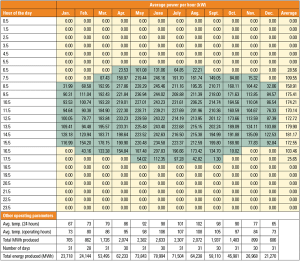
The operation of solar thermal power plants differs substantially from that of fossil-fired plants, as the sun determines the generation rather than market demand. However, design of the power island to minimize water usage is very similar to that of a fossil plant. This renewable technology requires renewed thinking of its water systems’ design.
-
 Coal
CoalIndia Revs Up Capacity with Massive Coal Plants
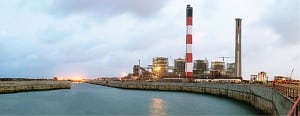
India, a country that plans to fuel its current level of gross domestic product growth of between 8% and 9% with massive, mostly coal-fired power capacity additions over the next decade, in March commissioned an 800-MW supercritical unit at the first of India’s government-envisioned ultra-mega power plants (UMPP).
-
 Smart Grid
Ten Smart Grid Trends to Watch in 2012 and Beyond
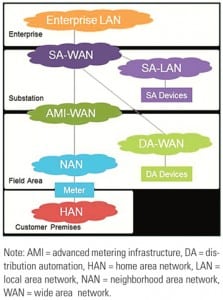
The year 2012 represents a turning point for the smart grid. Many foundational elements have been tested; several have been successfully deployed. Now the serious work of integration and value-generation begins, even though the challenges remain substantial.
-
 Gas
GasUkraine Looks Beyond Russian Gas
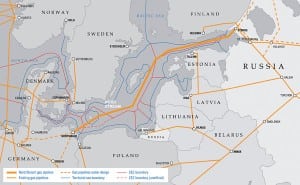
For years, tensions have been brewing between Russia, which provides about a quarter of the natural gas consumed in the European Union (EU), and neighboring Ukraine, a country through which 80% of those exports travel via pipeline.
-
 Business
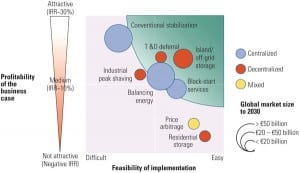
Getting Bulk Storage Projects Built
Unpredictable periods of operation are one of the disadvantages of wind and solar technologies. If there were an economic means of storing the energy from the time of production to the time of demand, the value of renewable energy sources would greatly increase. Here are some ideas for how to bridge that gap.
-
 Gas
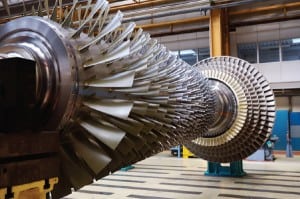
GasAs Small Gas Turbine Segment Grows, Alstom Launches E-Class Upgrade
Close on the heels of its recent upgrades of the GT26 and GT24 gas turbines for 50-Hertz and 60-Hertz power markets, Alstom in March launched its next-generation GT13E2 gas turbine, a medium-sized gas turbine of the 200-MW class.
-
Nuclear
Too Dumb to Meter: Follies, Fiascoes, Dead Ends, and Duds on the U.S. Road to Atomic Energy
The commercial development of nuclear power began immediately after the Second World War ended and the Manhattan Project secrets were released to the public. As the headline—also the title of a new book—implies, the development path was not always straight or even clearly marked. In this POWER exclusive, the first chapter of Too Dumb to Meter begins a serial presentation of the book.
-
 Gas
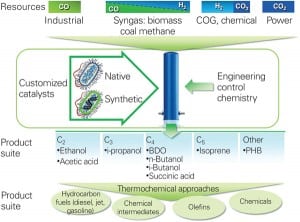
GasTechnology Converts Flue Gases to Jet Fuel
A new technology promises major advantages for coal-fired power plants, steel mills, and other industries that produce flue gases—and it could quell concerns about the increased use of arable land and food prices related to the production of ethanol.
-
 News
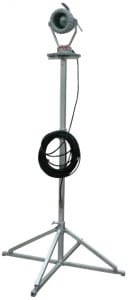
NewsExplosion-Proof Halogen Light
Magnalight.com announced the addition of the EPL-QP-1X150-100—a quad-pod mounted light tower designed to provide operators in hazardous locations with a powerful lighting solution—to its extensive line of explosion-proof lighting equipment. The portable tower and removable lamp assembly design of this tower provides versatile operating options, and a simple halogen lamp provides effective yet economical illumination. […]
-
 Water
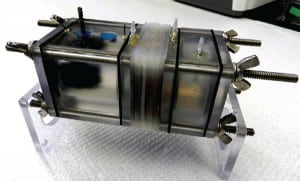
WaterTechnique Generates Salinity Gradient Power and Cleans Wastewater
Exploiting the difference in salt concentrations between the freshwater runoff from river mouths at the point where they meet saltwater reservoirs such as seas and oceans to harness power isn’t a new thing.
-
 News
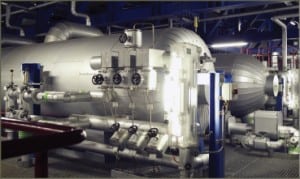
NewsNew Burner Management System
Siemens Industry Inc. introduced two new SIMATIC Burner Management Systems (BMS) to give end users greater flexibility to cost-effectively comply with revised 2011 burner standards. Designed with TUV-certified hardware and customizable software, the compact BMS300F and BMS151F systems comply with NFPA, IEC, and ANSI/ISA standards for single- or dual-fuel applications with single or multiple burners. […]
-
 News
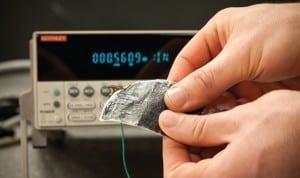
NewsPowered by Felt
It promises to be the most widely and easily distributed power generation technology to date: heat, captured in fabric. Work at Wake Forest University in North Carolina has led to the creation of a thermoelectric fabric called Power Felt that can turn theoretically any form of heat (body heat, waste heat from a car, or heat from any other source to which the material can be attached) into sufficient electrical current to help power devices or the systems the material is in contact with.
-
 News
NewsEasy-Use Spade Drill Bit
Spade drill bits are routinely used by electricians who do wiring and cabling, especially for drilling holes in wood for conduit runs. But traditional spade bits sometimes vibrate badly and dull after just a few uses. The new IDEAL Power-Spade spade bit helps eliminate these problems to provide an increased level of performance, whether the […]
-
Business
POWER Digest (May 2012)
Three South Korean Firms Opt for MHI’s J-Series Turbines. Japanese firms Marubeni Corp. and Mitsubishi Heavy Industries (MHI) on March 22 said they had been jointly awarded orders for three large-scale combined cycle electric power projects in Korea totaling 3,800 MW. The plants are the 950-MW 2nd Pyeongtaek Combined Cycle Power Plant, the 1,900-MW Dongducheon […]
-
Legal & Regulatory
Suing for (Pipeline) Safety
As a Valentine’s Day present to federal regulators, San Francisco City Attorney Dennis Herrera took the unusual step of suing the U.S. Pipeline and Hazardous Materials Safety Administration (PHMSA). The complaint alleges that the PHMSA has “abjectly failed to oversee the [California Public Utilities Commission’s (CPUC’s)] pipeline safety program or to ensure that federal pipeline safety standards are enforced.” The complaint chastises the PHMSA for “shirking that duty for over a decade, if not longer.”
-
 Water
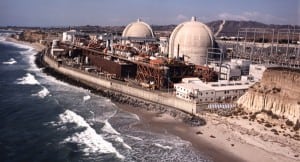
WaterClever “Helper” Tower Solves Cooling Water Dilemma
Gone are the days when ocean or river water for once-through cooling of a new power plant was assumed to be available. Today, more than 500 fossil-fueled and 38 nuclear plants use once-through cooling. However, regulators in several states are aggressively pushing what is essentially a ban on the use of once-through water cooling, forcing a conversion to closed-cycle cooling.
-
 News
NewsTechnology Trumps Policy
An energy policy should be the result of inclusive debate and a consensus approach to the means to leverage all of a country’s energy assets, including innovation and technology, to the advantage of its citizens. Current U.S. energy policy fails on all counts.
-
 Business
POWER Gets Social
Do you have professional insights to share with others in the industry—or questions for those with a particular expertise? Do you want to get news and information from POWER more than monthly or weekly? Then join POWER on these social media platforms.
-
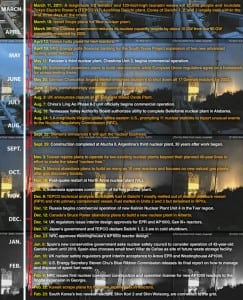 Nuclear
THE BIG PICTURE: Nuclear Aftershocks
In the year following the Fukushima accident in Japan, the nuclear sector has seen several setbacks (text in orange) as well as major milestones (white).
-
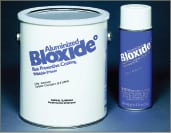 News
NewsRust-Preventative Weldable Primer
Tempil introduced BLOXIDE°, a rust-preventive weldable primer that provides protection from rust formation on edges prepared for welding. It also acts as an oxygen/oxide scavenger in the weld pool. This results in a clean X-ray quality weld. Steel sections having their prepared edges coated with BLOXIDE° can be stored outside in open yards for extended […]
-
 Nuclear
Less-Familiar Generation III+ Reactors Make Inroads
Following key regulatory approvals in the UK and U.S. of Westinghouse’s AP1000 and AREVA’s EPR Generation III+ reactor designs, France’s nuclear safety authority in February determined that the little-known ATMEA 1 reactor design met international safety criteria for Generation III+ reactors. The reactor is a 1,100-MW pressurized water reactor (PWR) developed and marketed by ATMEA, a 2007-created joint venture between France’s AREVA and Japan’s Mitsubishi Heavy Industries (MHI).
-
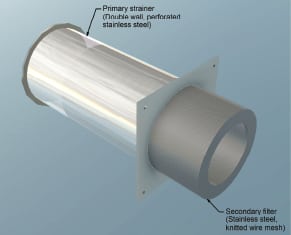 News
NewsPatented Filter Medium for Core Cooling
Multi-disciplined engineering and consulting firm ENERCON received patents for a filter medium for strainers used in nuclear reactor emergency core cooling systems (ECCS). ENERCON’s Debris Bypass Eliminator was developed in response to the Nuclear Regulatory Commission’s Generic Safety Issue, GSI-191, “Assessment of Debris Accumulation on PWR Sump Performance.” During long-term recirculation for cooling of the […]