The rapid growth of data centers in recent years is increasingly causing angst among power operators. Power industry leaders want assurances that the electric grid is reliable, protected, and sustainable for businesses and the public alike.
Underscoring the growth of data centers, the International Energy Agency (IEA) issued a report in November 2025 stating that global investment in data centers was expected to reach $580 billion by the end of 2025, $40 billion more than worldwide spending on new oil supplies.
COMMENTARY
That growth has led to challenges as the worldwide demand to build and operate data centers has forced some regions hosting these facilities to experience infrastructure bottlenecks and increased risks to electrical grid reliability. In response to this issue, an IEEE SA Industry Connections group recently released “Review of Industry Efforts and Standards of Grid Readiness For Data Center Deployment.”
And while challenges to the overall reliability of the grid are not abating any time soon, there are some key solutions that could be implemented to serve power professionals for years to come.
Challenges Abound
There are a host of global, technical, and related challenges currently impacting grid operators. Grid operators are encountering sudden loss of up to nearly 2 GW of load in response to everyday faults on the grid across North America and Europe, and dynamic stability issues such as forced and subsynchronous oscillations.

Data center operating patterns may result in very fast ramps—rapid load changes—seldom experienced with more conventional commercial and industrial loads. As a result, grid operators are forced to meet those load demands within 20 or 30 seconds, rather than over several minutes or hours. Grid operators have typically not had to manage the grid with loads that operate that fast.
The loads to satisfy artificial intelligence (AI) demand can also induce oscillations, which are swings in power flow, voltage, or frequency caused by imbalances between generation and demand. Among other issues, this can cause consumers’ lights to flicker and potentially damage generators.
Reliably serving data center demands is a global issue, but its urgency is increasingly forcing the stakeholders to deal with on a local level, by individual utilities and system operators. This leads to widely varying technical requirements across the world, but it remains unclear which solution is better than the other.

There is a lack of standards to guide the safe connection of data centers to the power grid and assure safe operation for all parties. There is no one-size-fits-all solution, forcing each application to be a custom project, at a considerable added cost. This lack of harmonized standards represents a significant obstacle to the safe evolution of the data center industry.
The report compiles an overview of many efforts by grid operators, utilities, industry trade groups and associations along with standard-setting bodies to develop technical requirements. These activities were then assessed by the authors and other industry experts to ascertain and prioritize the requirements for standards.
Recommendations
To address this lack of harmonized global standards, the report recommended that IEEE create several new standards for the coordination of data center design and operations with the power grid. Unified standards would allow for more modular data center designs that can contribute to grid reliability. The new standards that were recommended include:
High Priority:
- Definitions, scope, and terminology, including common definitions for data center load, load categories, and applicability thresholds.
- Standard for Data Center Performance Requirements and Interoperability
- Standard for Data Center Interconnection Process and Data Requirements
- Standard for Data Center Modeling in Power System Studies
Medium Priority:
- Certification and Testing Framework for Validating Data Center Performance
- Standard for the Coordination of Co-Located Generation Facilities and Data Center Facilities
- Data center flexibility requirements and definitions
Lower Priority:
- A Chips-to-Grid Framework and Strategy for Considering Grid Requirements in All Aspects of Data Center Design
Searching for Solutions
The first solution may seem obvious, but it often gets overlooked. It is critical for power systems operators to communicate with data center owners and operators to forge some meaningful fixes. Only when these groups are talking can they consider technical implementations.
Numerous solutions are being proposed to enable data centers to meet these emerging performance requirements. These solutions span both hardware changes to modifying the software running in the data center.
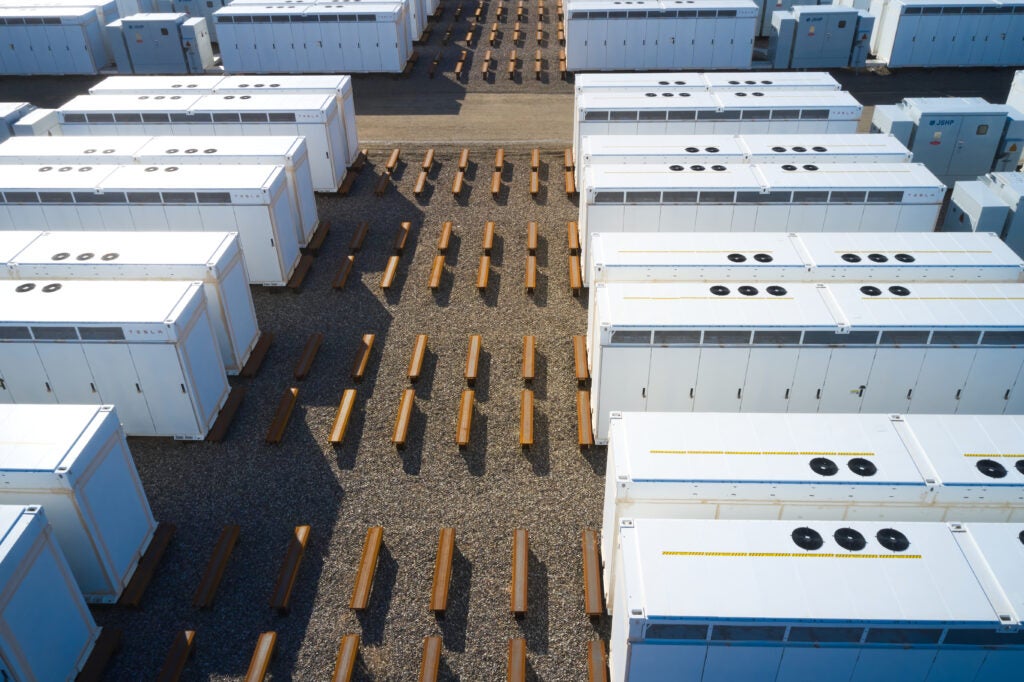
To meet emerging requirements such as voltage ride-through capabilities, equipment manufacturers are looking to battery energy storage as batteries can quickly inject and absorb power, allowing them to help balance the facilities demand. They can absorb power when the data center power demand drops during a ride-through event as the server hardware limits its power consumption to protect itself as the voltage falls and current increases. They can also inject and absorb power to stabilize fluctuations in the overall facilities power demand.
However, in addition to hardware solutions, there are also software-based solutions for managing fluctuating power demands that can lead to oscillations. In an effort to address power and thermal fluctuations, data center operators are increasingly seeking to modify software to improve operational efficiency.
A recent Google blog post addressed this issue noting, “Due to the high complexity and large scale of our data-center infrastructure, we posited that proactively shaping a workload’s power profile could be more efficient than simply adapting to it.”
The bottom line: There likely will not be a one-size-fits-all fix here. Instead, a basket of solutions will be deployed and developed over time. The space is continuing to evolve, and solutions will evolve alongside it.
Getting Involved
The growth of new data center facilities has been accelerating to keep pace with our ever-increasing digital society and has been particularly driven by the computational needs of artificial intelligence applications.
To learn more about the program and how to join the “Data Centers: Standards Needs Analysis and Recommendations” activity, one can complete the Data Centers: Standards Needs Analysis and Recommendations interest form.
—Veronika Rabl is chair and Eric Meier is vice chair of the IEEE SA Industry Connections group “Data Centers: Standards Needs Analysis and Recommendations.”