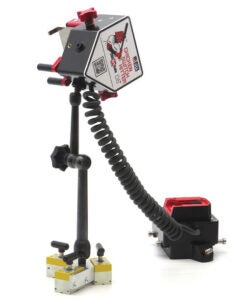
Courtesy: CBS ArcSafe
Chicken Switch Hitter
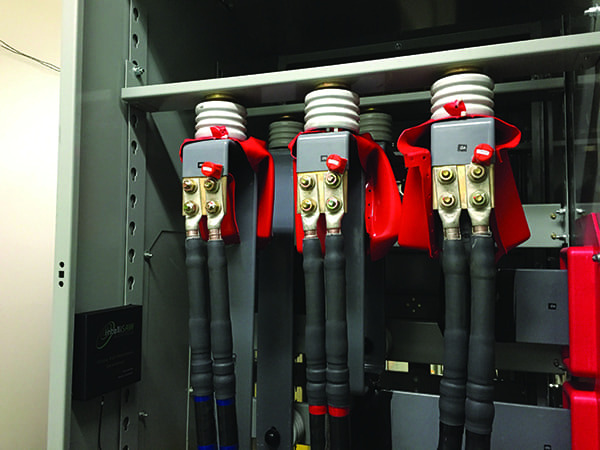
CBS ArcSafe, a leading manufacturer of remote racking and switching solutions for low- and medium-voltage switchgear, introduced the RSK-CSH-W Chicken Switch Hitter (Figure 1), a wireless remote switching kit designed to offer broad compatibility with single and dual pushbutton applications and breaker control switches. The solution operates pushbutton applications that are spaced 3 inches or less center-to-center and require less than 10 pounds of push force, and breaker control switches with pistol grip handles such as the Electroswitch Series 24/24P and GE SB-1. This versatility allows operators to safely complete multiple switching tasks with a single tool from up to 100 feet away, well outside the arc flash boundary.
The system attaches magnetically to switchgear without requiring modifications or equipment downtime. An integrated laser alignment system ensures precise positioning, while the motorized actuator and dual-adjustable linear actuators ensure reliable operation across various equipment setups. The Chicken Switch Hitter’s design ensures compatibility with various equipment types, such as insulated case circuit breakers, air circuit breakers, vacuum circuit breakers, and motor control centers, from manufacturers including ABB, Eaton, General Electric, Schneider Electric, Siemens, and Square D. It offers standardized remote switching for facilities with diverse electrical equipment. (cbsarcsafe.com)
AI-Powered Vegetation Management Platform
Bloom Spatial announced its vegetation management platform (Figure 2), the first system designed by and for electric cooperative utility vegetation managers. The product was developed in partnership with South Central Indiana Rural Electric Membership Cooperative (SCI-REMC), a 30,000-member electric co-op headquartered in Martinsville, Indiana. The platform addresses co-ops’ unique vegetation management challenges with technology that’s powerful yet practical for field teams. The platform combines remote sensing data, such as satellite, aerial, light detection and ranging (LiDAR), and others, with operational data from the utility to yield actionable insights for co-op operators.
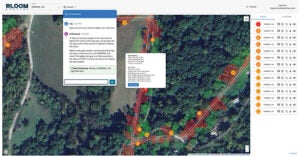
Courtesy: Bloom Spatial
Bloom Spatial also introduced the vegetation management industry’s first spatial large language model (LLM) chatbot. System vegetation managers can simply ask questions in plain language: “Which span is the most critical?” or “Show me areas where we’ve deferred maintenance beyond our cycle,” and receive instant, map-based answers with actionable insights. No geographic information system (GIS) expertise or complex queries required.

In This Issue
Full issueDeveloped collaboratively with SCI-REMC’s vegetation management team, Bloom Spatial reflects actual co-op needs rather than theoretical requirements. The platform handles rural service territories’ unique challenges—scattered tree densities, long cycle requirements, contractor coordination, and budget constraints that differ significantly from investor-owned utility conditions. Bloom Spatial offers tiered pricing based on service territory size and miles of line, with special consortium pricing for regional co-op alliances sharing services. Implementation includes training for vegetation management personnel and integration with existing systems. (bloomspatial.com)
Drone Platform Enhanced
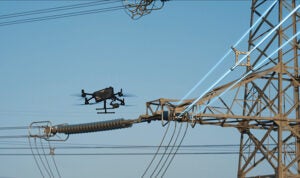
DJI, the global leader in civil drones (Figure 3) and creative camera technology, introduced DJI Matrice 400 as the company’s new enterprise flagship drone platform. It boasts an impressive 59-minute flight time, a payload capacity of up to 6 kilograms, and a powerful LiDAR and mmWave radar-based obstacle sensing system. Meanwhile, the O4 Enterprise Enhanced Video Transmission and Airborne Relay Video Transmission ensure safer handling and easier operations. Designed for versatility, DJI Matrice 400 can aid power line inspections and large-scale mapping, engineering, and construction.
The powerful obstacle sensing system enables Matrice 400 to avoid buildings and mountains while flying up to 25 meters per second. Equipped with LiDAR, mm-Wave radar, and full-color low-light fisheye vision sensors, it can also avoid smaller objects like high-voltage power lines on a mountain range at night. Its fusion positioning system also allows it to fly stably close to glass facade buildings or wind turbine blades and safely return from scenes like the top of a building or mountain bases—even when the return point has not been updated. (dji.com)