The global surge in energy demand is spurring investment in several sectors, and is bringing renewed interest in areas such as geothermal. The world’s literal hot spots—places such as Iceland, Indonesia, Kenya, and part of the U.S.—are seeing new projects, often as part of testing of advanced technologies such as enhanced geothermal systems (EGS). The U.S. Energy Information Administration in a recent report noted that the first large-scale commercial EGS in the U.S. is expected online in June. Fervo Energy’s Cape Station is a 500-MW, multi-phase development located in Beaver County, Utah.
Rystad Energy, a renewable energy research firm, recently said global investment in geothermal could reach nearly $9 billion by 2030, up from about $1.4 billion in 2020. New technologies, including closed-loop and advanced geothermal systems (AGS), super-hot rock geothermal, and advanced drilling and sensor technology, are being deployed, with much of the innovation tied to reducing costs and improving real-time monitoring of geothermal resources and output.
Geothermal is hardly new—people have been tapping into the energy provided by hot springs and the Earth’s heat for centuries—but these new technologies are enabling geothermal to be utilized in more places, and in more ways. The example of Iceland, which long has used geothermal to provide the country’s energy and heat its homes, is spreading elsewhere, particularly across Europe as more areas are looking at thermal networks.
Charlotte Adams, CEO of the UK-headquartered National Geothermal Centre (NGC), told POWER, “Geothermal energy provides a continuous, controllable, and secure source of low-carbon energy. It delivers water at stable temperatures, which leads to predictable energy supply and an ability to set secure pricing. For geothermal heat developments, the benefits can be realized locally. Geothermal energy installations generally have very low visual impact. For nations that rely on fossil fuel imports as part of their energy mix, developing in-country geothermal resources can massively increase energy security.”
 |
|
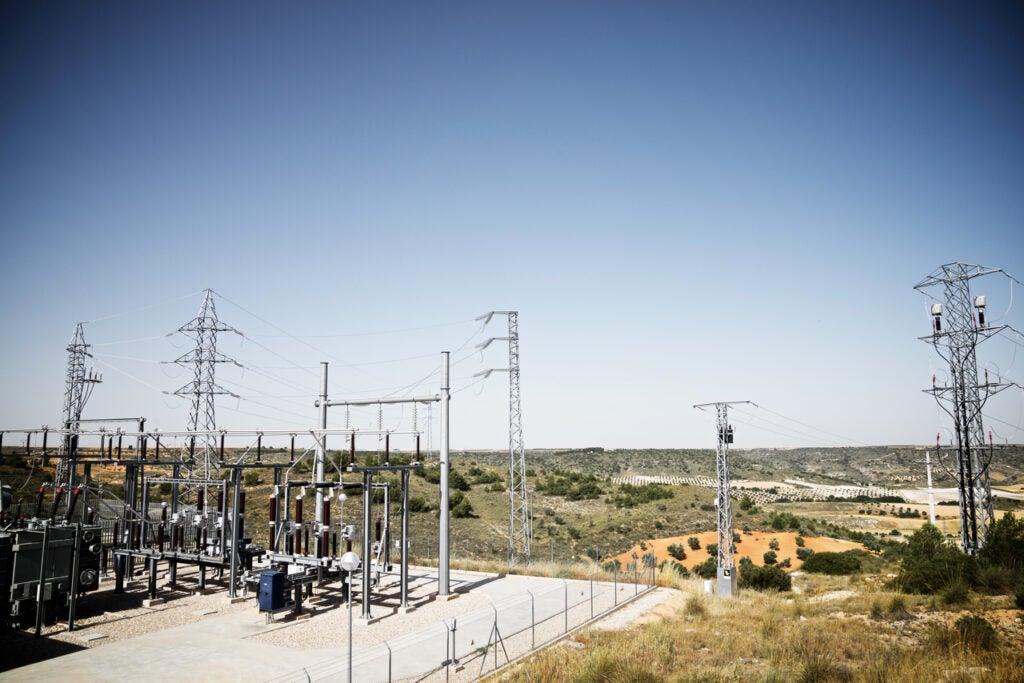
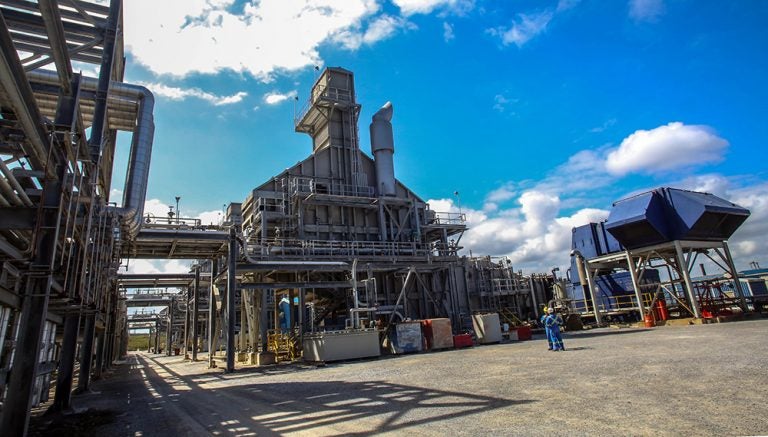
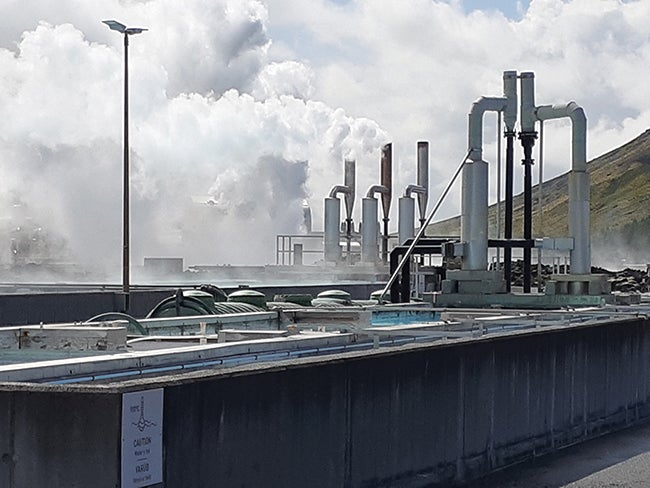
1. This is some of the equipment at the Svartsengi power station in Iceland, which provides hot water for the district heating system of the entire Reykjanes Peninsula, as well as the famous Blue Lagoon spa. Svartsengi is considered one of the most important heating plants in Iceland. It is connected to the wider Icelandic electrical grid through Reykjavík. Source: POWER/Darrell Proctor |
Global Energy Monitor (GEM) in a recent report said some 35 countries or territories are either building or planning geothermal projects. The group lists 10 countries that account for 94% of operating global geothermal capacity. In order of most capacity, they are the U.S., Indonesia, the Philippines, Turkey, New Zealand, Mexico, Italy, Kenya, Iceland (Figure 1), and Japan. GEM has said that just more than 16 GW of geothermal capacity is operating globally, and about 15.2 GW of that total comes from the top 10 countries. GEM said those new technologies are enabling geothermal exploration outside of the historical areas, with new markets including the UK, Laos, Slovakia, and even the Caribbean island of Dominica.
Gary Wong, Global Segment Leader of Power, Utilities, and Infrastructure at AVEVA, listed the advantages of geothermal power. “Geothermal energy is sustainable and less affected by fluctuations in weather compared to other renewable sources like solar and wind. [Geothermal] provides a continuous source of energy, unlike solar and wind, which depend on weather conditions,” said Wong, who told POWER that low emissions are another plus for geothermal. “Geothermal power plants emit significantly less greenhouse gas compared to fossil fuel plants … geothermal power plants require less land compared to many solar and wind farms.”
Andrada Pantelimon, Innovation Analyst with Rose Rock Bridge, a venture studio that helps industries meet innovation and sustainability goals, told POWER: “Where geothermal resources are viable, they offer a distinct proposition: firm, dispatchable power with very low lifecycle emissions and no fuel-price exposure. Unlike fossil generation, geothermal does not require ongoing fuel procurement and is therefore less exposed to commodity volatility and supply disruptions. It also provides steady output that can complement variable renewables and reduce the amount of backup capacity needed for reliability.
“From an environmental performance standpoint, lifecycle greenhouse-gas emissions for geothermal electricity are generally far below coal and natural gas on a gCO2 e/kWh [grams of carbon dioxide equivalent per kilowatt-hour] basis, although site-specific outcomes vary, notably depending on reservoir chemistry and whether non-condensable gases are vented or abated,” said Pantelimon. “This makes geothermal particularly relevant for power systems pursuing emissions reductions while still needing around-the-clock capacity. The main economic tradeoff is upfront capital intensity and execution risk, especially outside well-characterized hydrothermal provinces.”
Pantelimon added that “two factors improve the economic case for geothermal energy. First, simple levelized cost of energy [LCOE] comparisons can be misleading: fossil fuel plant LCOE typically excludes ongoing fuel procurement, transportation, and storage infrastructure costs, while geothermal LCOE is all-inclusive, covering wellfield development, plant construction, and operations. Second, cost-reduction efforts are underway. [The U.S. Department of Energy’s (DOE’s)] Enhanced Geothermal Shot targets EGS costs of $45/MWh by 2035, aiming to make geothermal broadly competitive as firm clean power.”
Recent announcements of new U.S.-based projects include Google’s long-term agreement with Ormat Technologies to provide geothermal for Google data centers in Nevada. The companies said the deal could bring 150 MW of geothermal under a special tariff program; Ormat said it is developing a portfolio of geothermal installations across Nevada that will come online between 2028 and 2030 in support of Google.
 |
|
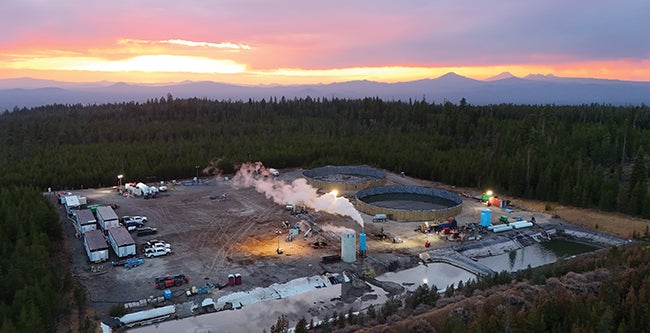
2. Mazama Energy’s SuperHot Rock geothermal project site is located on the western flank of Newberry Volcano in Oregon. Courtesy: Mazama Energy |
Texas-based Mazama Energy is advancing a next-generation SuperHot Rock enhanced geothermal system (SHR EGS) on the western flank of Newberry Volcano in Oregon (Figure 2). In 2025, the Newberry field pilot reached bottomhole temperatures of about 331C (629F) and demonstrated engineered reservoir connectivity, with circulation established between an injection well and a nearby production well as part of the EGS configuration.
“Mazama’s development plan at Newberry is phased, moving from pilot-scale validation toward commercial power,” said Pete Lumley, communications director for Mazama Energy. “The 2026 program includes field validation work on supercritical CO2 drilling and planning for a deeper, higher-temperature well targeting SuperHot conditions above 400C (752F). The drilling and stimulation campaign starts with an observation well in Q2 [second quarter] 2026, followed by an injector in Q3 and a producer in Q4, with permitting progressing in parallel. The horizontal injector-producer well pair is designed to support roughly 15 to 20 MWe net power, serving as the foundation toward a larger 200-MW class development at the site.”
The Colorado Energy Office in February awarded the town of Vail a $1.78-million geothermal energy tax credit for a $6-million project at the Vail Public Library. The library’s geothermal system will connect to a bore field, and waste-heat loop, at Dobson Ice Arena, in the first part of a three-phase plan to meet Vail’s goal of reducing its carbon emissions by 80% by 2050.
Italy-based Vallourec, which provides premium tubular solutions for the energy industry, and XGS Energy, a developer of next-generation geothermal systems, in late January announced a strategic supply chain partnership, as part of XGS’s 3-GW pipeline of commercial geothermal projects across the western U.S. XGS is starting construction this year on a 150-MW project with technology company Meta in New Mexico. Lucy Darago, chief commercial officer at XGS, told POWER the $1.2-billion project “will power Meta’s data center operations through the PNM utility grid. For a state with only 15 MW of geothermal capacity operating today, the project will expand the state’s geothermal capacity tenfold and support Meta’s rapidly growing data center operations.” Darago said “the two-phased 150-MW agreement will include an initial smaller phase and a second, larger phase, both projected to be operational by 2030.”
Geoffrey Garrison, vice president of Operations at Quaise Energy, said his company “is actively developing Project Obsidian in Oregon, the world’s first superhot geothermal power plant. The area has been continuously studied for decades, with superhot geothermal temperatures relatively close to the surface. Project Obsidian is currently undergoing several phases of construction and development before moving into power plant construction and operation. We expect the facility to be fully operational and generating power [eventual output would be 250 MW] for the local grid by 2030. Building geothermal energy facilities in Oregon can help reduce consumer energy costs by lowering long-term electricity prices, increasing system reliability, and stabilizing fuel prices.
“We will drill the wells using a combination of conventional and millimeter wave drilling,” said Garrison. “Our millimeter wave drilling technology uses high-power microwaves to ablate the toughest basement rocks, where mechanical drill bits struggle. Project Obsidian is paving the path for superhot geothermal development worldwide.”
Advancements, and to a large extent investments, in geothermal technology are being driven by the oil and gas industry. The DOE during the Biden administration updated its “Wells of Opportunity” initiative that directs funds to retrofit abandoned oil and gas wells to produce geothermal energy. Oil and gas companies have recognized that they can participate in producing cleaner, renewable energy by leveraging existing drilling practices, technologies, and infrastructure to tap into subsurface heat for electricity and direct use.
Mark Brasher, a partner in Energy & Infrastructure Projects at Vinson & Elkins, agreed that future growth in geothermal power will be tied to investments and technology advancements from the oil and gas sector. “Oil and gas industry participation is critical. The obvious contributions are rigs, directional-drilling capability, and subsurface and midstream expertise,” said Brasher. “But the harder-to-replicate value is what sits behind those capabilities: balance sheets large enough to underwrite performance, institutional risk-management frameworks, and established relationships with the infrastructure investors and lenders whose capital geothermal needs. While the exact terms on which oil and gas companies—and specifically oilfield service providers—participate are still taking shape, we certainly expect some of the industry’s better-known names to emerge as central players.”
“Skills and expertise from the oil and gas sector are pivotal to advancing geothermal, particularly for deep geothermal projects,” said NGC’s Adams. “There is extensive technical overlap, for example in exploration, drilling, and reservoir management. Embedding these skills sets in geothermal projects can save money and time. In addition, there is a further opportunity in repurposing redundant or declining oil and gas infrastructure. Operating offshore and onshore oil and gas wells produce increasing amounts of hot water as oil production recedes. If hot enough, this production water can be used to generate electricity on the platform to offset fossil fuel consumption associated with powering the platform. Onshore produced hot water can be used for heating, [such as] to supply a heat network. Onshore disused wells can be converted to provide geothermal energy either by retrofitting them with a single pipe-in-pipe heat exchanger or using them as part of a doublet if more than one well is available or by drilling additional wells if necessary. They can then be used to provide heat to meet local demands.”
Stephen Empedocles, CEO at Clark Street Associates, an advisory firm specializing in securing government funding and strategic partnerships for hard tech companies, told POWER: “Support from the oil and gas sector is highly important for accelerating geothermal deployment, as it can bring technical skills that enable scaling quickly. Because geothermal relies heavily on deep drilling, subsurface modeling, reservoir management, and more, the overlap with the oil and gas industry gives it an advantage, enabling it to leverage those industries’ skills to excel. In practical terms, we drill for geothermal the same way we drill for oil and gas, using similar equipment, engineering expertise, and supply chains.”
Empedocles added, “Federal programs have intermittently reflected the importance of this overlap. One past initiative is the DOE’s GEODE [Geothermal Energy from Oil and Gas Demonstrated Engineering], which is a great example of how to leverage the oil and gas sector’s knowledge, technology, skills, and experience to overcome geothermal deployment barriers. Specifically, they’ve reinforced this approach with a $165 million GEODE grant to leverage the oil and gas industry’s more than 100 years of drilling and subsurface engineering experience to address cost, risk, and technical uncertainty in geothermal development. Programs like this that draw on knowledge from other sectors should be implemented more in the future, as the opportunity going forward is not to reinvent these tools but to more intentionally deploy them at scale in support of geothermal commercialization.”
Support from the oil and gas industry is “huge because the oil and gas industry can leverage more than a century of investment, innovation, and infrastructure in accessing energy underground,” said Garrison. “We are bringing that tradition into the 21st century, using the same tools, equipment, and workforce to extract heat, rather than hydrocarbons, meaning subsurface energy is no longer limited by sparse structural and stratigraphic anomalies. Nabors Industries, one of the world’s largest operators of drilling rigs, is one of Quaise’s strategic investors—other geothermal companies count oil and gas firms among their largest investors.”
The Trump administration in December of last year approved an $8.6-million grant that will help Eversource Energy expand the nation’s first utility-led geothermal heating and cooling network in the U.S. Northeast. European countries are the clear leaders when it comes to such initiatives; the European Geothermal Energy Council, or EGEC, has said more than 400 geothermal district heating networks were in service in 2024, with Germany and France leading much of the development. The European Union (EU) Renewable Energy Directive and Energy Efficiency Directive have supported geothermal as a way to decarbonize the EU’s heating sector. The EGEC, as well as the European Technology & Innovation Platform on Geothermal (ETIP-Geothermal), are promoting investment and research into geothermal, looking at ways to grow geothermal adoption while reducing costs and risks.
 |
|
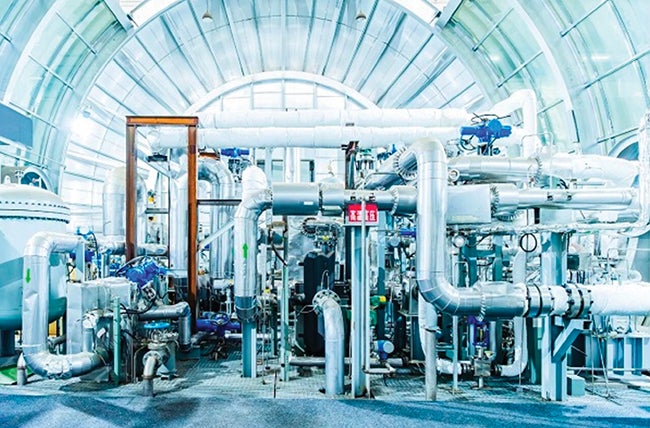
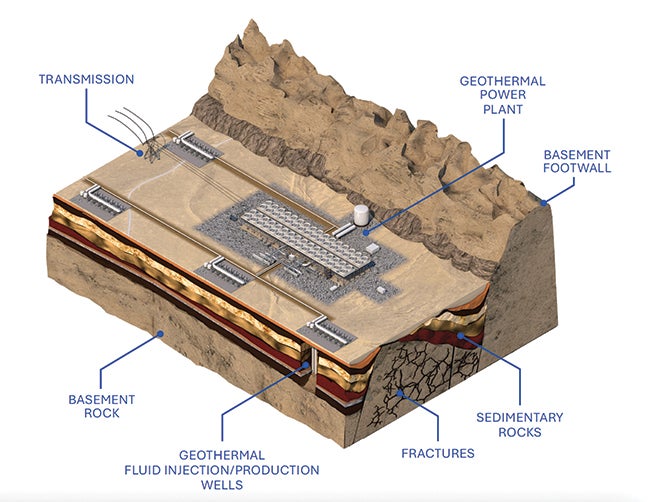
3. This diagram shows the layout of a geothermal power plant. Courtesy: Burns & McDonnell |
Tisha Scroggin-Wicker, director of the New Energy Solutions Group at Burns & McDonnell, told POWER: “In the quest for reliable, 24/7 baseload power, geothermal energy presents a compelling alternative to fossil fuels, and here’s why: First, in today’s market, the surface power generation equipment for a geothermal power facility [Figure 3] often boasts shorter lead times than those of a traditional natural gas combined cycle project. This is a significant advantage in a world with rapidly growing electricity demand, driven by data centers and other heavy load users who value speed to market over anything else.
“Second, geothermal power appears to be a ‘future-proof’ energy source. In an era of evolving energy policies and clean energy mandates, geothermal’s low carbon intensity provides a stable, long-term solution that is less susceptible to future regulatory changes. It’s a way to build a resilient power supply for generations to come, regardless of the political environment,” said Scroggin-Wicker. “Finally, and closely tied to the points above, geothermal is fuel-free. A geothermal plant is insulated from the volatility of global fuel markets and the geopolitical challenges associated with sourcing, refining, and transporting fossil fuels. It’s a source of clean, homegrown energy that provides energy independence, and it’s located right beneath our feet. Or to be more specific, between 10,000 and 20,000 feet below our feet.”
Maksim Sonin of Stanford University’s Center for Fuels of the Future told POWER, “Geothermal is great, yet situational. Here, a key factor for project development is subsurface risk. Unlike gas turbines or nuclear, which we design to operate for at least 20 years, geothermal plants deal with extreme temperatures and pressures, and still need to be tested over the long run. I see geothermal as a promising addition to the power mix, rather than something that will become mainstream anytime soon.”
Said Sonin, “I’ve come across a few ambitious early-stage plans to use geothermal for the downstream part of ammonia synthesis in remote places like Alaska. But again, in combination with another source of power.” Sonin added, “Geothermal is now part of a bigger trend that also includes geologic hydrogen. It creates certain synergies and helps both endeavors.”
Those who spoke with POWER said government support is important for geothermal, whether in the U.S. or globally. “Geothermal energy is already a globally mature industry, unlike other advanced energy sources currently under development,” said Garrison. “What geothermal needs from the government is fewer barriers. Too often, fossil fuels face fewer regulations and benefit from more government incentives. Geothermal should benefit from similar policies currently applied to fossil fuels.”
Garrison told POWER, “Governments can play a critical role in supporting geothermal by de-risking early-stage development, where subsurface uncertainty, long permitting timelines, and high upfront capital costs deter private investment despite strong long-term value. This can include funding exploration and demonstration projects, offering loan guarantees or insurance against drilling failure, streamlining permitting across agencies, and investing in shared infrastructure such as transmission, roads, and data.”
Vikram Rao, executive director at the Research Triangle Energy Consortium and an advisor to RTI International, an independent scientific research group, said government support could take several forms. “Governments ought to consider how they can facilitate the scaling of geothermal systems, and the policy and other means could differ by country,” said Rao. “A feature in common would be streamlining the permit process. Another would be the provision of loan guarantees or other means of accelerating construction. A further one would be the construction of power lines in the event the selected locations are remote from power grids.”
Rao also told POWER geothermal could be deployed at brownfield sites, as a new way of supplying electricity at a location that already has transmission infrastructure. “Geothermal systems have a relatively small footprint on the surface. Accordingly, they are suited to being the substitute energy source at sites of decommissioned coal power plants,” said Rao. “Governments could facilitate this process.”
—Darrell Proctor is a senior editor for POWER.