
Environmental
-
 Legal & Regulatory
Environmental Group Alleges TVA Coal Ash Pollution Is Leaking Into River
The Southern Environmental Law Center (SELC) informed the Tennessee Valley Authority (TVA) on Nov. 10 that it intends to bring suit under the Clean Water Act to stop the release of coal ash pollutants it says are leaking from the TVA’s Gallatin coal ash ponds into the Cumberland River. Gallatin Fossil Plant is a four-unit […]
-
 Renewables
IEA: 40% of World’s Power Fleet Will Need to Be Replaced by 2040
Events over the past year—turmoil in the oil-rich Middle East and the Russian-Ukraine gas crisis—along with uncertainty for nuclear power and pervading energy poverty worldwide show that the energy system is “under stress,” the International Energy Agency (IEA) says in its freshly released World Energy Outlook 2014 (WEO-2014). Despite technology and efficiency improvements, without actions […]
-
 Renewables
U.S. and China Agree to Increase Nationwide Carbon Reduction Targets
Reaching an unexpected climate breakthrough, the U.S. and China in a joint statement on Wednesday each announced new targets to slash carbon dioxide emissions by 2030. President Barack Obama set a new target to cut U.S. carbon emissions between 26% and 28% below 2005 levels by 2025. Chinese leader Xi Jinping, meanwhile, said his country […]
-
 O&M
O&MPoint Level Capacitance Switch for Fly Ash Hopper Measurement
If you’re the person tasked with controlling the level of fly ash in collection hoppers, you know how difficult the application can be. What at first looks like a simple measurement quickly proves to be much more demanding in actual execution. The first problem is the environment inside the collection hoppers, which is extremely challenging […]
-
 Legal & Regulatory
Nuclear Plants on the Edge Could Benefit from Clean Power Plan
A couple of recently released reports offer some hope for the future of nuclear power plants operating on the fringe of profitability. Moody’s Investors Service suggests that the U.S. Environmental Protection Agency’s (EPA’s) Clean Power Plan “could increase the value of nuclear power as a non-carbon emitting generation source.” In its report, “Environmental Mandates and […]
-
 Renewables
B&W to Spin Off Power Generation from Nuclear Business
On Nov. 5, The Babcock & Wilcox Co. (B&W) announced that its board of directors has unanimously approved a plan for the tax-free spin-off of the company’s power generation business to B&W’s shareholders, in the process forming two independently traded companies. In its third-quarter earnings call the following day, company executives emphasized that the two […]
-
Renewables
Ontario’s Long Term Energy Plan in Action
The decision to eliminate coal-fired power plants and the implementation of an aggressive feed-in tariff program puts Ontario’s electricity system in the spotlight. Download a pdf of this sponsored report, written by Global Business Reports: GBR_ONTARIO_PWR_1114_sm
-
 Legal & Regulatory
China’s War on Air Pollution
China has been battling—and losing—a “war” on air pollution for years. Stepping up its efforts, the country recently issued new policy measures, tougher even than those in the U.S. and European Union, that could have big implications for its coal power sector. Reports that heavy smog has blanketed large swathes of China’s provinces have become […]
-
 Coal
CoalPlant Washington Coal Project Gets Permit Extension [Updated]
Plant Washington, a planned $2.1 billion, single-unit, 850-MW supercritical coal plant that a consortium of generators has been trying to build near Sandersville in east-central Georgia, was given an 18-month air permit extension by the Georgia Environmental Protection Division (EPD) on Oct. 15. The Plant Washington project has been in development since 2006. The company […]
-
 Coal
CoalKemper County IGCC Project Costs Soar to $6.1B
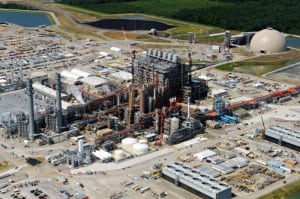
Cost estimates for the Kemper County Integrated Coal Gasification Combined Cycle project (IGCC) have surged another $330 million since August, mostly owing to delays that have shifted the plant’s in-service date to the first half of 2016. Plant owner Mississippi Power’s latest monthly report submitted to the Mississippi Public Service Commission shows that the project’s total […]
-
 Legal & Regulatory
EPA Releases Additional Information on Clean Power Plan
The U.S. Environmental Protection Agency (EPA) has released a notice of data availability (NODA)—making additional information and ideas available for public comment—and it has also proposed carbon goals for areas in Indian Country and U.S. territories. Janet McCabe, acting assistant administrator for the EPA’s Office of Air and Radiation, explained the two actions related to […]
-
 Legal & Regulatory
D.C. Circuit Greenlights CSAPR
The U.S. Court of Appeals for the District of Columbia Circuit ruled on Oct. 23 that the EPA can move forward with implementation of the Cross-State Air Pollution Rule (CSAPR) following the April ruling from the Supreme Court upholding most of the rule. The D.C. Circuit had previously voided the rule in December 2011, but […]
-
 Legal & Regulatory
EC Agrees on 2030 Climate and Energy Policy Framework
Meeting in Brussels, Belgium, Oct. 23–24, the European Council (EC) agreed on the 2030 climate and energy policy framework for the European Union (EU), calling on all countries to come forward with ambitious targets and policies. The EC endorsed a binding EU target of at least a 40% reduction in domestic greenhouse gas emissions by […]
-
 Environmental
CRS: Compliance Costs for EPA’s Revised Ozone Standard Are Unknown
Compliance cost estimates for a revised ozone national ambient air quality standard (NAAQS) soon to be proposed by the Environmental Protection Agency (EPA) “will be little better than guesses,” the Congressional Research Service (CRS) says in a recent document. The NAAQS does not directly impose emission controls on industry, “but it sets in motion a process […]
-
Gas
Beyond Common Sense
The Sierra Club’s frequently silly “Beyond Natural Gas” campaign just got a whole lot sillier. Last week, the New Jersey chapter put out the claim that repowering an old coal- and oil-fired power plant in Cape May with natural gas would hurt area reliability. If that sounds like an odd statement from an environmental group, […]
-
 Legal & Regulatory
Collusion Alleged Between EPA and NRDC
Republicans on the Senate Environment and Public Works (EPW) Committee released emails between top officials at the U.S. Environmental Protection Agency (EPA) and the Natural Resources Defense Council (NRDC), which they say demonstrate a “very close working relationship” between the two organizations. The emails are associated with the development of the EPA’s proposed carbon rule, […]
-
 Environmental
Energy Efficiency Is Second-Largest Power Resource in Pacific Northwest
The Northwest Power and Conservation Council (NPCC) reports that energy efficiency is the second-largest power resource in the Pacific Northwest region, ranking only behind hydroelectricity. The NPCC—authorized through the Northwest Power Act to develop and maintain a regional power plan, and fish and wildlife program, to balance the Northwest’s environment and energy needs—bases the claim […]
-
Legal & Regulatory
Supreme Court Rejects Review of EPA’s Ozone NAAQS
The U.S. Supreme Court on Monday declined to take up industry’s challenge to a federal court ruling that upheld the Bush administration’s air quality standard for ozone. The high court’s denial leaves intact the D.C. Circuit’s July 2013 decision upholding the Environmental Protection Agency’s (EPA’s) last revision of its National Ambient Air Quality Standards (NAAQS) […]
-
 Coal
CoalAEP Seeks Guarantees to Ensure Economic Viability of Ohio Fleet
American Electric Power’s (AEP’s) Ohio unit has asked the state’s Public Utilities Commission for permission to essentially charge customers for costs to operate nine unregulated coal-fired units, a move the company says will address market volatility and ensure the economic viability of Ohio’s generation. AEP Ohio on Oct. 3 proposed an “expanded” power purchase agreement […]
-
 Legal & Regulatory
World’s First Post-Combustion CCS Coal Unit Online in Canada
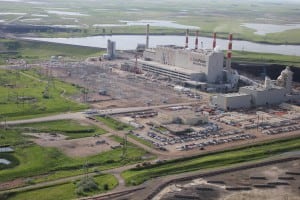
The first full-scale commercial post-combustion carbon capture and sequestration (CCS) project at an operating coal-fired power plant is now online in Estevan, Saskatchewan, roughly 10 miles north of the U.S. border. The heart of the $1.4 billion project at Boundary Dam Power Station is the rebuilt 110-MW Unit 3, originally commissioned in 1970. The project, […]
-
 Gas
GasNERC’s Polar Vortex Review Bares Natural Gas Dependency, Equipment Vulnerabilities
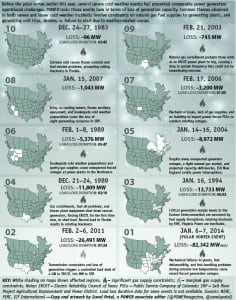
Despite record low temperatures and widespread generation outages during the polar vortex, bulk power system reliability was maintained, says the North American Electric Reliability Corp. (NERC) in a newly released analysis of the extreme cold weather event that engulfed most of the nation this January. The Jan. 6–7, 2014, weather condition that resulted in temperatures […]
-
 Infographics
THE BIG PICTURE [INFOGRAPHIC]: A Generation Freeze
Before the polar vortex earlier this year, several severe cold weather events had presented comparable power generation operational challenges. POWER ranks those events here in terms of loss of generation capacity. Common themes observed in both severe and lesser cold weather incidents involve constraints on natural gas fuel supplies to generating plants, and generating unit […]
-
 Legal & Regulatory
A U.S. Power Industry Regulatory Update
The U.S. power sector has seen a number of developments on the regulatory front in recent months. Here’s where major federal rules stand today. (For a more dynamic and graphic version of this article, see http://powermag.com/long-form-stories/bw-power/ .) GHG Rules New Power Plants. The Environmental Protection Agency (EPA) in September 2013 revised a 2012 proposal to […]
-
Commentary
Collaborating to Build a Cleaner Energy Infrastructure
Kelly Speakes-Backman Every day there is increasing evidence that we need to accelerate our nation’s transition to a cleaner energy infrastructure. The American Climate Prospectus released by the Risky
-
 Coal
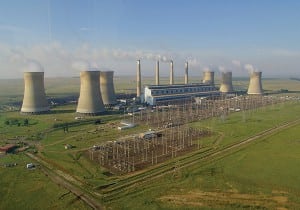
CoalCamden Power Station, Mpumalanga Province, South Africa
Eskom, South Africa’s largest utility, was established in 1923 as the Electricity Supply Commission and was converted into a public company, wholly owned by the government, in July 2002. Eskom produces about
-
 Coal
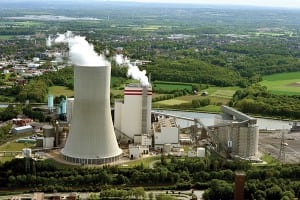
CoalTrianel Coal Power Plant Lünen, North Rhine-Westphalia, Germany
Germany’s energy transition— Energiewende —has made a lot of headlines. Whether you agree with the country’s energy policy or not, there is no denying that it has spurred the growth of renewables. Even
-
 O&M
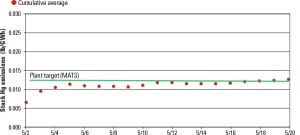
O&MNon-Carbon Reagent Injection for MATS Compliance
The upcoming implementation of the Environmental Protection Agency’s (EPA’s) Mercury and Air Toxics Standards (MATS) is putting pressure on coal-fired power plants to develop and implement compliance
-
 Hydro
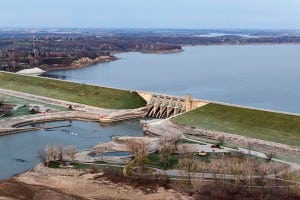
HydroA New Day for North American Hydropower?
Can hydropower get some love? Even fans of renewable energy can be forgiven for having forgotten about a resource that—up to now—has produced more electricity than wind, solar, biomass, and all other
-
 Coal
CoalPoland Mulls Energy Future
Resource-rich Poland’s push to prioritize coal as its main energy source and to cultivate a nuclear power program to boost energy security at the expense of climate objectives has provoked its portrayal
-
 Renewables
New Carbon Targets, Other Measures Proclaimed at UN Climate Summit
Several countries and companies at the United Nations (UN) Climate Summit 2014 in New York City pledged action to address climate change by slashing carbon emissions, mobilizing funding, or putting a price on carbon. The one-day event on Tuesday was designed to raise political momentum and spur transformative action ahead of COP 21, the December […]