
Articles By

-
News
Cliffside Settlement Legally Binds Duke to Shutter 1,600 MW of Coal Capacity
A settlement reached between Duke Energy and conservation groups on Tuesday legally binds the North Carolina–based utility to shutter 1,667 MW of coal-fired capacity from aging plants and tighten pollution controls at the new 825-MW pulverized coal unit that is scheduled to come online this year at its Cliffside Steam Station on the Rutherford/Cleveland County line in North Carolina.
-
News
Vestas Institutes Reorganization, Braces for Wind Market Slowdown
Vestas, the world’s largest wind turbine manufacturer, plans to lay off 2,355 employees (about 10% of its workforce), reduce its fixed costs by more than €150 million ($192 million), reorganize management, and close one of its 26 factories in preparation for a potential slowdown in the U.S. wind market in case the production tax credit is not extended at the end of 2012, the Danish firm said on Thursday.
-
News
TVA to Lease John Sevier Gas Plant to Help Complete Bellefonte
A lease-purchase transaction for a new combined cycle plant in Rogersville, Tenn., completed by the Tennessee Valley Authority (TVA) on Tuesday could provide the U.S. government–owned corporation $1 billion in financing to support completion of the 1,260-MW Bellefonte Nuclear Plant in Hollywood, Ala., by 2020.
-
News
EDF Withdraws Opposition to Exelon-Constellation Merger
Électricité de France (EDF), Constellation Energy’s partner in five nuclear plants on three sites in Maryland and New York and a 7.2% owner of Constellation shares, on Tuesday withdrew its opposition to a $7.9 billion merger between Baltimore-based Constellation and Chicago-based Exelon Corp. The French company said it had reached an agreement with Exelon to protect the “operational autonomy” of the Constellation Energy Nuclear Group (CENG).
-
News
DOE Reports: Tides, Waves Could Generate 15% of Nation’s Power by 2030
Two reports assessing wave and tidal resources in the U.S. released today by the Department of Energy (DOE) suggest that water power—including conventional hydropower and wave, tidal, and other resources—could provide 15% of the nation’s electricity by 2030.
-
General
Climate and the Wandering Albatross
By Kennedy Maize Washington, D.C., January 12, 2012 — The ancient English idiom “It’s an ill wind that blows no good” takes on specificity following an article in tomorrow’s Science magazine. The article argues that increased winds in the Southern Ocean, likely caused by a changing global climate, are a boon to the wandering […]
-
News
FERC, NARUC Launch Forum on Reliability, Environment
The Federal Energy Regulatory Commission (FERC) and the National Association of Regulatory Utility Commissioners (NARUC), an organization representing state public service commissioners, joined forces to launch a forum to explore reliability issues that could crop up as a result of new and pending environmental rules for the power sector.
-
News
Report: Utilities Major Force Behind Energy Efficiency Savings
A new report published by the Institute for Electric Efficiency (IEE) finds that electric energy efficiency savings are on the rise in the U.S.—and that electric utilities accounted for a vast majority of ratepayer-funded electric efficiency expenditures in 2010.
-
News
Distribution Companies Sue Vermont Yankee for Curtailed Power After Cooling Tower Collapse
Two of Vermont’s largest power distribution companies on Monday filed suit against Entergy Vermont Yankee, owner of the aging 620-MW Vermont Yankee Nuclear Plant in Vernon, Vt., alleging that Entergy’s faulty maintenance of cooling towers at the plant in 2007 and 2008 had cost them $6.6 million in increased power costs and lost capacity payments.
-
News
BPA Asks FERC to Rehear Order on Power Curtailment Practices
The Bonneville Power Administration (BPA) on Friday asked the Federal Energy Regulatory Commission (FERC) for a rehearing of a decision it made last December, when it ruled the Pacific Northwest–based federal agency discriminated against wind generators after the BPA curtailed wind power when high river flows hit the region last May and June.
-
News
Japan to Limit Reactor Operating Age to 40 Years
New policy on nuclear safety regulation could limit the operational life of Japanese nuclear plants to 40 years and require operators to prepare for severe accidents, Japan’s government announced on Friday. If the new law is passed, at least 13 plants, as well as the six Fukushima Daiichi reactors, will be shut down per the […]
-
News
Myanmar Halts Construction of 4-GW Coal Plant on Environmental Worries
Myanmar’s government on Monday cancelled construction of a 4,000-MW coal-fired power plant proposed by Thai company Italian-Thai Development on public concerns about the plant’s environmental impact.
-
News
DOE Launches New Power Sector Cybersecurity Initiative
The newest initiative to protect the nation’s power grid from cyber attacks is the “Electric Sector Cybersecurity Risk Management Maturity” project, led by the U.S. Department of Energy (DOE) and Department of Homeland Security (DHS). The project is expected to leverage the insight of private and public sector grid experts and build on existing cybersecurity measures and strategies.
-
News
Federal Court Blocks Implementation of CSAPR
The U.S. Court of Appeals for the District of Columbia Circuit temporarily blocked the Cross-State Air Pollution Rule (CSAPR) just two days before it was set to go into effect. The federal court ordered the Environmental Protection Agency (EPA) to continue administering the previously promulgated Clean Air Interstate Rule (CAIR) until a final decision can be made on the merits of the rule, likely this summer or fall.
-
News
AES New York Subsidiary Declares Bankruptcy on Coal Woes
An AES Corp. subsidiary that owns more than 1,000 MW of coal-fired capacity at six facilities in New York last week filed for Chapter 11 bankruptcy protection, citing falling power prices and heightened costs from compliance with environmental regulations.
-
News
Mass. Supreme Judicial Court Affirms Cape Wind–National Grid PPA
The Massachusetts Supreme Judicial Court (SJC) last week upheld a decision by the state’s Department of Public Utilities (DPU) that a Power Purchase Agreement (PPA) between Cape Wind and utility National Grid would be a cost-effective use of ratepayer money. The decision means Cape Wind is closer to building North America’s first offshore wind farm.
-
News
Sunbury to Shutter Five Coal Units, Make Switch to Gas
Pennsylvania’s Sunbury Generation, a company that owns the Shamokin Dam plant—the nation’s oldest coal-fired power plant—last week reportedly said it would close five of its six coal-fired generation units and replace them with two natural gas–fired turbines by 2015. The company cited stricter regulations on power plant emissions.
-
News
DOI Approves Renewable Projects in Calif., Ore.
The Department of the Interior (DOI) on Thursday approved a 275-MW solar plant in California and a 104-MW wind farm in Oregon that will be built on private lands and use power lines that cross public lands to connect to their respective grids. The projects are the 26th and 27th renewable projects approved by the DOI in the past two years.
-
News
BPA to Begin Construction of Six 500-kV Lines at Grand Coulee
The Bonneville Power Administration (BPA) plans to begin construction of six new 500-kV overhead transmission lines at the Grand Coulee Dam—the nation’s largest hydropower facility—next month, the public service organization said last week. The new lines will help ensure continued safe and reliable transmission of power between Grand Coulee Dam’s third power plant and the BPA’s vast high-voltage power grid.
-
News
PJM Rings in New Year with Two New Grid Systems
PJM Interconnection on Sunday began operational control of the transmission systems of Duke Energy Ohio and Duke Energy Kentucky, both subsidiaries of Duke Energy, and began administering open, competitive wholesale electricity markets in those areas, the regional grid operator said on Jan 1.
-
Coal
Editors Select Top Five Stories of 2011
The POWER editorial staff’s picks for the most significant stories of 2011.
-
Coal
Australia Levies Landmark Carbon Tax
After more than a decade debating whether to pass a carbon-limiting law, Australia’s Senate in November voted in a landmark bill that will impose a price on carbon emissions. The country, which accounts for just 1.5% of global carbon emissions, but which is the world’s highest emitter per capita because 80% of its power comes […]
-
 News
NewsA Wireless Cellular Controller
Xenon has introduced the T925 Wireless Cellular Controller for connecting remote sites with central control and monitoring stations through cellular networks. A T925 remote communications network eliminates the need to make hardwired Ethernet connections to the Internet or an intranet at each remote site and the central control and monitoring station. The network operates from […]
-
Solar
The U.S. Military Gets Smart Grid
At home and abroad, U.S. military microgrid and smart grid projects are driven by energy security concerns. The pace of such projects, however, can be slow, and the potential for civilian grids to benefit from lessons learned and technologies developed for these important installations may be limited.
-
 Nuclear
NRC to Implement Lessons Learned from Fukushima
The U.S. Nuclear Regulatory Commission (NRC) in October directed staff to begin implementing seven safety recommendations put forth by the federal body’s Near-Term Task Force on lessons learned from the nuclear accident at Tokyo Electric Power Co.’s Daiichi power plant in Japan’s Fukushima prefecture last March. The recommendations affecting all 104 nuclear reactors (Figure 1) […]
-
 News
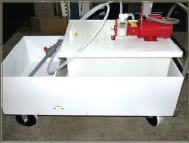
NewsNonmetallic Pump/Tank Carts Caustics, Acids
A new nonmetallic Mobile Pump/Tank Cart from Vanton Pump and Equipment Corp. transfers wastewater and caustic/acidic chemicals with no corrosion and ultrapure fluids with no contamination. All fluid contact surfaces of the tank, base plate, and secondary containment chamber are of solid polypropylene, polyethylene, PVC, or other inert thermoplastic, precluding corrosion across the entire pH […]
-
 Gas
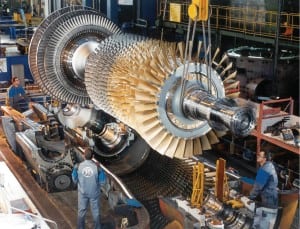
GasGE Uses Steel Mill Gases to Power Turbine
The world’s steel industry is power-hungry. Using energy both to supply heat and power for plant operations and as a raw material for the production of blast furnace coke, the sector uses a major fraction of the world’s total energy consumption. China’s steel and iron sectors have been mushrooming on the back of skyrocketing demand, […]
-
 News
NewsUniversal Voltmeter Kit
HDE’s newly launched DVM-80UVK Universal Voltmeter Kit expands features of the DVM-80 series voltmeter and includes several accessories that enable voltmeter and phasing operations for virtually all overhead and underground applications. HDE is offering the kit as a complete, ready-to-use universal voltmeter package. It includes a dual-stick phasing voltmeter with overhead hook probes for use […]
-
 Business
PJM Completes Unique Dual-Primary Control Centers
Swift technology developments in the power sector and increasingly sophisticated security threats have prompted regional transmission organization PJM Interconnection to switch from its aging centrally dispatched legacy system to two “state-of-the-art” primary control centers as part of its $200 million Advanced Control Center (AC2) program. The grid operator that serves parts of the Eastern Interconnection […]
-
 News
NewsV-Return Style Conveyor Belt Tracking System
ASGCO, a manufacturer of proprietary bulk conveyor components and accessories, announced a new addition to its line of Tru-Trainer conveyor belt tracking idlers: a V-Return style of the company’s Dual Return Tru-Trainer Conveyor Belt Tracker. Tru-Trainer idlers react as the conveyor belt moves off center, maintaining the belt’s original position, minimizing belt wear and conveyor […]