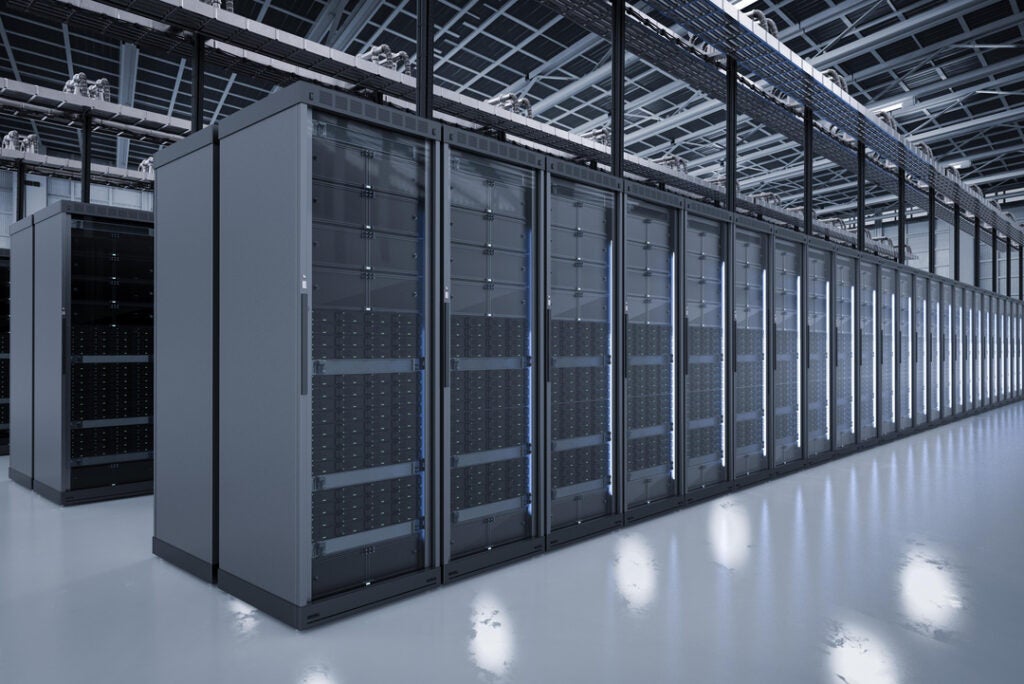
Power demand in the U.S. is rising faster than the grid was designed to accommodate, driven in large part by rapid growth in data centers. Large, concentrated data center loads are clustering in regions where grid capacity is already constrained, placing pressure on interconnection timelines and system operations. While grid expansion is often framed as a question of building new generation and transmission, an equally important constraint is how quickly the grid can connect and utilize available power. The speed at which power can be delivered to new demand has become a defining challenge.
Recent planning studies illustrate the scale of this issue. The U.S. Department of Energy’s 2024 National Transmission Planning Study estimates that transmission capacity may need to expand by roughly two to three times 2020 levels by 2050 to support reliability and demand growth, with even greater expansion required under higher decarbonization scenarios. At the same time, analysis from Americans for a Clean Energy Grid indicates that annual transmission build rates remain well below identified needs. The gap is particularly visible in major data center hubs, where long interconnection queues and congestion can delay when new load is served, even where generation capacity exists.
AI as an Accelerant for Grid Planning
These constraints are beginning to ease due to the emergence of artificial intelligence (AI). AI does not make electrons move faster, but it can reduce the planning and operational friction that delays when power becomes usable. For data center–driven demand, one of the most immediate applications is in interconnection and system planning. In 2025, PJM Interconnection, the largest regional transmission organization (RTO) in the U.S., announced efforts to deploy AI-enabled tools to streamline interconnection studies and planning workflows, responding in part to the surge in large-load requests from data centers. Faster modeling and scenario analysis can shorten review cycles and improve visibility into where and when capacity can be delivered.
AI is also improving real-time grid operations in regions experiencing rapid load growth. According to research published by the Electric Power Research Institute (EPRI) between 2023 and 2024, AI-driven analytics can enhance congestion management, dispatch efficiency, and voltage and frequency control. For data center developers, improved operational visibility can translate into greater confidence around connection timelines and capacity availability.
Industry participants are beginning to test AI applications beyond modeling. Some utilities are deploying machine learning tools to identify congestion patterns earlier and prioritize network upgrades that unlock capacity for large loads. Grid operators are also exploring automated screening of interconnection requests to reduce manual review burdens and accelerate queue processing. These approaches do not eliminate complexity, but they can materially shorten decision cycles that historically extended over several years.
Closing the Timeline Gap for Data Center Developers
The impact is particularly relevant for data center developers, whose investment timelines are often measured in months rather than years. Misalignment between infrastructure readiness and development schedules can delay projects even when capital and demand are secure. AI-driven planning tools can provide earlier visibility into feasible connection pathways, allowing developers and utilities to coordinate infrastructure delivery more effectively and reduce costly redesigns.

In This Issue
Full issueLooking ahead, the role of AI is likely to expand from optimization toward coordination across the grid ecosystem. As electrification, digital infrastructure, and clean generation scale simultaneously, planning processes must integrate more variables than traditional workflows were designed to handle. AI can support this transition by enabling continuous scenario analysis rather than periodic study cycles, helping stakeholders move from reactive planning to adaptive planning.
Practical Barriers to Adoption
Despite the progress, practical limitations remain. Many AI applications still depend on data quality, system interoperability, and regulatory acceptance, all of which vary across regions. Grid operators must integrate new analytical tools into workflows designed for deterministic planning, which can slow adoption even when technical capability exists. There are also institutional challenges, including coordination across utilities, regulators, and developers, that technology alone cannot resolve. As a result, AI should be viewed as an enabler rather than a solution in isolation.
At the same time, momentum is building. Industry collaborations between technology companies, utilities, and grid operators are accelerating pilot deployments, particularly in regions experiencing rapid data center growth. These initiatives suggest that AI’s role will expand from improving individual studies to shaping continuous planning processes that evolve alongside demand. Over time, this shift could help align infrastructure development timelines more closely with the pace of digital and industrial expansion.
Reducing Friction in a Higher-Demand Environment
AI will not replace the need for physical infrastructure investment, but it can improve how quickly investment translates into usable capacity. In a higher demand environment, reducing friction between planning and deployment may be one of the most immediate ways to improve system responsiveness. As power demand continues to rise, the ability to accelerate how power reaches the grid may become just as important as expanding the grid itself.
—Suleiman Ibrahim is an MBA candidate at the University of North Carolina Kenan-Flagler Business School with prior professional experience in energy and infrastructure finance, focusing on power generation and capital structuring for large-scale energy projects.