 |
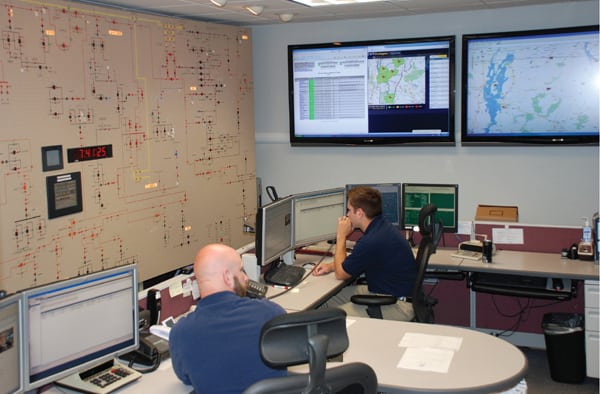
| Vermont Electric Cooperative System Operators Matt Anderson (foreground) and Craig Jewett monitor VEC’s smart grid. Courtesy: VEC |
A cooperative in northern Vermont serving a largely rural area has proven that even small utilities can achieve great smart grid results by planning wisely. For improving service to its members by developing a grid modernization strategy before “smart grid” was a buzz phrase, Vermont Electric Cooperative is the winner of the first POWER Smart Grid Award.
Most lists of top smart grid projects focus on large metropolitan areas, the highest number of smart meters installed, or the most smart grid technologies deployed at once. But a smarter, more robust grid is just as important to small population centers and rural areas. For example, given the distances between customers in largely rural service territories, smart grid technologies can be even more important for improving service restoration times than in urban service territories. In fact, improving outage management was a primary impetus behind the smart grid plans at Vermont Electric Cooperative (VEC).
VEC is a member-owned, not-for-profit cooperative founded in 1938 and Vermont’s third-largest electric distribution utility. From its headquarters in Johnson, it serves approximately 35,000 member-customers in 74 towns throughout more than 2,000 square miles of rural northern Vermont (Figure 1).
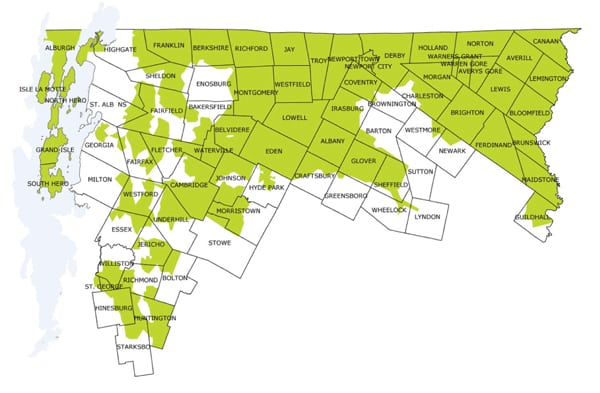 |
| 1. Challenging territory. Vermont Electric Cooperative was formed as part of the Rural Electrification Act of 1936. Its rural footprint, which includes serving island customers, presents cost challenges, which is one reason it has always been eager to adopt technologies that contain costs. Courtesy: VEC |
The co-op purchases power from a variety of generation sources. In 2011 the percentages are 56.76% from large hydro (some of it coming across the state’s northern border with Canada); 2.74% from small hydro; 17.51% from nuclear (Vermont Yankee); 15.64% from gas or oil; 3.60% from wind; 2.89% from wood; 0.85% from farm methane and solar; and none from coal. About 1.25% of the renewables come from customer-owned distributed generation, which is net metered.
Early Adopters
VEC began putting its grid modernization plan together in 2001—well before what would come to be known as smart grid projects were on the radar of even large utilities. Maybe you can ascribe the timing and strategy behind this utility’s plan to the legendary thriftiness of New Englanders, or the self-reliance that’s in the DNA of Vermonters, or the economic stake that co-op members have in their utility. In any case, VEC appears to have seen the potential for grid technology upgrades and pursued their implementation in a steady, smart way through four major steps, to date:
- Rolling out electronic meters and advanced metering infrastructure (AMI).
- Equipping field crews and operations control with a GPS-enabled outage management and mapping system (OMS), which eliminated the use of paper maps.
- Providing customers with web-based access to their energy usage information.
- Using a SCADA system for substation automation and connecting all substations to the control center with fiber backhaul.
The real work began in 2005, when—to improve service to its members—VEC began implementing a smart metering system and AMI technology. “We went with AMI before substation automation,” CEO David Hallquist told POWER, “because it’s the poor man’s SCADA and would have a greater immediate return on investment when coupled with the OMS.”
VEC was the first utility in Vermont to introduce AMI, and by 2009 it was in the top 1% of all U.S. utilities in terms of integrating AMI with an OMS. (See the table for a list of vendors.)
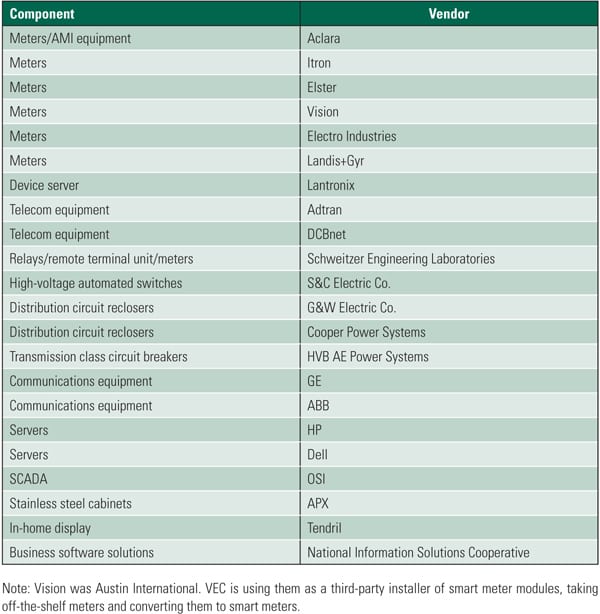 |
| Vendors involved in VEC’s smart grid projects. Source: VEC |
The new meters communicate with the utility using power line carrier (PLC) technology. Hallquist explained that PLC made sense because, although VEC does share the AT&T wireless cell phone network to obtain data from some, but not all substations, the cellular network is not reliable enough for the demands of the smart grid. “VEC is aggressively collaborating with telecommunications providers to replace that communications medium with fiber optic lines,” he wrote in a Jan. 18, 2011 letter to the editor of the Rutland Herald newspaper. In June, Hallquist noted that AT&T’s GSM network would be used for communicating with the final meters, to be installed by July 2012.
Unlike some other deployments of smart meters, VEC’s primary rationale for introducing meters equipped with bidirectional communication capabilities (the “smart” element) was to improve service, rather than change end user behavior right away. The smart meters were a prerequisite for introducing a new OMS, which was commissioned in February 2008.
Smart Meters: Just the Start of Service-Improvement Technologies
The OMS consists of a GPS system that is available to both the dispatch center and field crew team members via their laptops. That GPS system is linked to the smart meter information, which can show which addresses are without power.
Hallquist says that, “Prior to integrating the OMS with smart meters, it took at least 20 employees to manage a minor outage. Several would be answering calls and entering data while an equal number were running and sorting outage tickets to determine outage locations. The OMS system automated the process. The line crews all have laptops on their vehicles and are able to drive directly to the outage location. This also significantly reduced search time. In the past, the crews would be sent to a general map location and have to search. The system resulted in a 40% reduction in outage time (Customer Average Interruption Duration Index, or CAIDI).
“The OMS system also presents the outage causes in a report form so that the data can be used to improve system performance. VEC began to use the data to prioritize its work and investments by using the OMS data as part of a weekly root cause analysis meeting. VEC members saw significant reductions in outages since the implementation of the OMS. The average number of outages (the System Average Interruption Frequency Index, or SAIFI) was cut in half” (Figure 2).
 |
| 2. Cutting outages in half. Data from smart meters integrated with a new outage management system has enabled Vermont Electric Cooperative to cut outages in half. This chart shows a 12-month running average over the past six years for its System Average Interruption Frequency Index. Source: VEC |
VEC currently has the best outage performance of the major Vermont utilities, which is especially impressive because the others have a higher percentage of urban customers, who are easier to reach.
Next came substation upgrades. To date, approximately 60% have been modernized. By the end of 2012, all of VEC’s substations will be “smart,” thanks to intelligent electronic devices—including a substation local fiber loop that connects automated reclosers, smart regulators, intelligent breakers, and substation transformers that are reporting key parameters—and a SCADA system that will provide substation information to the operations control center, where it is monitored and controlled 24 hours a day.
Money spent on substation and line upgrades have shown “a great return,” Hallquist reported, even “on lines we never would have thought of before.” Operations now has data not only about outages but data that signals the threat of an outage so that proactive measures can be taken.
Yankee Ingenuity Gives Users Useful Information
Of course, once customers have a smart meter, there’s plenty of data available to the distribution utility, but that data—if converted into usable information—can be even more valuable to the energy users who pay the bills. That’s why VEC introduced its WattWATCHERS program at the May 2009 annual member meeting.
Using in-house staff, VEC developed software that would integrate with its TWACS Network Server from Aclara (which manages the AMI data) and enable members to view their usage details. The service was made available on the utility’s website (http://www.vermontelectric.coop).
Hallquist said that when the co-op began planning this interface in 2008, there were few vendors they could have turned to. One offered to develop the necessary software for about $2 million. Instead, VEC was able to develop the software with no external cost and minimal (less than $10,000) internal cost. Working part time, in additional to their regular responsibilities, VEC’s IT staff wrote the software between late 2008 and May 2009.
WattWATCHERS enables members to view their usage on an hourly, daily, or monthly basis. The time period can be selected depending on their analytical need. Usage information can be exported into a spreadsheet format for more detailed analysis. High usage limits can be set, and members can get text or email messages when that limit is exceeded. Members can also share their information on social networks like Facebook.
Since introducing WattWATCHERS, high-bill complaints have been dramatically reduced, because this tool helps members understand their usage better and can help identify the causes of high power consumption, such as a malfunctioning appliance. Improving consumers’ understanding of their electricity use by providing better information is one of the promises of smart metering technology, but it’s a promise that has not been fulfilled by all smart meter deployments.
Next Steps
VEC continues its leadership by engaging, along with eight other utilities of various sizes nationwide, in the first consumer behavior study approved and funded by the U.S. Department of Energy (DOE). The goal, according to the DOE, is to “examine the response of consumers to variable electricity prices, referred to as time-based rate programs in conjunction with the deployment of advanced metering infrastructure (AMI) and associate technology.”
VEC is also set to explore the flexibility afforded by demand response (DR). It will be the first utility in ISO New England to roll out a DR program based on creating capacity from home and business area network devices and is scheduled to begin (at the ISO’s request) in late 2012, to manage peak load. It will start with refrigeration units used by large and small commercial customers and with farm lighting—the “low-hanging fruit,” as Hallquist calls it—because those plug loads are already controllable.
In addition to ongoing improvements that include substation and line replacements, VEC is in the process of making transmission upgrades in support of a wind power project being developed by Green Mountain Power. The 63-MW Kingdom Community Wind project, to be located in the Lowell Mountains, is anticipated to cost $150 million and will use 21 3-MW Vestas turbines. Power generated by the project, expected to be online by the end of 2012, is projected to cost $0.092/kWh. Hallquist said he would be more concerned about adding this variable generation source to the grid—particularly given its potential effects on harmonics—if VEC didn’t have advanced metering and substation-monitoring technologies in place.
In addition to the large wind project, VEC’s grid includes many smaller wind, solar, and farm methane projects. Its smart grid technologies have helped VEC reduce the cost of interconnection for its consumers, particularly because no special telecommunication or equipment requirements are necessary for metering those distributed generation sources.
Costs and Benefits
What VEC calls its Smart Grid Outage Management and Web Presentment project cost a total of $15 million. Of that total, $5.2 million came in the form of an American Recovery and Reinvestment Act (ARRA) grant from the DOE. VEC has spent almost half of that grant, and Hallquist notes that only 4% is going toward administration, while 96% of the money is being spent directly on infrastructure improvements.
However, it bears repeating that VEC began investing in smart upgrades well before those funds were made available in 2009. In fact, VEC used ARRA funds to install only the last 20% of smart meters. The metering and OMS stage cost roughly $5.5 million; approximately $7 million went toward substation automation, SCADA system, and fiber backhaul components; and the balance was earmarked for customer behavior studies and the web interface.
The AMI/OMS system paid for itself in five years, partially as a result of reducing the number of meter readers needed. “However,” Hallquist explained in his January letter to the editor, “a very large component of the payback was reduced system losses as well as improvements in outage management” (see Figure 1). He told POWER, “None of us expected SAIFI to be down to 1.6, where it is today.”
Other benefits have been happy surprises. For example, in 2006, Hallquist said, the co-op was “almost at junk bond status.” In March of this year, Standard & Poor’s gave VEC an A- rating (up from BBB). “Our use of technology was cited as one of the reasons for the improvement,” Hallquist explained.
Sensible Messaging
One of the great temptations for vendors of smart grid technologies and the utilities introducing them is to promise too many benefits too fast. Though it is true that the benefits of a fully modernized, smarter grid will be many, utility customers are unlikely to directly experience—or appreciate—them all. Failing to deliver immediately on promised benefits (especially lower bills) has been one major cause of backlashes against smart grid projects.
VEC has taken a more cautious approach. “You’ve got to underpromise and overdeliver,” Hallquist explained. When VEC switched out its old analog meters, it referred to the new ones as “advanced” or “bidirectional” meters, rather than as “smart meters.” To be fair, it was easier for VEC to use these technically accurate terms exclusively because the figurative term “smart meter” was not yet part of the public lexicon in 2005.
VEC has also “been completely unscathed,” by data privacy concerns, according to Hallquist, largely because it was “ahead of the curve” in deploying electronic meters. Nevertheless, the co-op has developed a data privacy policy that is proving to be handy now that third parties are interested in customer data.
Similarly, the utility didn’t talk about the OMS until it was in place, which prevented prematurely raised expectations about what it could achieve. Operating it first in silent mode ensured that members would continue to call in if they experienced an outage. WattWATCHERS, too, was not touted until it was up and running.
To this day, VEC is not telling customers that its “smart grid” efforts will save them money. (VEC rates for industrial customers are among the lowest in the state, its commercial rates are average, and though the $0.18/kWh residential rate is about 10% higher than rates of other Vermont utilities, the gap is closing because VEC rates have been stable while other utilities’ rates are going up, according to Hallquist.) The system has paid for itself through operational savings, Hallquist points out, but he can’t be sure when members will see cost savings on their bills that are a direct consequence of the upgrade projects, so the utility is not making that claim.
Wise People
When asked whether it was easier or harder to implement all of these smart grid technologies because of VEC’s size and legal structure, Hallquist immediately responded, “It was much easier. We don’t have the levels of decision-making [larger, investor-owned utilities have], and we’re all hands-on.” Too many small utilities use their size as an excuse for sitting on the smart grid sidelines, in his opinion.
What’s more, noted Elizabeth Gamache, manager of corporate services, technology upgrades to reduce costs were favored by the member-owners, who directly benefit from any operational cost-savings. “Little did I realize,” said Gamache, who has been with VEC for just three years, “how remarkable the work was that was going on in rural Vermont. If smart grid can happen here, there’s no reason it can’t happen anywhere.”
Developing a smarter power grid requires more than “smart” technologies and smart people. It also requires wise people, like the member-customers, staff, and leadership of Vermont Electric Cooperative. POWER congratulates you for being early adopters of smart grid technologies, taking the long view, tackling smart grid projects in logical stages, and communicating effectively.
— Dr. Gail Reitenbach is POWER’s managing editor.