
For much of the 20th century, the U.S. set the global standard for civilian nuclear energy. American innovation shaped reactor design, safety culture, and regulatory practice worldwide. Yet today, as nuclear power regains prominence amid concerns over climate, energy security, and industrial competitiveness, America faces a quieter but more consequential challenge: the erosion of its nuclear fuel supply chain.
In the global nuclear marketplace, leadership is no longer defined solely by who designs or builds reactors. It increasingly depends on who can reliably provide the fuel services that sustain them over decades. On that front, America’s position has weakened while competitors have moved with purpose.
COMMENTARY
China and Russia approach nuclear energy as a fully integrated system. Their international offerings extend well beyond reactor construction to include fuel supply, processing, and long-term service arrangements. For countries investing in nuclear power. often making commitments that last half a century, such continuity is not a luxury; it is a prerequisite.
The U.S., by contrast, has often competed project by project, without a similarly cohesive approach to the broader fuel ecosystem. As a result, allies considering American reactor technologies frequently face uncertainty about long-term fuel availability and services. In a market that values predictability, that uncertainty matters.
This pattern should feel familiar.
In critical minerals, the U.S. learned that technological leadership without secure supply chains leaves the nation exposed to price volatility, geopolitical pressure, and strategic dependence. That recognition has driven recent efforts to rebuild domestic and allied capacity across mining, processing, and manufacturing.
Liquefied natural gas (LNG) offers another instructive parallel. America became a global LNG leader not merely through resource abundance, but by building the infrastructure and market conditions that allowed private investment to scale across the entire value chain. The result reshaped global energy markets and provided allies with reliable alternatives to coercive suppliers.
Nuclear energy now stands at a similar inflection point.
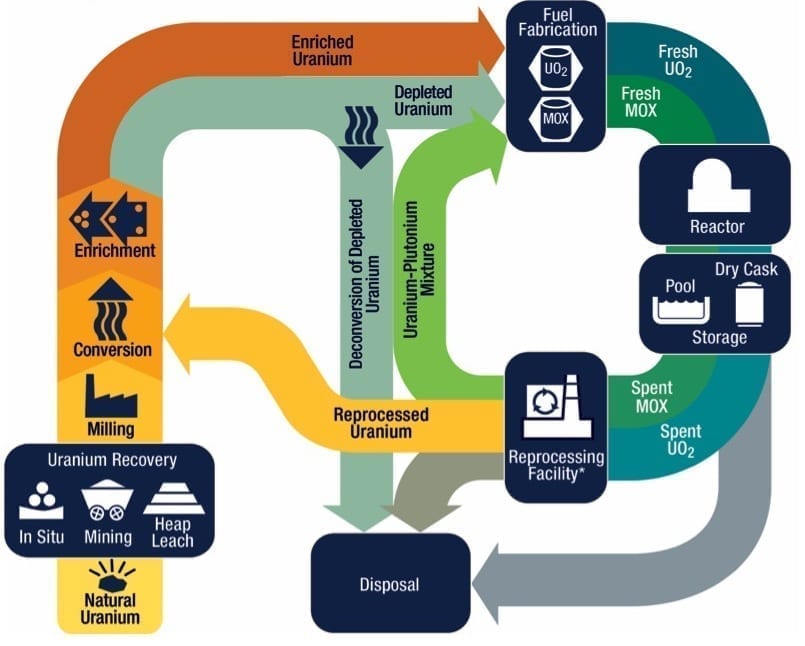
A durable nuclear future requires more than deploying advanced reactors. It depends on rebuilding and integrating the complete fuel supply chain: uranium mining, conversion, enrichment, fuel fabrication, and credible long-term fuel management, developed domestically and in close coordination with trusted partners. Without these foundations, even the most promising nuclear technologies will struggle to compete globally.
This need not come at the expense of nonproliferation or safety. In fact, the opposite is true. Strong, transparent fuel-cycle capabilities within aligned, well-regulated systems can reinforce global norms and reduce incentives for riskier alternatives. When responsible options are unavailable, countries do not abandon nuclear ambitions, they simply turn elsewhere.
The stakes are long-term. Nuclear partnerships shape energy systems, industrial development, and geopolitical alignment for generations. If the U.S. cannot offer a complete and reliable nuclear ecosystem, others will. And the strategic consequences will extend far beyond the energy sector.
Rebuilding the nuclear fuel supply chain does not require a radical departure from market principles. It calls for the same tools that have worked before: public-private coordination, clear long-term signals, allied cooperation, and a policy environment that enables investment while maintaining rigorous oversight.
The question facing the United States is not whether nuclear energy will play a role in the global energy transition. It is whether America will help define that future or allow others to do so.
In nuclear energy, leadership is ultimately measured not just by who builds the reactor, but by who stands behind it for the long term.
—Jeff Duncan is the Former Chairman of the U.S. House of Representatives’ Energy & Commerce Subcommittee on Energy. Rabbi Yechezkel Moskowitz is an energy investor and founder of Curio, a U.S.-based nuclear innovation firm.
- Generation IV reactors
- advanced nuclear
- Thorium fuel cycle
- Fuel conversion
- molten salt reactor
- Experimental reactors
- Shanghai Institute of Applied Physics (SINAP)
- Idaho National Laboratory
- Chinese Academy of Sciences (CAS)
- nuclear innovation
- Clean Core Thorium Energy
- Thorizon
- ThorCon International
- Copenhagen Atomics
- nuclear research