The Southwest Power Pool (SPP) said it has successfully expanded its service territory. The SPP’s expanded operations took effect on April 1, and the regional transmission organization, or RTO, is now aligned with the Western Interconnection of the U.S. power grid.
The expansion means SPP is the first RTO with services spanning two interconnections. Officials said the member organizations of the SPP will now “reap benefits from an operationally and geographically diverse integrated system.” SPP now serves a 732,000 square-mile region comprising all or part of 17 states, an area that is home to 20 million people.
The announcement comes after “months of intensive testing, simulation, and joint operational coordination with dozens of participating utilities,” according to SPP.
“SPP’s western expansion is a landmark milestone for our organization, our new members, and the broader energy industry,” said SPP President and CEO Lanny Nickell. “This is one of many bold steps we’re taking to deliver long-term value to more consumers.”
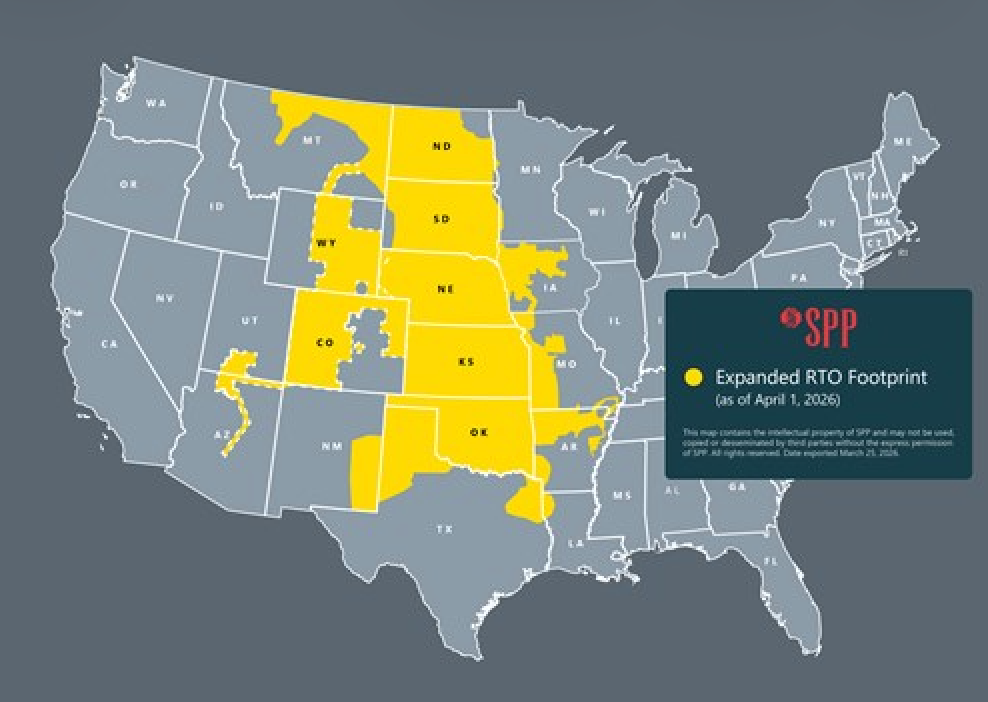
Nine load-serving utilities led the expansion. SPP’s service territory now includes resources and customers of numerous utilities in seven states, including Arizona, Colorado, Montana, Nebraska, New Mexico, Utah, and Wyoming. Those groups, as RTO members and participants in SPP’s wholesale market, will have access to a large portfolio of power generation resources, innovative planning services, and support in coordinating electric reliability.
The groups either joining or expanding their participation in the SPP RTO as of April 1 are:
- Basin Electric Power Cooperative
- Central Montana Electric Power
- City of Aztec, New Mexico
- City of Farmington, New Mexico
- City of Fountain, Colorado
- City of Page, Arizona
- City of Sidney, Nebraska
- Colorado Springs Utilities
- Delta-Montrose Electric Association
- Deseret Power Electric Cooperative
- Guzman Energy
- Kimball Wind
- La Plata Electric Association
- Los Alamos County
- Municipal Energy Agency of Nebraska
- Northwestern Energy
- Platte River Power Authority
- Tenaska Power Services Co.
- The Energy Authority
- Tri-State Generation and Transmission Association
- United Power
- Western Area Power Administration (WAPA) – Upper Great Plains region
- WAPA – Colorado River Storage Project region
- WAPA – Rocky Mountain region
- Warren Air Force Base
Duane Highley, CEO of Colorado-headquartered Tri-State Generation and Transmission, said “Tri-State Generation and Transmission Association is delighted to join SPP’s RTO in the West. This step strengthens the value we deliver, enhances reliability, and supports long-term cost savings for our members and the communities they serve.
“Tri-State and its members constantly look for ways to build long-term reliability and lower costs,” said Highley. “For Tri-State members, our participation in the SPP RTO’s western expansion is about building a more efficient, resilient and affordable energy future—one that delivers real value today and positions our communities well for decades to come.” Tri-State in a news release called the expansion “a foundational move that will provide better value, greater reliability and long-term savings to its members.”
Travas Deal, CEO of Colorado Springs Utilities, said, “Joining SPP’s expanded RTO allows us to coordinate across a larger geographic footprint, strengthen reliability and provide our customers the most cost-effective power. We can take full advantage of an increasingly diverse energy mix, providing long term value for customers while supporting future economic growth across the region.”
Jason Frisbie, general manager and CEO of Platte River Power Authority, another Colorado-based energy provider, said, “Actively participating in a fully organized energy market is the first and most significant element of our Resource Diversification Policy. We recognized early on that we could not achieve the noncarbon energy future our owner communities are asking for on our own. Joining the SPP RTO provides access to a much broader footprint of renewable resources while helping us maintain the reliability and affordability that our communities and their customers expect.”
—Darrell Proctor is a senior editor for POWER.