A Florida-based startup intends to build factory-produced nuclear systems designed to fit in shipping containers and run for 30 years without refueling. Here’s how the technology works—and where it stands.
The global appetite for electricity is surging. Data centers, industrial electrification, and perhaps a coming wave of humanoid robotics are layering exponential demand onto a grid that was never designed for it. Renewables alone can’t fill the gap, and conventional nuclear, with its decade-long construction timelines and ballooning budgets, moves too slowly. Into that opening steps AMPERA, a Palm Beach Gardens–headquartered company that emerged from stealth in November 2025 with a bold claim: it can manufacture compact, sealed nuclear energy systems the way factories produce industrial equipment, not the way utilities build power plants.
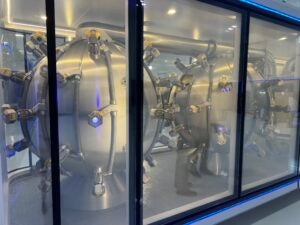
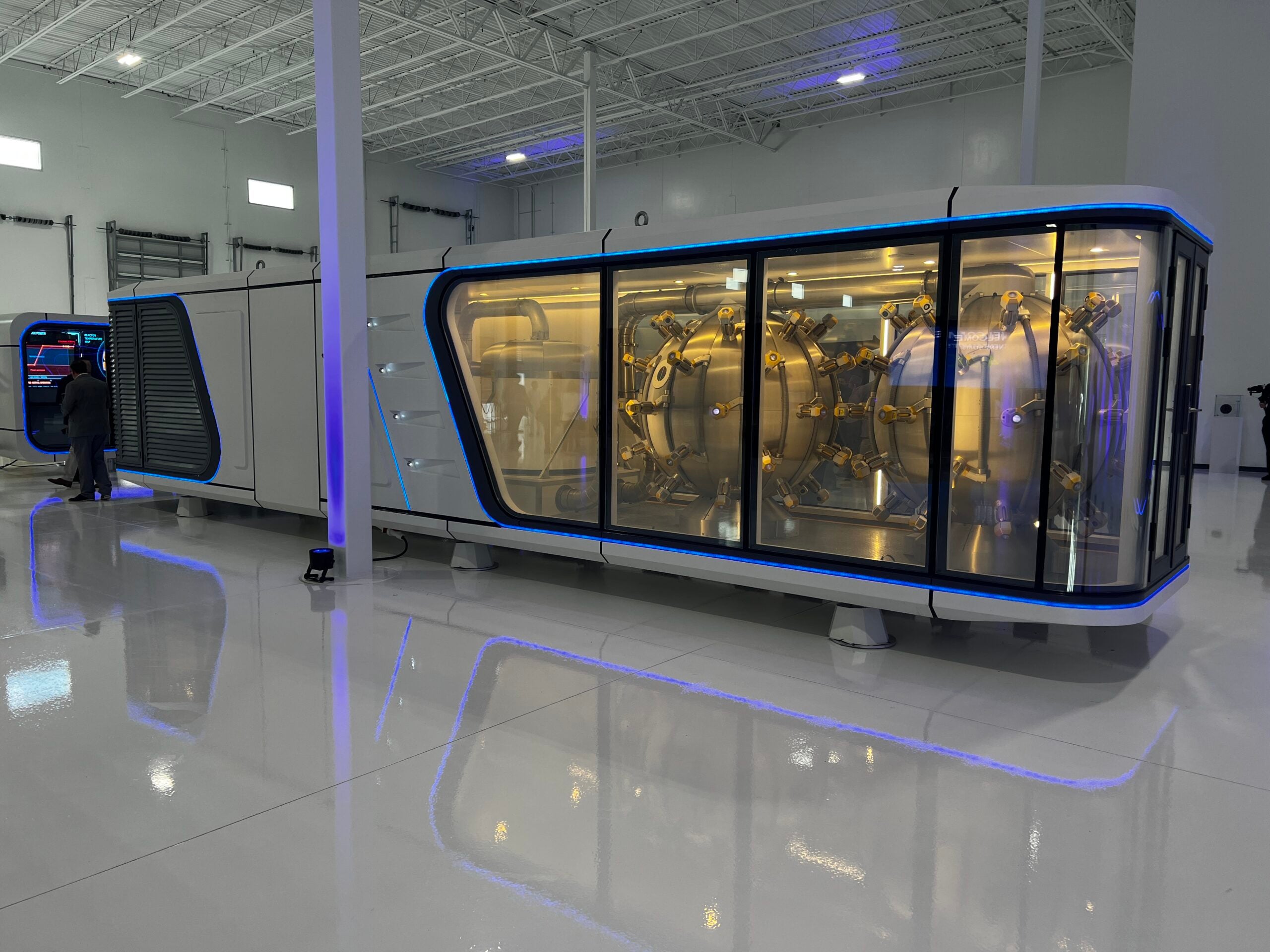
Founded and led by CEO Brian Matthews, AMPERA is developing what it calls a subcritical thorium breeder microreactor—a mouthful of a term that encodes several deliberate departures from mainstream nuclear engineering. The company has already built full-scale mock-ups of its containerized reactor system (Figure 1) and is actively engineering toward a non-fueled prototype by the end of 2026. Backed by a Fortune 500 global technology leader in artificial intelligence (AI), cloud, and data-center infrastructure, AMPERA is targeting three initial markets: data centers, defense, and maritime shipping.
A Different Kind of Reactor
Most nuclear reactors in operation today are critical systems, meaning the fission chain reaction is self-sustaining once initiated. AMPERA’s design takes a fundamentally different approach. Its reactor operates in a subcritical regime, meaning the core cannot sustain a chain reaction on its own. Instead, external neutron generators continuously supply the neutron flux needed to breed the thorium into uranium-233 and sustain fission within the core. Turn off the neutron generators, and the reactor shuts down.
Curtis St.Brice, AMPERA’s vice president and Chief Intellectual Property Counsel, put it plainly in an exclusive interview with POWER: the neutron generator is the trigger. If more power is needed, the neutron output increases. If the reactor needs to stop, the generators are switched off and the reaction ceases. There is no residual chain reaction to manage, no days-long transient to wait out before restarting.
This on-off capability is central to AMPERA’s value proposition. Matthews has emphasized that conventional critical reactors cannot offer this kind of responsiveness; once shut down, they may require extended cool-down and restart procedures driven by xenon poisoning and other transient effects. AMPERA’s subcritical architecture, sustained by its external neutron source, is designed to allow immediate restart, stable ramp rates, and rapid power changes, making it attractive for military field operations, shipboard propulsion, and the variable loads of data center campuses.
Thorium, TRISO, and a Spherical Core
The fuel choice is equally unconventional. Rather than enriched uranium-235, AMPERA’s primary fuel is thorium, an element that is naturally abundant, far less radioactive than uranium in its raw state, and not directly fissile. Thorium must be “bred” into uranium-233 by bombarding it with neutrons, a process that takes roughly 20 to 30 days inside the core. Once bred, the uranium-233 sustains the energy-producing fission process for the life of the reactor.
AMPERA plans to manufacture its fuel as TRISO (tri-structural isotropic) particles using a proprietary liquid-metal jetting process, protected by 66 global patents. TRISO fuel encapsulates fissile material in multiple layers of ceramic and carbon coatings, creating tiny, robust fuel kernels that can withstand extreme temperatures. Because the company uses natural thorium, there is no need for uranium enrichment, a fact that simplifies the supply chain and reduces proliferation concerns.
The reactor core itself is spherical, a geometry chosen to maximize neutron efficiency and thermal performance. At roughly three meters in diameter, the core is built around an internal gyroid structure—a complex, mathematically defined lattice with channels approximately two millimeters wide. This is not something that can be machined conventionally, which is where one of AMPERA’s most distinctive capabilities comes in.
Additive Manufacturing at Scale
The gyroid core structure is 3D-printed. AMPERA has already produced cores in plastic for proof of concept and in silicon carbide, the company’s preferred structural material, at smaller scale. Silicon carbide was selected for its ability to withstand temperatures up to about 3,000F, which is well within the operating envelope of the reactor. A full-size silicon carbide core print is targeted for mid-2026.
The additive manufacturing capability comes from a sister company also created by Matthews. The company operates a printer roughly the size of a small room—about 10 feet by 10 feet—that already serves commercial clients in the shipping industry and other sectors. This in-house capability is part of AMPERA’s vertical integration strategy, which spans everything from fuel fabrication and core printing through power conversion and system assembly.
Matthews has been emphatic that this manufacturing-first mindset is what separates AMPERA from the broader advanced nuclear field, which has swelled from roughly 10 startups to more than 100 in the last five years. Building reactors one at a time, he suggested, will never achieve the cost reductions needed to compete. His goal is to eventually produce approximately 300 units per year, almost one per day, from a large-scale manufacturing facility. The company is currently evaluating a 300,000-square-foot facility near its Palm Beach Gardens headquarters for its first production line.
How the System Works
Each AMPERA unit is designed to fit within a standard 40-foot shipping container, the same Conex boxes used in global freight transport. This form factor allows the systems to be moved by truck, rail, ship, or military cargo aircraft.
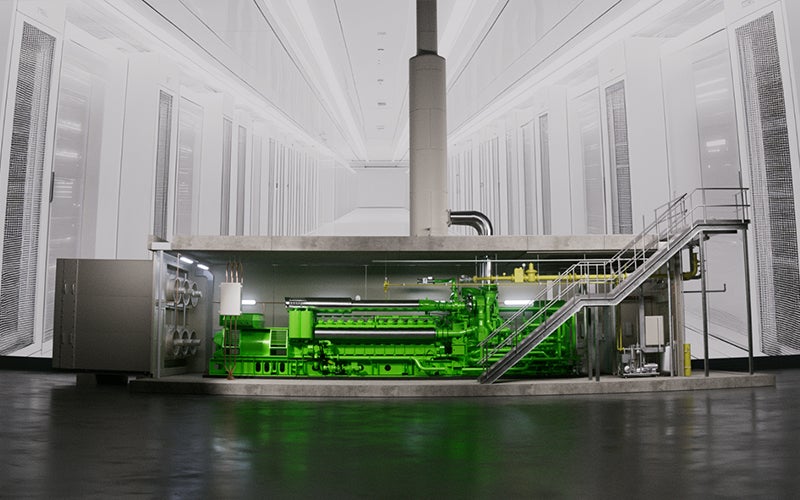
Inside the container sits the reactor core surrounded by shielding (a combination of lead and potentially graphite materials), a heat exchanger, a turbine, and a generator. The primary coolant is helium, which carries heat from the reactor core to a heat exchanger. There, the thermal energy is transferred to supercritical carbon dioxide (sCO2), which drives a closed-loop Brayton-cycle turbine to generate electricity. The system uses no water for cooling, relying instead on helium and air-cooled condensers on the power generation side.
A single reactor core produces approximately 30 MW of thermal energy, which converts to about 15 MW of electrical output—a conversion efficiency approaching 50%, enabled by the high performance of the sCO2 cycle. For the company’s larger 30-MWe commercial configuration, two reactor cores operate in tandem. The entire system occupies roughly 86 cubic meters, a figure Matthews cited as evidence of the architecture’s extraordinary energy density.
The core is sealed at the factory and designed to operate continuously for 30 years at full capacity without refueling. Once the thorium is loaded and bred, the core cannot be opened, accessing the fuel would require, as Matthews described it, “a government-style operation.” This sealed design eliminates fuel handling during operation and makes it physically impossible for fuel to be diverted, a significant advantage from both a safety and a non-proliferation standpoint.
St.Brice noted that AMPERA is also exploring the use of a small uranium seed mixed with the thorium to help initiate the breeding process more efficiently. The uranium would provide an initial neutron source to jumpstart the reaction, after which the thorium would take over for the remaining decades of operation.
Autonomous Operation and a Leasing Model
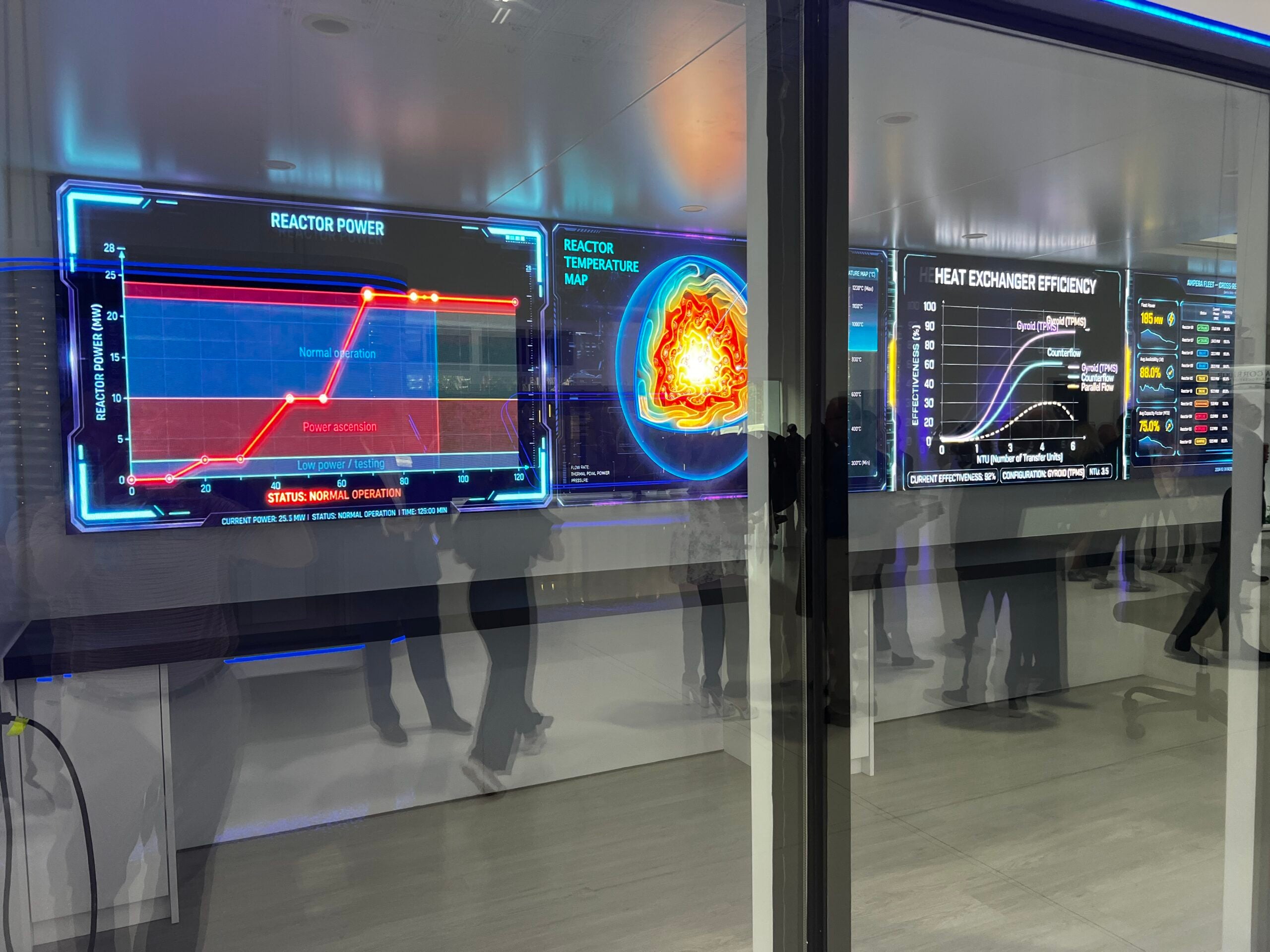
AMPERA envisions its reactors operating autonomously, managed by AI-driven control systems (Figure 2) rather than on-site operators manually adjusting the plant. A command-and-control module accompanies each unit, but the interface is designed to be simple: a user requests a power level, and the system adjusts neutron generator output, heat transfer, and power conversion accordingly.
The company does not plan to sell its reactors outright. Instead, it intends to lease them under power purchase agreements, retaining ownership and managing operations remotely. On-site command-and-control centers would provide local oversight, but day-to-day management would be handled from centralized facilities.
Regulatory Path and Lab Partnerships
AMPERA is pursuing licensing under the Nuclear Regulatory Commission’s (NRC’s) newly finalized 10 CFR Part 53 framework, a regulation designed specifically for advanced reactor technologies, which allows companies to make a safety case on the merits of their own design rather than explaining how it differs from traditional light-water systems. On Feb. 23, 2026, the company submitted a formal pre-application letter to the NRC’s Office of Nuclear Reactor Regulation, Office of Nuclear Material Safety and Safeguards, and Division of Fuel Management, requesting an initial meeting by the end of May. The company has hired Dr. April Smith, a former NRC official, as its licensing strategist to navigate the process. According to St.Brice, initial NRC engagement has been positive, with regulators expressing interest in the safety-by-design approach—particularly the inherent shutdown characteristics of the subcritical architecture, which eliminate the possibility of a runaway chain reaction or meltdown scenario.
On the research side, AMPERA is finalizing an agreement with Lawrence Livermore National Laboratory to support development of its TRISO fuel technology. The company is also exploring work with Idaho National Laboratory for potential fueled reactor testing. While AMPERA has not yet secured Department of Energy (DOE) funding—an application to the Army’s Project Janus was submitted but the company was too early-stage at the time—it is actively pursuing both DOE and Department of Defense support, led by Scott Fisher, a retired U.S. Navy Captain and AMPERA’s vice president of Military Programs and Engagement.
Timeline and Ambitions
AMPERA’s development schedule is aggressive by nuclear industry standards. The company expects to have a full non-fueled prototype, including printed core, shielding, heat exchanger, turbine, and generator, by the end of 2026. A fueled prototype, with thorium loaded and bred in the core, is targeted for the end of 2027. First commercial deliveries are projected in the 2028–2029 timeframe, with full-scale manufacturing ramp-up between 2030 and 2035.
The company is growing rapidly to meet these targets, planning to reach approximately 200 employees by the end of 2026 and scaling into the thousands in subsequent years. An international expansion is also underway, with a new regional headquarters planned for London to strengthen partnerships across the UK and Europe.
Matthews framed AMPERA’s ambition in sweeping terms: not merely to build a nuclear company, but to become the “default energy platform” across all generation sources. The path to that position, he argued, runs through cost competitiveness and energy density, two metrics where he believes AMPERA’s architecture will prove difficult to match. Whether the technology delivers on that promise will depend on the coming years of engineering, regulatory approval, and manufacturing scale-up. But Matthews believes it will happen, and sooner rather than later. “What you see today is not a concept, and it’s not a road map, and it’s not something 10 years away,” he said at the open house. “We’re building this in Palm Beach Gardens. We’re building it now.”
—Aaron Larson is POWER’s executive editor.