
Coal
-
 O&M
O&MIn-Line Sorbent Milling Improves Dry Sorbent Injection Performance
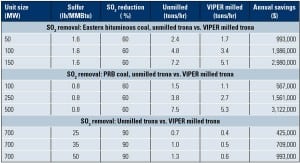
Complying with air emissions rules doesn’t always require construction of a scrubber or SCR. Finely ground trona has proven to be very successful at economically removing SO3, SO2, and HCl from stack gases.
-
Coal
Federal Court Rejects Challenges to EPA Industrial, Automotive GHG Rules
A three-judge panel of the U.S. Court of Appeals for the D.C. Circuit on June 26 ruled that the U.S. Environmental Protection Agency (EPA) was "unambiguously correct" in its interpretation of the Clean Air Act (CAA) to regulate carbon dioxide emissions. The federal agency’s endangerment finding that greenhouse gases (GHG), including carbon dioxide, are a threat to public health and welfare, and its decision to set limits for industrial and automotive emissions of GHGs, was "neither arbitrary nor capricious," the court ruled. The court, however, found that it lacked jurisdiction to review the timing and scope of the GHG rules that affect larger stationary sources, including new coal-fired power plants.
-
Coal
EPA Proposes Clean Air Standards for PM2.5
In response to a court order, the U.S. Environmental Protection Agency (EPA) proposed updates on June 15 to its national air quality standards for harmful fine particle pollution, including soot (known as PM2.5). The agency says that 99% of U.S. counties are projected to meet proposed standards without any additional actions.
-
O&M
Coal Could Regain Ground from Gas as Summer Demand Ramps Up
Natural gas-fired generation enjoyed a competitive advantage through this past winter and spring as historically low prices for the commodity combined with mild weather and relatively light demand to turn the dispatch stack on its head and favor gas over coal. That advantage is narrowing as summer demand approaches. A senior market analyst with Bentek Energy expects coal-fired generation to be advantaged at least until the fall shoulder season.
-
Coal
Federal Appeals Court Upholds EPA NAAQS Standards for NOx, SO2
The U.S. Court of Appeals for the D.C. Circuit last week handed the Environmental Protection Agency (EPA) two legal victories over challenges from states and industry, affirming the agency’s revisions to the National Ambient Air Quality Standard (NAAQS) for nitrogen oxides (NOx) and upholding its revised final sulfur dioxide (SO2) standard.
-
Coal
EPA to Stay, Reconsider New Source Emission Standards in MATS Rule
The Environmental Protection Agency (EPA) intends to stay and reconsider new source emission standards contained in its February 2012-finalized Mercury and Air Toxics Standards (MATS), a letter from the agency’s assistant administrator, Gina McCarthy, shows.
-
Coal
Settlement to Force Wisconsin Cooperative to Install Pollution Control, Close Coal Units
A settlement to resolve alleged violations of the New Source Review (NSR) provisions of the Clean Air Act reached between the Dairyland Power Cooperative (DPC), federal entities, and the Sierra Club will force the Wisconsin utility to invest about $150 million in pollution control technology, retire three coal units at its 210-MW Alma Station, and pay a civil penalty of $950,000.
-
Coal
EPA Grants PNM Stay on San Juan Pollution Control Mandate
The Environmental Protection Agency (EPA) on Tuesday granted PNM a 90-day stay in the effectiveness of the federal plan that would force the Albuquerque, N.M.–based utility to install pollution controls at its 1,800-MW San Juan Generating Station by September 2016 to meet visibility requirements of the Clean Air Act in New Mexico.
-
 Coal
CoalNew Technologies Advance Biomass for Power Generation
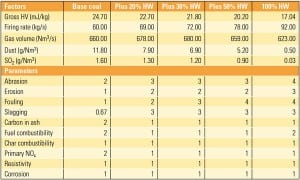
As U.S. utilities seek to increase the percentage of carbon-neutral biomass used in their generation portfolios, they must deal with a number of complex challenges unique to this fuel source. Several breakthrough technologies are poised to help promote greater use of biomaterials.
-
 Coal
CoalClean Air, Dirty Water
Efforts by power producers to meet clean air rules mean that wastewater effluent streams now face revised EPA regulations. A skirmish involving a New Hampshire power plant could set the tone for the next battle over regulations.
-
O&M
Dusty Trail: The Movie
The season’s blockbuster includes white-hatted heroes, good-natured regulatory sidekicks, bar fights, and a lurking menace named Fugitive Dust.
-
 Coal
CoalConsortium Tests Alloys for Advanced Ultrasupercritical Boilers
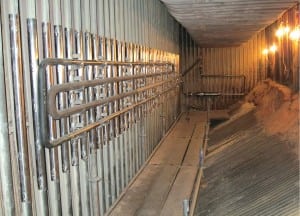
A two-year project begun this April by Southern Co. and a consortium of partners including boiler vendors Alstom, Babcock & Wilcox, Foster Wheeler, and Riley Power; the Electric Power Research Institute (EPRI); and the Oak Ridge National Laboratory will gather data on the performance of alloy materials under advanced ultrasupercritical (USC) temperatures of about 1,400F. […]
-
 Coal
CoalSafety Implications of Coal and Biomass Fuel Mixes
Practically everyone would agree that the energy policy of the U.S. is in a great state of flux. Not since the introduction of commercial nuclear power some five decades ago has our country come to such an energy crossroads. No matter what your political ideology, no one can refute that conventional coal-fired power plants are being paralyzed by recent and potential U.S. Environmental Protection Agency (EPA) regulations designed to cut the nation’s reliance on coal.
-
 O&M
O&MImproving Slurry Knife Gate Valves in FGD Applications
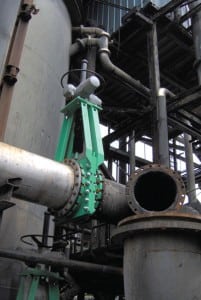
The primary considerations in slurry valve selection are reliability in function and design, abrasion resistance, and ease of maintenance. In addition, valves with a straight-through, unobstructed flow minimize the effect of abrasion and therefore reduce the need for maintenance.
-
 Coal
CoalOptimizing Catalyst Performance Lowers O&M Costs
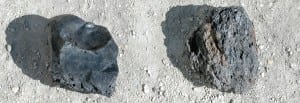
Santee Cooper’s Cross Station has implemented a catalyst optimization program that reduces catalyst replacement cost while maximizing catalyst performance. This case study illustrates the economic advantages of taking a holistic approach to optimizing unit catalyst performance by controlling slag, fouling, sulfur trioxide, and ammonium bisulfate—key factors that lead to premature shortening of catalyst life. With catalyst costing $2 million a layer and up, there is plenty of economic motivation to find ways to improve its life.
-
 Coal
CoalPower in India: Opportunities and Challenges in a Fast-Growing Market
India’s long-term annual economic growth rate is projected at over 7%, and the country is investing in its hydroelectric, nuclear, and renewable resources. However, the primary fuel used to produce electricity remains coal, and the government has ambitious plans to significantly increase coal-fired capacity. Those plans have been challenged by a number of unexpected factors that threaten to stifle India’s economic growth. India’s long-term annual economic growth rate is projected at over 7%, and the country is investing in its hydroelectric, nuclear, and renewable resources. However, the primary fuel used to produce electricity remains coal, and the government has ambitious plans to significantly increase coal-fired capacity. Those plans have been challenged by a number of unexpected factors that threaten to stifle India’s economic growth.
-
 Coal
CoalInnovation Required as Gas Displaces Coal
Panelists at the ELECTRIC POWER Keynote and Roundtable Discussion in Baltimore in May wrestled with a range of issues. But despite calls for a “balanced portfolio,” an “all-of-the-above” energy strategy, and predictions of “more changes in the next 10 years than in the last 100,” the focus of attention appears to be the decidedly mundane displacement of coal by natural gas.
-
 Coal
CoalDenmark Extends Renewables Standard to 100% by 2050
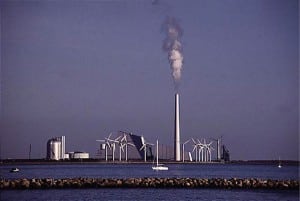
Denmark’s parliament in late March agreed to a new energy strategy seeking to wean the country off oil and gas. It could result in the Nordic country cutting its greenhouse gas emissions 34% by 2020, compared to 1990 levels, and decreasing energy consumption by more than 12%, compared to 2006.
-
 Coal
CoalCallide Oxyfuel Carbon Capture Plant Retrofit Moves Forward
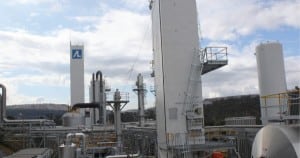
Oxyfuel technology has been retrofitted at a 700-MW coal-fired power plant in Queensland, Australia, and is now capturing carbon dioxide from one of the plant’s six steam boilers.
-
 History
Japan Scrambles to Revamp Its Electricity Sector
The March 2011 Japanese earthquake and tsunami that destroyed a number of Japanese power plants—most notably, four nuclear units—hit quickly. Almost as speedy were calls to take all other nuclear units out of service for safety reviews. What will take much longer is developing a new, sustainable energy plan to fill the generation gap left by a potential total lack of nuclear power.
-
 Coal
CoalCoal-to-Gas Switching: It’s All in the Price
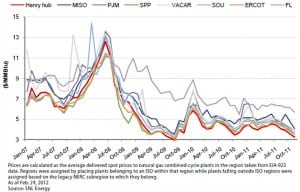
Trying to assess the potential for coal-to-gas switching in today’s environment is something of an art form. Suppose for a moment that one were able to devise an economic model that truly replicates real-world generation dispatch for plant operators. A model is only as good as the inputs that go into it, and, let’s face it, future natural gas prices are a critical component.
-
Coal
EPA Sets Carbon Standards for New Coal Units, Compliance Options Limited
In late March, the Environmental Protection Agency (EPA) proposed its first-ever carbon pollution standard for new power plants, limiting carbon dioxide emissions from new fossil fuel–fired power plants. However, the technology options for complying wiith the proposed rule remain few and expensive, as recent developments demonstrate.
-
Coal
FERC: Coal Generation Losing Out to Natural Gas
Coal generation, as a percentage of total power output in the U.S., declined steadily to 39% at the end of 2011 from about 51% in 2002, while generation from natural gas–fired combined cycle plants grew to more than 20% from 10% over the same period, the Federal Energy Regulatory Commission (FERC) said in late April, as it released its annual assessment for U.S. energy markets.
-
Coal
Mercury and Air Toxics Standard, CSAPR Legal Pushback Mounts
Two Environmental Protection Agency rules are facing legal challenges. The Mercury and Air Toxics Standards is being challenged by half the U.S. states, while a decision in a case concerning the Cross-State Air Pollution Rule could be reached as soon as this summer.
-
 O&M
O&MOptimizing Your Coal Ash Recovery Operation
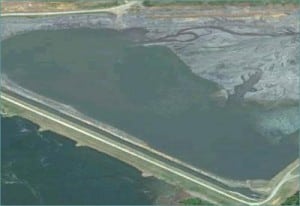
Coal combustion products often can be recycled into a variety of construction and building materials. However, first you must be able to retrieve the wet ash from a holding pond before the ash can be dried and sold.
-
 Coal
CoalDesign Features of Advanced Ultrasupercritical Plants, Part II
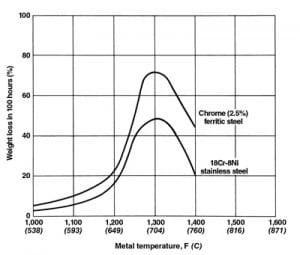
Advanced ultrasupercritical (A-USC) is a term used to designate a coal-fired power plant design with the inlet steam temperature to the turbine at 700C to 760C. In Part I of this three-part report, we introduced the A-USC boiler. In this segment, we look at the metallurgical advancements required for the A-USC boiler to operate at such high temperatures. The final report will explore the A-USC boiler’s unique design challenges.
-
Coal
Wisconsin Public Service Proposes Installation of New Multi-Pollutant Control Technology
Integrys Energy Group subsidiary Wisconsin Public Service Corporation (WPS) on Monday filed for a Certificate of Authority (CA) from the Public Service Commission of Wisconsin (PSCW) to install Regenerative Activated Coke Technology (ReACT) at its 321-MW Weston 3 plant.
-
 Coal
CoalIndia Revs Up Capacity with Massive Coal Plants
India, a country that plans to fuel its current level of gross domestic product growth of between 8% and 9% with massive, mostly coal-fired power capacity additions over the next decade, in March commissioned an 800-MW supercritical unit at the first of India’s government-envisioned ultra-mega power plants (UMPP).
-
 Coal
CoalTHE BIG PICTURE: Coal Demand Surges
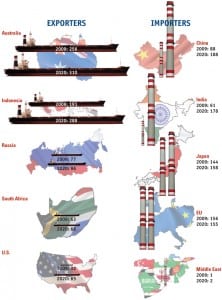
Patterns of coal trade have been shifting in recent years as demand surges in Asian countries. Whereas Japan and the European Union (EU) have long been the world’s largest hard coal importers, China and India are now emerging as top importers. This surge has shifted the center of gravity in international coal trade to the […]
-
 Coal
CoalPartnership Develops Innovative CCP Project
In 2009, the North Carolina Asheville Regional Airport Authority (Airport), with partners Progress Energy Carolinas Inc. and Charah Inc., began development of the Westside Development Fill Project (Westside Project), a long-term infrastructure strategy located in the southwest quadrant of the Airport’s property. The project included phased construction of a developable pad for general aviation and commercial use, a new taxiway running parallel to the existing runway, and a major expansion of the existing runway.