Business
-
 O&M
O&MThe U.S. Gas Rebound
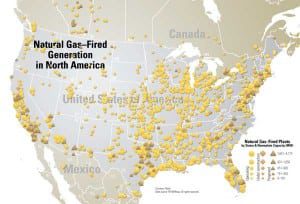
"It’s déjà vu all over again," said Yogi Berra. The Hall of Fame catcher could easily have been predicting the coming resurgence of natural gas – fired generation. Yes, a few more coal plants will be completed this year, but don’t expect any new plant announcements. A couple of nuclear plants may actually break ground, but don’t hold your breath. Many more wind turbines will dot the landscape as renewable portfolio standards dictate resource planning, but their peak generation contribution will be small. The dash for gas in the U.S. has begun, again.
-
 Environmental
A New Regulatory and Environmental Milieu
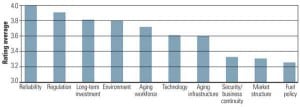
There will be no shortage of important issues to keep utility executives and their staffs busy throughout 2010. Few of these will be surprises, although a number will emerge quickly and assume larger-than-life significance. The confluence of the great recession and the sturm und drang of environmental legislation will create the liveliest of the debates, but more subtle trends will drive additional stressors. The results of Black & Veatch’s 2009 fourth annual industry strategic directions survey can offer guidance as to how these issues will affect the industry in the coming year.
-
Business
Despite Economic Downturn, Renewable Energy Development Expected to Move Forward
While the overall economy is down, the effort to add renewable energy resources in the U.S. continues to push project development forward.
-
Legal & Regulatory
Talking Smart Grid Talk
What is the smart grid all about? A new book—a dictionary—attempts to define and demystify the jargon and bafflegab surrounding the buzzing smart grid. It’s a somewhat flawed but worthwhile first attempt at unraveling the often bizarre and sometimes baloney-filled smart grid nomenclature.
-
Legal & Regulatory
Pushmepullyou: Disputes and Discussions on Grid Politics
While industry interests were trying to get on board the smart grid gravy train last fall in Washington, D.C., in rural West Virginia folks were dealing with the force of a political locomotive pushing a high-voltage interstate grid, with property owners opposed and labor in favor.
-
HR
Today, Time Management Knows No Boundaries
It’s no longer a 9-to-5 world. Management gurus Peter Stark and Jane Flaherty offer advice on how to manage time in today’s multi-tasking environment.
-
 Legal & Regulatory
The Natural Gas Glut and the Doctrine According to Hefner
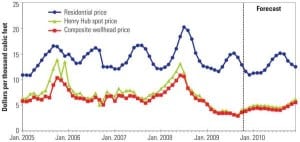
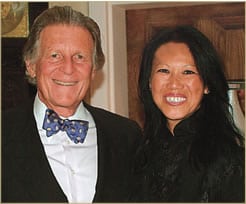
Natural gas is back, says gas guru Bobby Hefner, and in a big way. New technologies, new discoveries, low prices, and new optimism characterize a natural gas industry that just three years ago was bemoaning its future and looking to foreign LNG imports as the industry’s salvation. Today, the gloom is gone, and the gas folks are clicking their gaseous heels in glee.
-
Legal & Regulatory
NRC Withholds “Waste Confidence” Finding, Citing Yucca Decision
In a series of ironies, the U.S. Nuclear Regulatory Commission has voted to reject an early finding that the U.S. can adequately manage nuclear reactor spent fuel, in the wake of the Obama administration’s decision to pull the radioactive plug on Nevada’s Yucca Mountain. The vote by the majority Republicans on the commission effectively puts a temporary ban on new nuclear reactor construction in the U.S.
-
Legal & Regulatory
TREND: Coal in a Hole
While pundits opine that the U.S. economy is in recovery, that doesn’t show up in the world of coal-fired electric power plants (perhaps lagging economic indicators). For proof, see these recent stories.
-
HR
Social Media in the Workforce: Tweet, Tweet, Tweet, Tweedly-Deet
Social media have emerged as an important force in the workplace, both as new ways of doing business and as challenges to organization management. Among those challenges is defining acceptable employee behavior on and off the job.
-
-
 Business
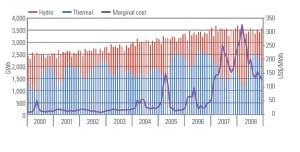
Chile Plans for Growth with "All the Options" Energy Mix
Chile was considered a world leader for reforming and liberalizing its power sector as early as the 1980s. However, 25 years later, Chile is at a crossroads in terms of developing future capacity. With an estimated GDP growth rate of 2% to 3% during the current global financial crisis, a highly competitive economy, an established democracy, and a stable macroeconomic environment, Chile is considered a premium destination for foreign investment.
-
 O&M
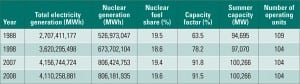
O&MBenchmarking Nuclear Plant Operating Costs
In an exclusive agreement with the EUCG Nuclear Committee, POWER was provided access to some key, high-level performance and operational data from the group’s nuclear industry benchmarking database. All U.S., and many international, nuclear power plants are members of the committee and have contributed to its database for many years. This month we introduce you to the EUCG Nuclear Committee and share sample nuclear operating costs. Look for future reports on other key performance benchmarking metrics during 2010.
-
Nuclear
New Nuclear Plants Are on the Horizon
Most of the big utilities, with an eye to ensuring a good mix of future generation resources, have a new nuclear plant in development. Even though federal loan guarantees are slow to materialize and financing these multi-billion-dollar projects has become a bet-the-company investment, the NRC has more than 40 applications from generators that continue to believe in the future of nuclear power.
-
-
 Coal
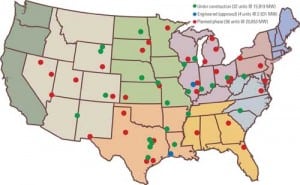
CoalCoal-Fired Generators Worried About Getting Burned
The expected renaissance for U.S. coal-fired generation has been more evolutionary than revolutionary: Less than half of the announced plants will likely progress to construction. However, the percentages for coal-fired plants aren’t significantly different from those for combined-cycle plants a decade ago, when dozens were ultimately canceled, leaving developers with warehouses full of unused gas turbines. The difference this time: The threat of carbon control legislation has moved many projects to the “wait and see” category.
-
 Solar
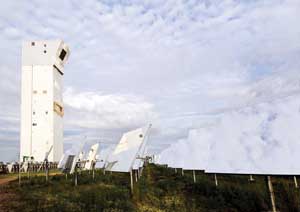
SolarDLR to Commercialize Technology from Solar Tower Demonstration
A solar thermal demonstration power plant in Jülich, Germany, that was developed by the German Aerospace Center (Deutsches Zentrum für Luft- und Raumfahrt; DLR), was formally handed over to its future operator, the Jülich Department of Works this August.
-
 Coal
CoalReport: Costs for First-Generation Carbon Capture Plants Will Soar
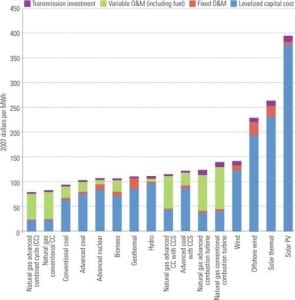
Carbon capture and storage (CCS) has of late gained steam as the best way to mitigate emissions of the greenhouse gas carbon dioxide (CO2) from fossil fuel power plants, despite evidence that the approach would require much energy and increase the fuel needs of a coal-fired plant by more than 25%. A new study from […]
-
 Business
DOE Funds Electrification of Transportation Sector
On August 5, President Barack Obama announced that 48 new advanced battery and electric drive projects will receive $2.4 billion in funding from the Department of Energy under the American Recovery and Reinvestment Act. The announcement marks the single largest investment in advanced battery technology for hybrid and electric-drive vehicles ever made. DOE funds will […]
-
-
Legal & Regulatory
Flipping the Switch: Why Utilities Need to Shed Light Now on Carbon Risk
Carbon is poised to become an auditable and verifiable reporting requirement for American business. Because utilities are among the organizations with the most at stake in a carbon-constrained economy, they should proactively tackle carbon management and carbon accounting in spite of uncertainties about the precise formulation of the final regulatory framework. In short, whether a carbon accounting requirement is legislative, administrative, or driven by business partners and consumers, now is the time for utilities to act.
-
Legal & Regulatory
Appeals Court: EPA Rule Oversteps on NOx Allowance Purchases
The Appeals Court in D.C. has struck down a Bush administration 2007 ozone rule, sending the issue back to the Environmental Protection Agency for a mulligan. What will this mean in the future?
-
Legal & Regulatory
DOE Mission Support
The National Academy of Public Administration faults the U.S. Department of Energy on human resource management, contract controls, and financial management.
-
-
 Coal
CoalOperation of World’s First Supercritical CFB Steam Generator Begins in Poland
The world’s first supercritical circulating fluidized-bed (CFB) steam generator began successful operation at the Lagisza power plant in Poland early this July, according to power equipment and engineering firm Foster Wheeler. The new CFB — believed to be the world’s largest — replaced 1960s-era pulverized coal units at the power plant owned by Polish utility […]
-
Legal & Regulatory
Falling Demand Leads TVA to Trim New Reactor Plans
TVA scales back plans to revitalize new nuclear construction at its Bellefonte plant, suggesting that it will scrap plans for new units at the site and perhaps focus on its unbuilt unit that has been mothballed for 25 years.
-
Legal & Regulatory
SWEPCO’s Construction Conundrum
"If you build it, they will come" — the litigants, that is. The lawsuit involving the construction of Southwestern Electric Power Co.’s (SWEPCO) John W. Turk Jr. ultrasupercritical coal-fired power plant in Arkansas gives new meaning to that popular quote from the movie Field of Dreams.
-
HR
Is Employee Engagement Passé?
“Engagement” was once the buzzword for employee satisfaction. That was then, say some HR gurus, but these authors argue that engagment is as important as ever.
-
Finance
TREND: Wind Power Becalmed?
U.S. wind power appears becalmed, partially stymied by transmission constraints, and also by financing difficulties in the current recession. Read the details.