Moving Tasmania’s abundant renewable power to the mainland means threading a subsea and underground cable through farmland, coastline, and Victoria’s Latrobe Valley—each stretch carrying its own community, land use, and approval process to navigate.
Australia has set a target for renewable sources to provide 82% of its electricity by 2030. Reaching that level requires a rapid expansion of renewable generation alongside changes to an electricity system that was largely built around centralized coal-fired power.
While work is already underway on both fronts, Australia’s physical scale increases the complexity. Major population centers can sit hundreds of miles from areas with strong renewable resources, so new transmission has to connect generation with demand across long distances.
Unlocking Opportunity
Despite these challenges, Australia’s size and wide variety of landscapes and environments, create opportunities for a diverse mix of renewable energy sources that can support the wider electricity market, including Tasmania’s hydropower and rapidly growing wind sector, which has about 420 MW to 568 MW of installed capacity and more than 7,300 MW of projects under development.
To unlock this opportunity, increased transfer capacity across Bass Strait, which separates the island state of Tasmania from the state of Victoria, is needed. Victoria has relied on coal-fired generation for decades, and plants are now moving toward retirement as renewable capacity grows. New sources of electricity, therefore, need to be connected into a system that can move their output across regions according to demand.
While Tasmania and Victoria already have an electricity connection via the Basslink 500-MW interconnector, expanded interconnection is needed to allow more electricity to move in either direction between the two states, providing Victoria and the wider Australian east coast grid with another source of power when the mainland system needs it and giving Tasmania access to mainland generation when supply there is high.
Marinus Link
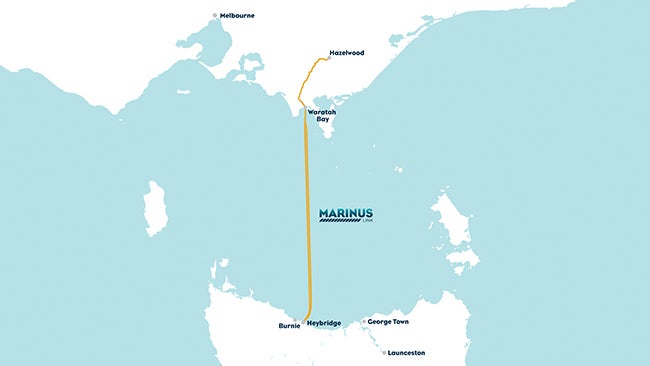
Marinus Link, a new 1,500-MW electricity and telecommunications interconnector between Northwest Tasmania and Victoria’s Latrobe Valley, is currently being developed to connect Tasmania’s renewable energy resources with demand on the mainland. Its route runs for about 214 miles, which includes roughly 158 miles of subsea cable across Bass Strait and 56 miles of underground cable through Gippsland.
The project is being developed in two 750-MW stages, rather than a single 1,500 MW circuit to meet transmission network operation (availability and reliability) requirements in Tasmania and Victoria. Stage 1 is scheduled for completion in 2030. A decision on timing for Stage 2 will be made soon, in line with National Electricity Market transmission planning and demand requirements.
The cable will run from Heybridge, near Burnie, across Bass Strait to Waratah Bay in Victoria. From there, it will continue underground to Hazelwood in the Latrobe Valley (Figure 1). Converter stations at Heybridge and Hazelwood will connect the high-voltage direct-current (HVDC) system with the existing alternating-current (AC) networks in each state.
 |
|
1. This map shows a simplified route for the Marinus Link. Courtesy: Jacobs |
Jacobs is currently serving as integrated delivery partner for Stage 1 of the project, providing project management, engineering, environmental management, construction management, and site oversight, as well as program governance, working alongside other delivery partners including Prysmian Powerlink, Hitachi Energy and TasVic Greenlink (a joint venture of DT Infrastructure and Samsung C&T Corp.).
A Project Across Multiple Systems
The project, which has been recognized on the Australian government’s National Renewable Energy Priority List, requires significant coordination across engineering, planning, construction, and long-term grid needs in addition to managing multiple stakeholders including governments, regulators, councils, contractors, and communities.
Community and landholder requirements are also a significant consideration. The Victorian route passes through the Latrobe Valley, agricultural land, and coastal communities before reaching Bass Strait. Each area has different land uses and local priorities. Early engagement helps ensure concerns are heard and considered in site and route decisions to reduce physical disruption as much as possible.
Site Selection
Marinus Link has used existing energy and industrial locations at both ends of the HVDC connection. This reduces the amount of new infrastructure needed to connect the project into the transmission networks in both states.
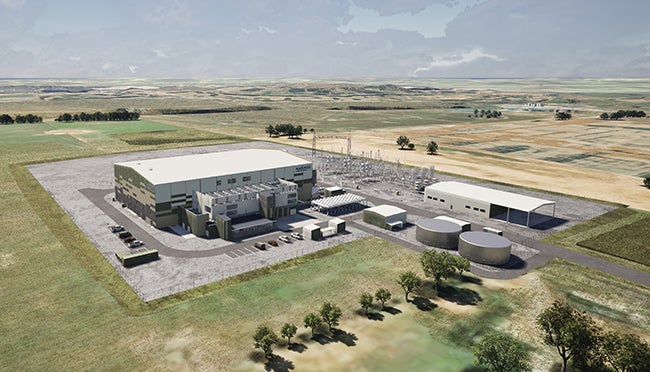
At Hazelwood, the converter station will sit beside the existing Hazelwood Terminal Station in the Latrobe Valley (Figure 2), which has a long history of electricity generation and established transmission infrastructure, and will provide access to Victoria’s 500-kV AC transmission network.
 |
|
2. This rendering shows the converter station in Hazelwood, Victoria. Courtesy: Jacobs |
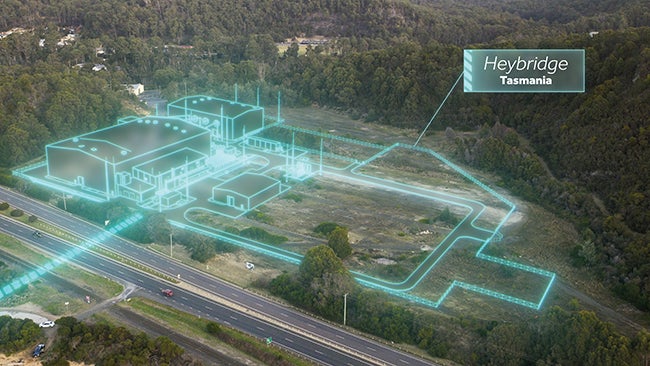
Heybridge follows the same approach. The converter station is being developed on the former site of a titanium dioxide factory near Burnie (Figure 3), where it can connect with Tasmania’s 220-kV AC network.
 |
|
3. This illustration shows the converter station in Heybridge, Tasmania. Courtesy: Jacobs |
Locating both converter stations close to existing transmission assets keeps the new AC connections relatively short and reduces the amount of additional land needed around the endpoints. From there, the engineering challenge moves to the cable system between them.
Engineering the Connection
Stage 1 will provide 750 MW of capacity through a symmetric monopole±320-kV HVDC connection. The link forms part of an approximately 214-mile undersea and underground route between Tasmania and Victoria, including about 56 miles of underground cable on the Victorian mainland. The HVDC converter stations utilize newer voltage source converter (VSC) technology to achieve the high transfer capacity at this voltage.
Marinus Link uses VSC technology instead of the older thyristor-based line commutated converter (LCC) approach used on many traditional HVDC schemes because it:
- ■ Provides independent control of active and reactive power.
- ■ Supports weak grids more effectively.
- ■ Improves voltage stability.
- ■ Enables black start and system support functions.
- ■ Requires smaller converter station footprints than equivalent LCC installations.
These features are particularly valuable on the Tasmanian side, where renewable generation and hydropower are highly fragmented, creating operating conditions that benefit from dynamic voltage and frequency support.
Installation of the cable utilizes horizontal directional drilling (HDD) for river, road, and rail crossings, as well as the shore crossing on either side of Bass Strait. This is a common approach for major submarine power cables because it reduces environmental impacts and avoids exposing the cable to wave action and coastal erosion.
The scale of the route creates a series of engineering interfaces. The connection has to cross Bass Strait, reach land and continue underground before connecting into the electricity networks at either end. Work on the cable also has to be coordinated with the converter infrastructure and the civil construction needed to support both.
In 2025, Marinus Link’s HVDC cables and converter technology had been secured as it prepared for construction. Our role as integrated delivery partner includes managing the technical engineering and construction packages, and putting the governance structures in place for the HVDC cable and supporting infrastructure.
That coordination becomes particularly important where the different construction packages meet. The cable contractor and civil contractor have to work across common areas during cable installation, while the converter station work also interfaces with the civil construction program. Managing those dependencies allows the individual packages to progress as parts of the same 750-MW connection.
Australia’s renewable energy target depends on transmission expanding alongside new generation. Building more solar, wind, and other renewable capacity only addresses part of the country’s energy requirements. Electricity also has to move from the regions where those resources are available to where demand occurs.
Projects such as Marinus Link bring that challenge down to individual engineering and delivery decisions. The location of converter stations affects how efficiently a new link can connect with the existing grid. Cable technology determines how power can travel across long distances, while installation methods have to respond to the physical conditions encountered along the route. Those choices also sit within approval processes, construction schedules, and the requirements of the communities hosting the infrastructure. Managing all of these together will be vital in delivering the energy system Australia needs for the future.
—Lara Kruk is regional solutions director for Energy & Power, Asia Pacific with Jacobs.