With the U.S. economy still struggling, few things are as important as having an abundant, reliable supply of energy to help drive our recovery. Many American families are hurting and our businesses are being challenged to create new jobs. That’s why federal, state, and local public policies must balance the need for broader economic prosperity, greater energy security, and a cleaner environment. Coal and clean coal technology can play vital roles and must be at the center of this public debate.
Coal Is Essential and Affordable
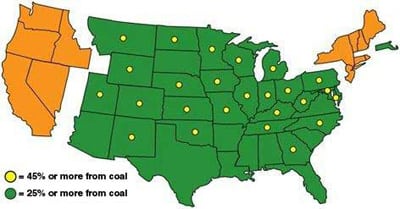
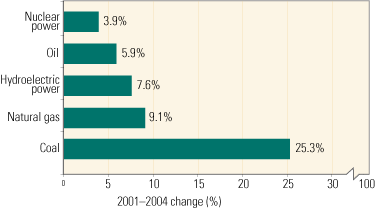
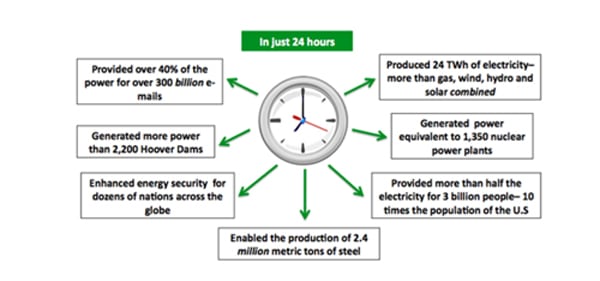
Today, nearly half of our nation’s electricity is generated by coal. As our nation’s largest source of domestically produced fuel, coal is essential to rebuilding our nation’s economy and protecting U.S. jobs, while keeping electricity reliable and affordable for our families and businesses. America—and, indeed, the world—continues to “electrify” the way we live, and that electrification contributes significantly to a higher standard of living.
Coal is not only the dominant source of American electricity now; it also will remain so for decades to come. Just this April, the U.S. Department of Energy’s Energy Information Administration (EIA) released its 2011 Annual Energy Outlook report, which underscored the long-term contribution that coal-fueled electricity will make to our economy and the quality of life for millions of Americans. The EIA projected that, absent overly stringent new federal regulations, total megawatts generated from coal will increase by 25% from 2009 to 2035 and coal will generate 43% of America’s electricity by 2035.
Electricity from coal is affordable, and that is a crucial fact for millions of U.S. families and businesses. The one-half of American families earning $50,000 per year or less, on average, pay about 22% of their after-tax income for energy costs (home heating and cooling, and transportation). That percentage has risen steadily over the past decade. An American Coalition for Clean Coal Electricity (ACCCE) report notes that the one-in-10 families in our nation earning $10,000 or less annually pay, on average, about 70% of after-tax income for energy.
Coal Is a Strategic Asset for America
The U.S.’s abundant, domestic supply of coal is a strategic asset for national and energy security in an unstable world. America’s recoverable coal reserves exceed those of any other country and represent one-quarter of the world’s total coal supply. The U.S. has 272 billion tons of coal reserves and currently uses about 1.1 billion tons per year. At this consumption rate, America’s coal reserves would last nearly 250 years.
The energy in U.S. recoverable coal reserves alone is roughly equal to that of the world’s known oil reserves. The power held in our nation’s coal reserves is critical to limiting, to the greatest degree possible, the need to rely on other countries for our energy supply.
Clean Coal Technology’s Role
One reason coal will remain the fuel of choice for generating electricity is that we are able to use it in an increasingly cleaner manner. By 2015, America’s coal-based electricity providers will have invested between $115 billion and $125 billion in clean coal technologies to reduce air emissions; moreover, that total does not include the additional costs of complying with new regulations the Environmental Protection Agency (EPA) will promulgate during the next two years. These investments have paid great dividends to the environment. The EPA’s latest analysis shows that since 1970 emissions traditionally controlled under the Clean Air Act have been slashed by more than 80% per unit of electricity produced at coal-fueled power plants.
In many instances, advanced technologies have been developed and then commercially deployed more rapidly than otherwise thought possible because of private-public sector partnerships. These partnerships (often referred to collectively as the “Clean Coal Technology” program) have been an important driver for innovations that have allowed electricity providers to meet more rigorous environmental standards while holding down costs for the consumer. A study sponsored by the ACCCE found that, by 2020, American taxpayers will see a return of $13 for every dollar that the federal government has invested in these technologies.
We are also seeing advanced coal generation technologies emerge and broaden, such as the ultra-supercritical pulverized coal plant that American Electric Power is building in Arkansas, along with the integrated gasification combined cycle plants that Duke Energy is constructing in Indiana and Southern Company is siting in Mississippi. These advanced generation technologies, combined with new supercritical coal plants with very low emissions, such as the Prairie State coal-fired plant in Illinois, are important steps in building the bridge to our clean energy future.
Finally, carbon capture and storage (CCS) technologies will play a vital role in addressing concerns about climate change. Last year, President Obama’s Interagency Task Force on Carbon Capture and Storage concluded that “there are no insurmountable technological, legal, institutional, regulatory or other barriers that prevent carbon capture and storage from playing a role in reducing greenhouse gas emissions.” However, more robust partnerships between the private sector and government, as well as legislation clarifying the legal and liability framework, are essential to accelerating the pace for broad commercial deployment of CCS technologies.
Coal’s importance to our nation’s clean energy future is clear. With continued, prudent investments in clean coal technology and vigorous government and private sector partnerships, coal will help our nation to claw out of the Great Recession and continue to be America’s fuel for decades to come.
— Steve Miller (smiller@cleancoalusa.org) is president and CEO of the American Coalition for Clean Coal Electricity.