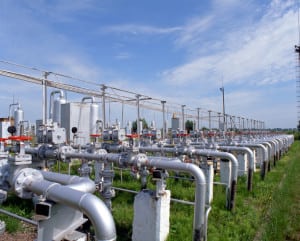
Utilities that provide natural gas to customers are investing in smart technologies to modernize their infrastructure. These measures are leading to better efficiency in gas delivery, while also enhancing safety measures along their delivery networks.
The advanced technology includes “intelligent” pipeline systems that enable continuous monitoring and proactive maintenance. Safety measures include preventing leaks and avoiding network failures or damage to equipment. Sensors help monitor pressure and flow rates in pipelines. Smart solutions that use ultrasonic gas metering and other devices can provide utilities with real-time data on consumption.
Brandon Carlson, director of Product Marketing, Water and Gas Network Solutions at Itron, gave POWER insight into how gas utilities are building safer energy networks with technology. The companies are focused on improving operational efficiency and customer engagement, knowing that having more information leads to better decision-making.
POWER: Gas utilities are reporting rising operational pressure around leak detection, unaccounted-for gas, and public safety expectations. As data collection improves with the shift toward solid-state metering and real-time sensing, where do you see the biggest opportunity for utilities to materially reduce safety incidents rather than simply improve reporting?
Carlson: The biggest shift that we are seeing with solid state metering is the move to place decision-making intelligence at the edge of the distribution network. By incorporating pressure and temperature sensors alongside existing flow measurements, these meters can now detect conditions such as high flow, over pressure or high temperatures that can be indicative of a local safety event, and shut off the gas flow. This autonomous action protects the end consumer, first responders and utility personnel, enabling them to perform the investigation and address the safety concerns promptly.
POWER: Digital transformation in electric utilities has been driven by volatility from data centers and renewable energy. Given that gas networks are now adopting hybrid network architectures that combine cellular, mesh, and drive-by collection to close data blind spots, is the gas sector entering its own “visibility moment”?
Carlson: Absolutely. With advancements in intelligent connectivity for battery-powered devices, the expectation of cost-effectively covering all endpoints across the vast gas distribution network on an advanced metering infrastructure (AMI) network is becoming a reality. The innovation of battery-mesh technology allows meters to hop from one to another, providing connectivity and low-latency performance. This enables gas utilities to address challenging connectivity use cases such as meter vaults, high-rise buildings, underground meter banks and meter rooms.

By combining mesh and cellular technologies, utilities can leverage a range of communication options to address the most extreme connectivity use cases, delivering the visibility needed to improve safety and reliability across the network.
POWER: Solid-state meters utilization is expected to continue rising across North America in the coming years. From a safety-first perspective, what changes when every meter can act as both a sensor and a protective device rather than just a billing endpoint?
Carlson: The biggest paradigm shift is moving from a posture of rapid response to one focused on preventative action. Equipping meters with pressure and temperature sensors unlocks the ability to detect abnormal flow, pressure and temperature conditions and proactively shut off gas flow to prevent a catastrophic event.
Much like the evolution of the cell phone to a multifunctional personal assistant, the gas meter is transitioning beyond its core billing role. It is becoming an intelligent instrument that enables advanced safety features and will continue to evolve to support capabilities such as proactive outage management, personalized load analysis and integration with localized sensors like methane detectors, flood sensors and distribution pressure monitors.
POWER: There is a growing discussion about “actionable data versus passive data.” As utilities increase sensor density and network intelligence, what does it take to ensure that more data does not simply create more alarms but instead translates into targeted field-level safety interventions?
Carlson: Actionable data is essential for managing the surge of information generated from these solid-state instruments that are rapidly being put into service. A layered approach can help utilities maximize the value of this data. One effective strategy is to enable localized decision-making at the network edge, using configurable thresholds to trigger autonomous actions based on sensor inputs and flow measurements. This ensures timely responses at the service point without waiting for centralized commands.
At the system level, software tools that aggregate events and alarms from connected devices can provide visualization and prioritization capabilities. These tools allow utilities to identify critical safety actions, link them to workflows and optimize field workforce efforts. The goal is to move beyond simply generating alerts and instead create actionable insights that drive targeted interventions and improve overall safety.
POWER: Utilities are beginning to integrate shutoff capabilities directly into network endpoints triggered by conditions like high flow, temperature, or overpressure. How does automation at the edge change a utility’s approach to emergency response and consumer protection?
Carlson: The integration of shutoff valve functionality into solid-state meters is transforming the approach from rapid response to proactive prevention. Historically, utilities relied on forensic analysis after a catastrophic event, reviewing consumption data to understand what happened. Today, the focus is shifting to detecting and preventing these events before they occur.
Modern meters can sense high flow, overpressure or elevated temperature conditions and autonomously shut off gas flow regardless of network connectivity. This capability protects consumers, first responders and utility personnel by ensuring the flow of gas is stopped before anyone arrives on site, enabling safer troubleshooting and emergency response. As communities begin to recognize these benefits, they are quickly becoming advocates of this next generation of technology.
POWER: As hydrogen blending programs continue their expansion, and utilities begin to test new gas compositions, what role will sensors, analytics, and network intelligence play in validating safety under changing fuel chemistry?
Carlson: As the gas industry invests in carbon reduction through initiatives like hydrogen blending and renewable natural gas, the composition of delivered fuel is changing. The distribution network must adapt to ensure these new blends are delivered safely to end users.
This evolution will require sensors and meters that remain compliant with varying fuel mixes over their lifecycle. Additionally, enhanced sensing and analytics across the network will be critical to monitor fuel composition, measure and bill accurately for variations and identify any new safety risks associated with hydrogen or other molecules. Network intelligence will play a key role in integrating these insights to maintain safety and reliability under changing conditions.
POWER: Many utilities are still operating mixed fleets of legacy diaphragm meters, automated meter reading (AMR) systems and new AMI-enabled devices. What lessons are emerging from that transition period, especially when safety depends on interoperability rather than a single technology standard?
Carlson: As with most technological advancements, utilities and ratepayers cannot adopt new systems overnight. A successful rollout requires a long-term business strategy and a tactical plan to support digital transformation over several years. A critical component of that strategy is organizational change management.
Field crews must adapt to working with digital instruments at each service point, back-office teams need to manage advanced alarms and customers must understand potential service interruptions for safety events. Every part of gas delivery and management must learn to think differently and adjust to new processes.
The transition period, and the need to operate legacy systems alongside the latest technology, will be shaped by individual business cases and regulatory guidance. These factors determine how quickly utilities can realize the operational and safety benefits that modern solutions can deliver.
POWER: Artificial intelligence (AI) and anomaly detection are gaining traction in demand forecasting and load analysis, but adoption is still early in gas compared to electric. Where do you see AI contributing to safety resilience first: predictive leak detection, theft anomalies, or hydrogen readiness analytics?
Carlson: I expect AI will be used in the very near future to support both predictive leak detection and abnormal usage patterns. We already see similar applications in other sectors, such as predictive analysis for water pipeline failures, and I believe the same science can be applied to natural gas pipelines to guide capital planning for replacement programs.
Early use cases are emerging for spotting anomalous gas loads at the customer level, like, identifying outdoor appliances left on overnight. AI can also detect anomalies tied to theft, failing appliances or low-level leaks on the premises.
The combination of AI and the breadth of interval data coming from each meter creates a rich opportunity to identify safety issues, reduce revenue loss and improve customer service to levels never possible with traditional analytic tools.
POWER: Workforce readiness is an often-overlooked part of modernization. As utilities increase their real-time data visibility capability, what changes culturally and operationally for field teams who now receive continuous safety signals rather than periodic inspection reports?
Carlson: Utilities that have successfully navigated digital transformations for meters and AMI have implemented strong change management programs across the organization, from field crews to the CEO, to ensure everyone understands how to interact with the new solutions.
Field crews are now working with digital instruments that include onboard diagnostics, make autonomous decisions and require advanced training to program and manage. Meanwhile, back-office systems are processing exponentially more data, over a thousand times more per month, necessitating analytics tools and AI to support improvements in safety and operational efficiency.
To fully realize the benefits of these technologies, utilities must embrace cultural change and invest in advanced workforce training to equip their teams with the skills needed for this new era.
POWER: Looking at the next five years, with solid-state dominance, hybrid communications, and hydrogen pilots underway, what milestone will signal that the gas utility sector has entered a new era of proactive safety rather than reactive compliance?
Carlson: We are seeing the first major milestone quickly coming into view: by the end of 2026, more than 50% of new meter purchases per year are expected to be solid state. This reflects a significant shift in buying behavior, driven by the localized safety benefits these meters deliver today.
The next big milestone will be the gas utility sector’s full embrace of AMI with intelligent connectivity. To unlock benefits beyond the individual metering point, utilities need real-time visibility into every metering and sensing location across the network. This step will provide access to usage intervals, consumption data, real-time alarms and sensor readings—pressure, temperature and flow—along with the ability to analyze this information to identify lost and unaccounted-for gas, spot safety issues before they become catastrophic and better support capital planning programs.
—Darrell Proctor is a senior editor for POWER.