
Latest
-
 O&M
O&MGetting to the root of lube oil degradation problems
Doctors and engineers realize that solving a health problem is better done by identifying and eliminating its cause than by treating its symptoms. For machinery, the class of multidisciplinary methods known as root cause analysis (RCA) is an important tool for addressing chronic reliability problems. But RCA often is improperly applied to lubrication-related problems. Read on to learn how to use the technique correctly.
-
 O&M
O&MUtilities surpass other industries in asset maintenance practices
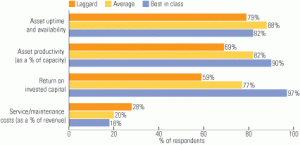
Want some good news about your predictive maintenance program for a change? A recent research report by the Aberdeen Group found the electric utility industry benchmarks exceptionally well against other industries in its PDM practices. In fact, the research found that best-in-class companies outperformed industry peers in improving asset availability by up to a three-to-one margin. In a web exclusive, the Aberdeen Group has provided its report for download from powermag.com as a service to our readers.
-
 O&M
O&MSO3’s impacts on plant O&M: Part III
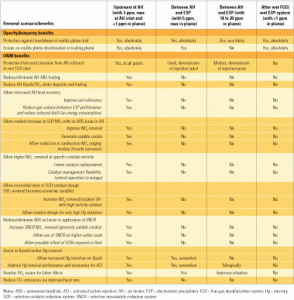
Part I of this three-part series (POWER, October 2006) explored the negative impacts of sulfur trioxide (SO3) on the operations and maintenance of back-end plant equipment. Part II (February 2007) listed and quantified the likely and potential benefits of limiting the concentration of SO3 in flue gas to 3 ppm at the entrance to the air heater. This final part describes the characteristics of an optimal SO3 removal technology and details the operating experience of a patented process that has worked successfully at a half-dozen plants for up to three years.
-
 O&M
O&MBlades, better than new
The challenge for suppliers of aftermarket turbine blades is that their starting point is an existing blade and nothing else. There are no CAD models, drawings, measurements, tolerances, or inspection data associated with it. However, thanks to the latest in computer tools, a blade now can be digitally recreated to exact specifications and built using the latest design and manufacturing practices. Here’s an inside look at how turbine blades are captured, reconstructed, inspected, and remade to be better than the originals.
-
 Coal
CoalAt CERA Week 2007, most life was carbon-based
For the past 25 years, Cambridge Energy Research Associates has hosted an annual conference that has drawn the captains of the worldwide oil and gas and electricity industries. The 120 distinguished speakers at this year’s summit attracted more than 2,000 delegates from 55 countries, making it the largest and most diverse ever. Naturally, one of POWER’s contributing editors was there, too; here’s his take on what transpired.
-

Unequivocal bragging rights
The new congressional leadership has promised a “new” agenda for fighting climate change based on reducing the quantities and rate of growth of greenhouse gases (GHG) discharged to the atmosphere. My first question to the Democrats: Where have you been the past few years? My second: How much are you willing to spend to make […]
-
 Gas
GasGlobal Monitor (March 2007)
Winter storms ravage Nebraska grid / Waste-fired plant coming to Arizona / Wartsila lands jobs in Azerbaijan, Sweden / Yet another controversial LNG project / Siemens lands two-gasifier order in China / IndyCars drink nothing but ethanol / New Otto/diesel engine to debut in Russia / POWER digest / Readers talk back
-
 O&M
O&MFocus on O&M (March 2007)
The critical subset / Aging workforce challenges / Tighter tolerances in retrofits / Writing sensible start-up and shutdown procedures
-
 Legal & Regulatory
Why raising renewable portfolio standards won’t work
Almost half of U.S. states now insist that their investor-owned electric utilities serve a specified percentage of their load with electricity from renewable resources by a date certain. Utilities struggling to comply with their mandate increasingly warn that they will be unable to achieve the required level on time. Yet even as utilities express these […]
-
 Water
WaterReclaimed cooling water’s impact on surface condensers and heat exchangers
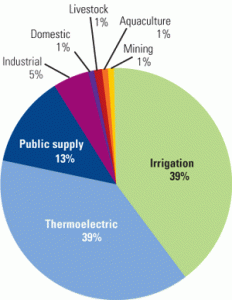
Because water is more precious than power in many regions of the U.S., plant designers are more frequently specifying the use of treated wastewater for plant cooling. Using "gray water" poses its own challenges for critical service equipment like condensers and heat exchangers. Some problems—like corrosion—are familiar, whereas others are rare. But so far, none has been a match for the ingenuity of multidisciplinary design experts.